Friday, 24 February 2012

Food and Friends

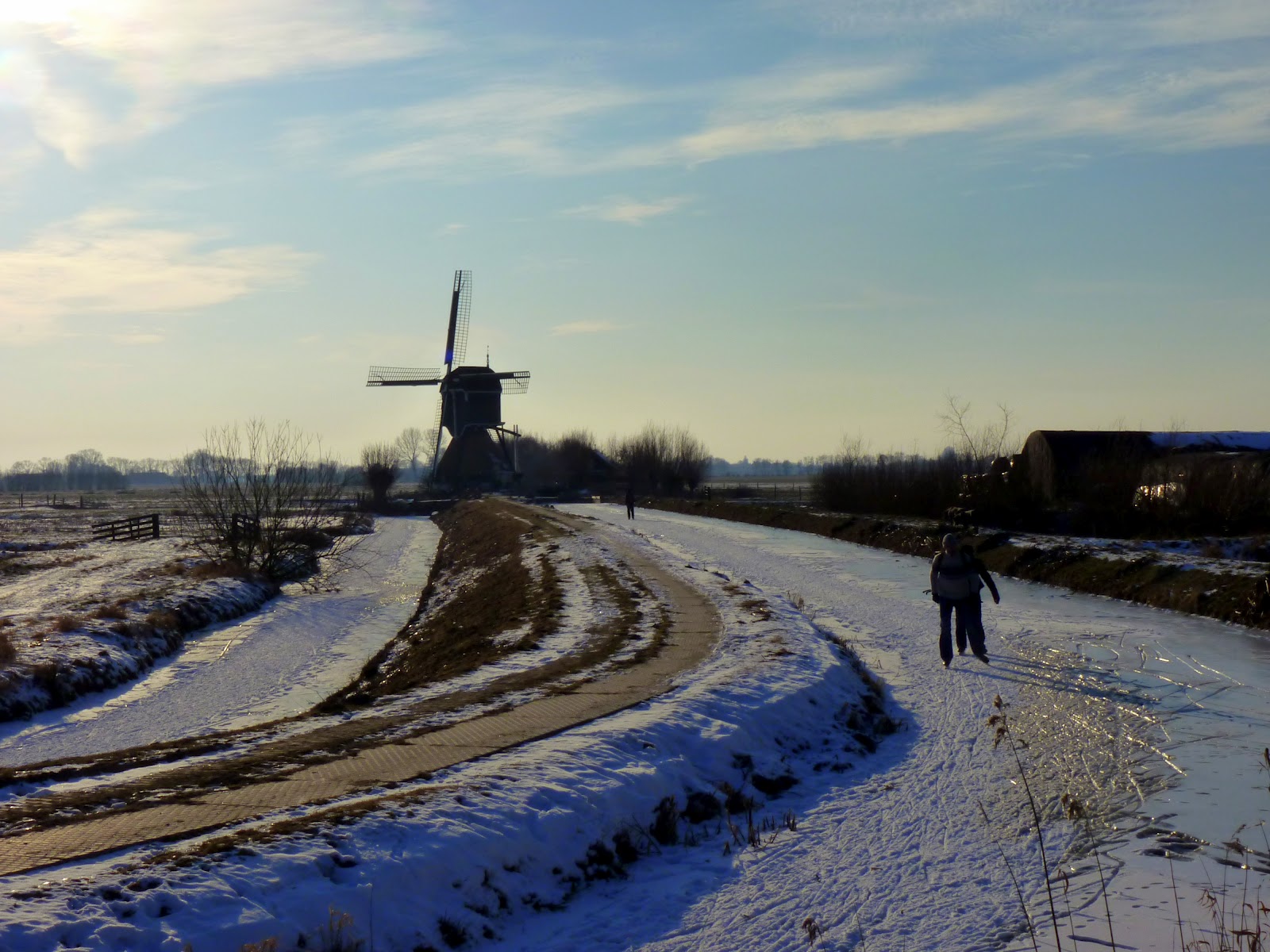
The frost and ice and skating lasted for two glorious weeks. On Sunday old and young were still skating on all the canals in Leyden, on Monday thaw set in with a vengeance and overnight the weather changed completely. No pretty pictures, except of walls of ice floes building up against dikes and lighthouses because of the strong winds.
At least I wasn't tempted to go out with a camera, which was just as well, as the week was characterised by baking and cooking, seeing friends and plodding away in the kitchen. I baked three large cakes for the choir flea market, to be sold piecemeal with coffee; a slice of cake and a cup of coffee being a welcome refreshment after digging through dusty white elephants and second hand books. Or just to celebrate a special find!

On the same Saturday that the flea market took place, one of my neighbours had organised a "running dinner", the type of dinner party where we all trouped to one house for drinks and nibbles, moved on to the next house for starters, the next one for a sit-down main course, and so on. All the courses were very nice, but the main course was exciting. We were served salmon, which had been cooked in thick layers of salt. This crust of salt turns into stone during cooking. It is a marvellous way of preparing salmon, as the juices stay in, the fat runs out and the fish, which can become very dry, stays succulent . Two of the neighbours posed with the big salmons before smothering them in brine. 

I "was volunteered" - by some neighbours who made the decision for me - , to make the desserts. I hardly ever eat sweets – too fattening - , but like making them. Although I had been very firm and told myself just to make a huge bowl of healthy fresh fruit salad, with a bowl of cream for those who liked that, I ended up by making two big dishes of chocolate mousse,  with cherries soaked in kirsch, and a very large dish with tiramisu. It involved using and cleaning many bowls: separate ones for melting dark chocolate, for beating the egg whites, for the egg yolks and sugar, for the whipped cream, for the mascarpone, a grater for the chocolate, a bowl in which to soak the slices of cake in some nice tipple, etc. From Wednesday till Saturday I whipped, beat, stirred, grated, licked spoons, washed bowls, and started all over again. In the end I ended up with far too much – I thought! – as only 16 of the neighbours took part, and after already three courses it seemed unlikely anybody could eat such rich desserts. But lo and behold, two bowls were completely scraped – or licked? - clean. I had kept one aside, and gave that to one of the neighbours to share with her family which is larger than my single person household. Especially the tiramisu seemed to be delicious, but I never tasted it. Click to see mouth watering pictures of Tiramisu.

Less culinary and more interesting were visits to old friends and unexpected visits from friends, which again included cooking and sharing meals. So much more enjoyable than eating alone.

Meanwhile I tried to take up sewing again after 30 years or so. After all I no longer have a job, and I used to be quite good at dress making. And there is a crisis... Now I am rather rusty, so I am taking my time over a summer dress, which I cut out three years ago, but which I never finished. No hurry yet! The trouble is that I can hardly now see the different lines on the paper multi pattern sheets found inside sewing magazines. It took me almost as much time to draw the pattern for another dress, as I expect it will take me to make it! The three year old summer dress is now almost ready, except for the lining, which isn't necessary but which I like. It makes a garment so much nicer and it gives it a better fit.

Now that my friends from University days all seem to be retired and their children settled, we gradually try to restore old but neglected friendships. So I went to Lelystad, for the first time in my life, not being interested in new cities. I must admit I did not see much of the town itself, but just my friends' house on the outskirts, next to the Oostvaardersplassen, a nature reserve on the drained bottom of what used to be the IJsselmeer. Here you'll find some pictures of the area.
I had often passed that area and enjoyed it driving on the dike around the IJsselmeer, but never been in it. The number of wild ponies, horses and deer was amazing. It seemed too much for the area, which originally was meant to be an industrial area. But it did not drain very well, so it was left as a rather wet bird reserve. In the end it was furnished with ponies, (highland) cattle and deer. Those animals have no natural enemies, so they multiply lustily and the population is now far too large. In winter the reed lands have this orange glow. The deer seemed used to humans and came very close to the road and the parking lot where we watched them for a while. It was most interesting. The stag with his beautiful antlers stayed a bit further away, but from a distance kept an eye on his straying harem. I will certainly go back there one day.


We also went to see the Batavia, a replica of a 17th century merchant ship, which is now a museum, and docked at Lelystad. Another replica of a ship from that period is in the process of being built here.

Two days later I met with another friend who lives in Rotterdam. She took me to hotel New York for lunch, the place from which in the nineteen fifties many Dutch emigrants set sail for the USA and Canada, thinking they would never see their home country again. That part of Rotterdam has changed considerably in the past 20 years or so. Instead of docks and old warehouses there are now very modern apartment buildings, offices, restaurants, terraces overlooking the busy river with a wonderful view of the skyline of Rotterdam. It now is a fashionable nightlife spot, has cinemas, bars and restaurants. Before lunch we visited the Photo Museum next to the hotel, which I enjoyed enormously.  A large hall in the museum had been converted into a dark room. Visitors can pick up a large white sheet of cardboard which represents a virginal sheet of photo paper. When you place it in a "tray", a photo slowly appears, as it did when as a child I assisted my father in his home made dark room. It was magical, white or chamois paper on which this picture appeared after exposing the paper to the light projected through the negative film. In the museum it seems as if the tray is filling up with developing fluid, and just like I remembered it from my childhood, slowly the images become visible. The website of the Photo Museum gives information about the exhibition, also in English.

View from Hotel New York towards the historic dock North of the river 


Hotel New York dwarfed by modern buildings
After our visit to the museum I took some pictures of the remarkable architecture in this small part of Rotterdam, a mixture of old and new. I think it is amazing what they have done with the former docklands here, de Kop van Zuid ("Head of the south" side of Rotterdam. If you look at the small map on the website, you'll see why it has that name). Here are some snapshots taken with my small camera which I almost always carry with me. It was a rather grey day, but nevertheless they give an impression of this area. 
But the most enjoyable part of the day was sharing a delicious lunch with a wonderful friend in the restaurant of Hotel New York, chatting and exchanging ideas and opinions, as well as gossip of course! The most valuable thing in life is having good friends, especially if they are creative, talented and supportive, with a zest for life!

Thursday, 16 February 2012

Ice and snow. a Dutch weekend

A lovely week and two wonderful weekends thanks to the weather: ice, snow, long walks, crisp snow and later firm, black ice. I took three very long walks during the week, along frozen lakes and canals, and it was so peaceful and beautiful, really a bonus.

Kromme Does, Hoogmade
The second and last winter weekend for the time being (February 11-12) was absolutely glorious and Holland looked in some places like a Dutch painting from the Golden Age come to life. I had an English friend to stay and showed him that Holland still exists behind the motorways and the big cities in the West, the "Randstad". We began our tour on Saturday by driving through Hoogmade towards the Wijde Aa where there happened to be a skating match for professionals.
Wijde Aa, Hoogmade
Windmills, ice, sun and skates, what more does one want? Besides at that spot it is very clearly visible why we desperately need dikes as the water level of the lakes and canals is considerably higher than the land.
         On we went along the river Gouwe to Gouda, to see the famous medieval Town Hall and the even more famous windows of the church of St. John. A host of market stalls unfortunately spoilt the view of the free standing Town Hall. On the other hand the stalls are a truly Dutch phenomenon and as such fitted our Dutch day! 
         Of course the first thing we did when we came to Gouda was to order coffee and Dutch apple pie in a cafe with a view of the Town Hall. Gouda is well-known for its "stroopwafels', but we needed something more substantial. Thus fortified we explored some market stalls and went to the church to admire its wonderful stained glass windows, their colours very vivid and bright, depicting Biblical scenes as well as scenes from the 80-year war with the Spaniards. The church itself, the Sint Jan, is still used as a church, but also for organ recitals as the organ is indeed beautiful. We could have spent hours exploring each individual window in detail, but I had an agenda for the day. After reluctantly taking leave of the church, we made a small tour of Gouda, the library, almshouses, the fish market and the harbour with the historic ships, still in working order.
Library Gouda
Everywhere people were skating on the canals, skating couples pulling small children and babies along on sledges, shoppers cutting across the canals to get somewhere quicker. There are many historic buildings in the town. The harbour used to be very important. Ships had to go through Gouda which connected the Hollandse IJssel with the river Gouwe and ultimately with the Old River Rhine, the "Oude Rijn". It was the route to Amsterdam. Warehouses, big homes of merchants, churches, former convents and monasteries one of them now  housing the public library, almshouses, it is all there and within a limited space. It was unusual and quite a surprise to see people skating in the harbour.
Historic Harbour Gouda
The next leg was via Haastrecht towards Vlist along the small and picturesque river also called Vlist. Here too was a skating tour, and it seemed everybody, young and old, was on skates, passing windmills, cropped willow trees, reeds and big old farmhouses. Enterprising people were selling hot chocolate milk, mulled wine and pea soup in tents on the narrow and winding river. Although the sky was an intensely deep blue and there wasn't a lot of wind, the windmills were turning their sails. The echo of the skates cutting across the ice is fabulous! We stopped many times to take pictures, as it just seemed to be a tableaux vivant from a Dutch painting. It is amazing how bare the river looked at this time of year, while it is so lush and green in Spring and Summer, with horse parsley lacing the road and fruit trees in their delicate pink or white bridal outfit around the old farmhouses.


River Vlist
The Vlist ends in Schoonhoven, which is on the river Lek. Here we enjoyed Dutch pea soup with rye bread and ham in a restaurant with a view of the ferry. The water was full of ice floes and it seemed as if there was a certain sluggishness in the movement of the current. Due to the ice? Or just my imagination? Schoonhoven is a nice, old town, partly walled. It is known as the Silver City, as there is a school for silversmiths here, and a Silver Museum. Like Gouda, there are canals and gabled houses, but the town is much smaller. The canals and houses are a miniature Gouda, a real old Dutch town. The entrance to the harbour is spanned by a white wooden drawbridge on top of the city walls. From here one has a lovely view of both the river and parts of Schoonhoven. It is a pity that big industrial buildings on the south bank of the river spoil the view. It could have been so beautiful.


Sunset at Schoonhoven
When we returned to our car to cross the river by ferry, we were surprised by the most gorgeous sunset I had ever seen. The sky was a deep rosy red and orange, the sun a fiery red ball. The water of the river seemed to be of liquid gold. Of course we took pictures and more pictures. Even after crossing the river, the sun stayed a purplish pink for a long time, which we enjoyed while driving to the West along yet another narrow dike with farmhouses, windmills and late skaters on the frozen river. It did not get dark till we reached our destination, a former farmhouse, Steeckershil, now a home with a concert hall where the hayloft used to be.

Sunset in the Alblasserwaard
Here we enjoyed a piano recital, and most of all the hospitality of our host and hostess, and the company of the friends of this unique enterprise. Not a typically Dutch event, but in a typically Dutch environment: a 16th century converted farmhouse on a narrow river in a very picturesque and rural part of Holland. In a spot where during the day there had been a skating tour, which our host could have joined by stepping on the ice at the back of his garden. The young Hungarian pianist was Eva Szalai (1987), played compositions by Schubert, Schumann, Chopin and Ravel.

On Sunday we joined the church choir in the morning  and went sightseeing in Leiden in the afternoon. Here too almshouses, bridges, skaters on the many canals, two big churches, and most surprising of all, a cafe on the ice of the Nieuwe Rijn in the very heart of Leiden, worth a photo.
"Rembrandt" Mill

One of the many almshouses in Leyden

An ice cold drink???


Saturday, 4 February 2012

Winter

After a very mild and warm Spring in January, with daffodils in bloom as well as hellebores and snowdrops, and roses still flowering from last year, winter has come with a vengeance. It has been cold for a week now, temperatures in Lelystad, a town built in the former IJsselmeer, dropping to 22,9 below zero. The last time such a low temperature was recorded was 27 years ago. Even here on the coast, where the sea moderates any extremes, the temperature dropped last night to -18 Celsius. Today it did not get any warmer than -5. However, today has absolutely been a glorious day! Yesterday it snowed, covering Holland from 5-15 centimetres, depending on the area. No snow suitable for snowmen or snowballs, as it is dry and powdery like frozen dust, diamond dust. And by the way, not for trains either apparently! The lovers of ice-skating are very disappointed, for the canals are frozen over, although only the shallow ones are safe. Any true Dutchman or – woman has been eagerly waiting for that. People had hoped for at least a week of fun, skating on natural ice. However, the snow has spoilt that! It is far too dangerous as weak spots and thin ice don't show. 


     But it was a splendid day for walking. I went for a two hour walk in Warmond, and attractive village on the lakes near Leyden. As the many ditches, canals and even rivers were frozen over, the normally isolated fields, surrounded by water, could now be reached across the ice. It was lovely to walk in those fields, on the low dikes and along the banks of the river Lee, frozen over. The houseboats one normally only sees from the water, could now be reached. I first walked through the wooded parkland of "Huys te Warmont", a castle surrounded by a moat, which was now a smooth, white sheet. Trees were decked out with hoary frost, which had built up like intricate lace. The sun, which is low in the sky at this time of year, shone through it and let it sparkle. Once in the fields after crossing the ice, the views were wide and exhilarating. Hares were running across the fields, at one point chased by a happy dog, which however wasn't fast enough for the hare. Geese flew up, disturbed by the chase. Although cold, seeing the sun and bright blue skies was fantastic, and this winter day just as beautiful as any summer day.

For more pictures, got to my pictures on Picasa:


Wednesday, 1 February 2012

Haarlem

At last winter has arrived. It is very cold indeed, temperatures staying below zero during the day, and a strong north-easterly wind. Snowdrops have shrunk away, my hellebores which were in full bloom, have bent their open flower heads to the ground, shrivelled up. I wonder if they will survive. Without snow and just a freezing dry cold, it might be difficult. But at least we have blue skies and sunshine! Very nice to know the sun is still there! We had almost forgotten what it looked like.
     I went to Haarlem for the day. Haarlem is attractive any time, with its old city centre, its quaint and ancient houses, the beautiful Market Square with the St. Bavo Cathedral in the middle, famous for its pipe organ. In the Market Square we also find the statue of Laurens Janszoon Costers who is proudly showing off on his pedestal, the Dutch inventor of book printing. If he really was the first, is arguable. But in Holland he is considered to be the first. Haarlem also has many small specialist shops and boutiques. Of course there are all the chain stores as well, but designers, photographers, have boutiques here. There are quilt shops with surprising cutters, scissors, patterns, etc., a treasure trove of paraphernalia.  Cookware shops, photo shops, shops with design furniture, specialists shops in coffees and teas, etc., they can all be found in Haarlem. Via this site one can download walks along monuments and almshouses and other places of interest. The pdf files are available in Dutch and in English. Click here for the site for English speaking visitors
 One of the almshouses
The museums are among the main attractions. This time I headed for the Frans Hals Museum – distracted on my way there by interesting shops – to see an exhibition of paintings from the Golden Age, each of them depicting some merry feast: 'Sinterklaas' St. Nicholas, festivals, al fresco dining and banquets of the civic guards. It seems that some of the feasts lasted for days on end and drunkenness was common. So many of those feast were forbidden by the then protestant local authorities which considered them sinful and a waste. There is a remarkable difference in style between the feasts of the common people, the farmers and workmen, and the rich and famous. And that doesn't only apply to the way people dressed, but also to their behaviour. The building, a former old people's home and later an orphanage, is in itself very interesting and worth a visit even if there is no special exhibition. Unfortunately it was too cold to sit in the garden in the courtyard, but I managed to take some pictures through the glass doors.
 Festive table in the museum with food and tableware similar to what we can see in some of the paintings exhibited.
On my way to the museum I passed the local, or rather provincial, Archives. They are housed in an unusual building, the former church of the Order of St. John (Johanniter Orde), a protestant order, the Maltezer order. They were related to the medieval Crusaders to the Holy Land. They built an abbey here, with a graveyard, orchards etc. The only thing that remains is the church, which was eventually converted into a protestant church and now houses the Archives. Although in use as a library and archives, the original plan of the church has not been ruined, which is great. Unfortunately the website explaining the history of the church is in Dutch. The English pages only give information about the archives: opening hours, contents, etc. But there is a very interesting  virtual tour of some of the historical rooms in this building. And one can download a folder in pdf format about the church. Behind the church, where the orchards used to be and the rest of the abbey grounds, one now finds narrow streets with interesting old, gabled houses.
Behind the St. John church. The name 'Korte Wijngaardstraat' refers to the vineyard which used to be here.

Sunday, 29 January 2012

A Concert

The "ResidentieOrkest" is one of the better-known symphony orchestras in Holland and its home base is The Hague, the Residence of the Queen and of Parliament (hence the name, I suppose). For years I had a season ticket, but after my husband died, I gave up. Anyway, from this year on the orchestra will not limit itself to The Hague, but give concerts in Leyden as well, which they apparently stopped doing some 20 years ago. The "Stadsgehoorzaal", the concert hall in Leyden is smaller than the one in The Hague. The advantage is that one is much closer to the orchestra, so it is a far more intimate experience. This evening Christian Zacharias was the conductor, as well as the soloist in Mozart's Piano Concerto (nr. 27). Because of his double function, the grand piano was placed in such a way that the keys were facing the audience, and the soloist was facing the orchestra, sitting with his back towards us. It was amazing to see how seemingly  effortlessly Zacharias changed from being the soloist to being the conductor, even doing two things at the same time, using his head, and his shoulders to conduct. And probably his eyes and facial expressions as well, but we could not see that. It was a marvellous performance. Christian Zacharias seemed happy to be able to share his joy of music with us and also inspired the orchestra by his enthusiasm and beautiful performance.
Because this was the first concert of this orchestra in Leyden, apparently organised after the programmes for this season had been printed, there was no programme available. Instead the conductor introduced each piece to us personally. Unfortunately there were no flowers either, which Christian Zacharias clearly deserved. A bad omission of the organisers? We tried to make up for it by applauding till our hands hurt! And to top it all I got my ticket at half price, since this was a new venture and not everybody was aware of this concert. I hope this will become a tradition. (the concerts, not the half price although I would not mind that either).
Schubert, Entr'acte nr. 1 from 'Rosamunde' and his Symfonie nr. 8 'Unvollendete',
were played as one piece, without a pause, being written in the same key. Zacharias said that he considered the Entr'acte from Rosamunde to be the third movement of the Unvollendete, although it came first! It is a way of looking at it. But I must admit it worked very well indeed.
The progamme began with Ravel, Le tombeau de Couperin. Here is a recording of that piece, played by the Berlin Philharmonic conducted by Pierre Boulez.


Sunday, 22 January 2012

Choral Evensong

Just back from Choral Evensong in The Hague. At the Friday practice we were dangerously short of male voices, but fortunately Christina had persuaded some good singers to join us tonight, so that surprisingly the sound was now well-balanced because of these trained extra voices.
The psalm had an unusual chant. What I really loved was the anthem, Tribus Miraculis by Luca Marenzio. Here it is, sung a wee bit faster than we did. But I think it sounded good. I had only attended one single practice as I had been away, but loved singing it. For once the altos have interesting and challenging parts. It is a joyful anthem.


Latin text
Tribus miraculis ornatum,
diem sanctum colimus:
Hodie stella magos duxit ad praesepium:
Vinum ex aqua factum est adnuptias:
Hodie a Joanne Christus baptizari voluit,
ut salvaret nos,
Alleluia.
English.png English translation
       
We solemnly observe this day ornamented with three miracles:
today the star led the magi to the manger;
today wine was made from water at the wedding;
today Christ desired to be baptized by John in the river Jordan so that He might save us, :alleluia.

Portobello Road

And then there is Portobello Road, the farmer's market and antiques market. With bric-a-brac and rubbish, china, but also real antiques, priceless, furs, plus buyers wearing furs without being sprayed with paint by angry activists. This is Notting Hill with a different clientele. 
genuine furs and leather
The street is a long, colourful vein pulsing right through this very distinguished, wide, and elegant area of London, indeed built on a hill with Notting Hill Church on the highest point, views extending in all directions. In contrast to Portobello Road with its colourful houses and shop fronts, here white stucco fronts, cast iron decorative gates and balconies, big palms in pots and tall windows. Portobello Road carries a stream of visitors, thickening as the days goes on, like a stream of lava or a colony of ants, marching along or loitering, taking pictures, browsing the many stalls and window shopping. The locals have already done their weekly shop for food, as we have, buying the crisp fresh loaves displayed on the stalls, the delicious cheeses and smoked meats, the root vegetables, such a variety here, colourful as well. The trendy cafés at that end of Portobello Road fill with locals who meet each other over a cafe latte or a nice lunch, gossiping. Many young professionals seem to live or congregate here. Mews are leading off Portobello Road, probably the former stables of the grand and rich houses and apartment buildings on the roads and avenues of Notting Hill. They are regrettably but wisely closed off for visitors. A pity, because as far as I can see they look very attractive and artistic. I only get a glimpse of them. But given the number of visitors coming here, even on a very cold Saturday in winter, I understand that decision.
No, not France but Notting Hill
   I spot several perfect and unusual inkwells and inkstands in the antique shops. But here they certainly come with a big price tag, so I just feast my eyes.

And what to think of a clothes shop which has a huge collection of old sewing machines lined up on shelves against the walls and the shop windows!
just a colourful picture of the market

Followers

Blog Archive