Tuesday, 9 April 2013

Wetlands, reeds, bogs and churches


A choir-free Sunday. So I decided at last to pay a visit to family in the North. What attracted me most was the route through that part of the country. I had hoped for a clear and bright morning, but when I got up, the sport fields in front of my house were wrapped in a milky mist. Last time that happened I did not go on the trip I had planned and was sorry for it as the weather cleared in the course of the day. And so indeed it did today. A feeling of excitement, of discovery took hold of me. I love driving on a Sunday when the roads are free of trucks and heavy vehicles. The world seems quieter, almost serene, as the feverish rush of workday traffic is absent. Going through the flat parts of the west it grew gradually brighter, till the sun shone in all its glory. It was cold, very cold for this time of year. Spring seemed far away. The rows of trees on the horizon lining invisible roads were delicately drawn against the sky, their branches outlined as if by a fine pen, showing no signs of buds yet. There was a certain beauty in it. Also the light is so unusual when the trees are still bare, so clear and pure. There was no wind whatsoever, quite a relief and a miracle in this country after what seemed like weeks of icy cold winds from the east, making the temperature seem even lower than it already was. Driving through the polders, the flat land reclaimed from the former sea, I seemed to drive through a land completely at peace. The many modern windmills dwarfed the lines of trees on the horizon. They were enjoying their Sunday rest and did not move at all, not even slightly, something I had never witnessed before in this flat land which is so seldom without wind. They looked like lazy ballet dancers on strike, still holding their elegant pose. Crossing the water the lake was like a perfect mirror , a silver sliver reflecting electricity masts which even seemed beautiful in this pearly morning light.


Once I left the new land and entered the 'old' land I was filled with happiness. This is still the Dutch countryside as it used to be: small winding dikes which formerly followed the shore of the Zuiderzee and the banks of rivers, streams and canals, old farmhouses, huddling under their red tiled or thatched roofs, pitch black soil where the reeds had been harvested and which were waiting for new growth, bundles of reeds, cut in winter, shrubs struggling to survive in the moorland, old oak trees with knotted trunks, firmly rooted, wide open vistas, with farmhouses on the horizon. There were many birds and water fowls, a stork on a high nest, its beak in its own feathers hiding from the cold, some horses , a rare donkey, and many geese. Everything seemed eagerly to be waiting for spring, which this year has kept us waiting far too long.


I followed minor roads, small dikes with the occasional low lying reed and peat workers' cottages, now much sought after holiday homes. The only traffic were hikers and cyclists, well wrapped up. The bushels of reeds seemed made of burnished gold in the low light.
Leaving this fascinating land, a land which must know tales of witches and ghosts, a land of mists and treacherous bogs, mysterious hovels with mossy roofs, I meandered though small villages, in search of old churches and wooden bell towers. Unfortunately many churches are no longer used and seem to go to ruin. Some are now used for venues, parties and chamber music concerts, eg. the church at Peperga, the Peter Stuyvesant Church, others are just neglected.

Peperga


The Peter Stuyvesant church has a remarkable stone tower, which seems far too grand, high and wide for the small church it is attached to. Black crows were circling around the top of the tower, a perfect lookout point. Peter Stuyvesant, born in Peperga, was the son of a Dutch minster, worked for the West Indian Company and played an important role in what was New Amsterdam and now is New York. He died in New York in 1672.

 Vinkega


A church which is falling to ruins is the church at Vinkega, which was built in 1899, used as an artist studio after closure and is now empty and falling to pieces. However, there is hope as the path towards the church which is rather hidden in between two farmhouses, has been restored. It is now a nice lane bordered by old and gnarled trees. It took me some time to find it though. Two fat cows in a bordering field looked at me curiously while lazily lying in the rough grass.
 Noordwolde
Grave stone of the Bell ringer of Noordwolde
This part of "Friesland", West Stellingwerff, has many interesting villages. Some of the churches have wooden bell towers, standing apart from the brick churches. Sometimes the bell towers might be old, and the churches uninteresting and relatively new, dating only from the beginning of the 20th century. Sometimes both church and bell tower date back to the 14th century. I took lots of pictures. This is a country where one could spend  weeks exploring on foot the many small settlements and towns, history book in hand. Street names indicate that there must have been many monasteries and nunneries in this area, but they are hard to trace.
 Boyl

 "leaning" gravestones

At last I arrived at my destination, my relatives, the end of my trip, on my way there distracted by many picturesque houses and small holdings for sale. After a nice dinner and a happy evening I began my two hour drive back home through the darkening land, very satisfied with my day away and determined to go back to that area soon.
Elsloo, double bell tower

Tuesday, 5 March 2013

Spring!


March 5
Yesterday, all of a sudden, we experienced the first day of spring! On Sunday it was still cold and grey. And the nights are still very cold indeed. Monday morning the sun miraculously rose in a cloudless sky and shone on us all day long, as it has today. So I tackled the garden and first did the things I do not really enjoy doing: pruning the roses which have fierce thorns, the ramblers and the wild wysteria. Now is the time, for they are not in leaf yet. Once they are, it is a tangle and I wouldn't know where to begin. I feel very virtuous indeed, for I also cleaned the pond and took out a lot of oxygen plants, which are marvellous to keep the water clear, but they are very enthusiastic growers and in no time convert the pond into a bog. So before the frogs come back and deposit their spawn on the plants after a few weeks of wild orgies and indiscriminate coupling, I needed to take a lot of aquatic plants out. I feel like a true farmer, who has this duty to clean ditches twice a year. Well, I did it!


Meanwhile the botanic crocuses in the garden had their delicate lilac and blue petals wide open to the sun. They reproduce themselves, so there are more every year which is a joy to the eye. After the snowdrops and the hellebores, they are the first colourful promises of spring.

It is amazing that only two weeks ago this is what my windows looked like: covered in black ice!
Looking out into the garden

March 2


March, the month of Spring, of new hopes. The days have been lengthening, the birds are singing early in the morning, bulbs tentatively pop their spiky leaves through the topsoil, ready to close up and withdraw as soon as the weather turns nasty again. The helleborus has been in bloom for several weeks now. Amazingly they drop their heads and look wilted and dead when the temperature drops below zero again. But as soon as the weather picks up, they raise their heads and their petals which seem so delicate are totally undamaged. I have to prune my roses and ramblers before they bud, and prepare the garden for spring, as it is still waiting to be made ready for winter. At least that means it has been well protected throughout the very cold periods which we have had.
Although I haven't posted much since mid-January, it doesn't mean nothing has happened. We have enjoyed a wonderful spell of frost. Canals and lakes were frozen over and the winter scenes with people skating on the ice of lakes and canals, the small makeshift stalls selling piping hot pea soup, chocolate milk and coffee, reminded me of paintings from the Golden Age, the only difference being that people nowadays are dressed differently. At that time there was no special clothing for outdoor sports. Women would skate in nice, wide long skirts, very elegant indeed. Nowadays our wardrobes carry a different outfit for each sport. There was also ice sailing. With enough wind those sailing- boats-on-skates can fly across the ice at a very fast speed, an amazing thing to see.

Below: The frozen Gouwzee at Monnickendam


I had friends to stay, music to sing, evensongs to take part in or to attend. But the fact is that every year is just a repeat with variations of the previous year. It is like a musical composition: each variation, each year seems similar to the previous one, but nevertheless surprises us in places. The dissonants are always different, always unexpected, and never in the same place. They stand out, may disturb a peaceful harmony. It may be illness of people dear to us, a shocking and most unexpected death, reminding us of our own vulnerability. It may be an assault or theft of one's dear possessions, which happened to me. They are things which happen to each and every  one of us, even if we think we are immune. But they shock us out of our lethargy or false feelings of safety and comfort, in short out of our comfort zone.

The dark and cold days of winter are a good time to catch up with things we do not do in summer, when we, or at least I, spend as much time as possible outdoors. I have been sorting through pictures, composing travelogues, gone through cupboards and cleared out stuff I no longer needed or wanted. There is still far too much stuff left to clutter up the house, alas.
After Breda, I did go out and explore Zwolle one day, on my free travel pass. I know Zwolle, but old city centres always have surprising shops. They spring up and may disappear again, but they are usually special and specialist shops. I happened on a shop, the "Hanze Huis", which sold products from cities which at one time belonged to the Hanseatic League, so products from Russia, Germany etc. Liqueurs, chocolates, teas and coffees, in the most amazing packaging, such as decorated tins and fake FabergĂ© eggs. The shop assistants were every bit as colourful as the packaging of their products.  Discovering only that shop was well worth the trip, although we did other things as well. There is a new railway connection between Lelystad and Zwolle, which I had never been on. However, instead of seeing the landscape and trying to figure out where exactly we were, I couldn't see a thing because of the persistent haze which bordered on fog. Bare branches against the mist may be decorative and artistic, it did not give me a clue as to the position of the tracks and where we were crossing from the new polders into the old land – which was through a new tunnel. I did not even notice going through it! So I will have to repeat the exercise on a sunny day, travelling on beyond Zwolle for a change.
Below: Some oictures of Zwolle

The only city gate which still exists, the "Sassenpoort", taken from a difficult angle.


Yesterday (Saturday) I went to Amsterdam in the late afternoon, to the Choral Evensong in the church of St. Nicholas opposite the railway station, which is celebrated every Saturday at 17.  It is a very imposing church, and in spite of being in a busy city, inside the noise of trams and traffic and people is shut out. The choir is very well-trained and sitting there in that beautiful, spacious church a feeling of peace and joy filled me. I knew some of the music, had sang it myself, but listening is another matter. It is amazing that this beautiful and mysterious service is attended so well on a Saturday afternoon, in a part of Amsterdam with the red light district and coffee shops on its doorstep. To me it seemed that angels had descended, just for the 45 minutes the service took, and with their singing filled me with an inner calm. The song of Mary and the song of Simeon, age old poetic texts which have lost nothing of their beauty and meaning.
Here is what the choir sang:
          Introit:          Purcell, Thou knowest Lord
         Office Hymn: Audi benigne conditor
         Psalm:          6
         Responses:    Ebdon
         Canticles:      Batten, 1st Verse Service (Magnificat & Nunc Dimittis)
         Anthem:       Attwood, Enter not into judgement        

Here is Purcell, sung by the choir of King's College Cambridge


Monday, 14 January 2013

Breda


A glorious day: blue sky, sun and around freezing point. Such a bonus after the months of darkness, drizzle and misery. I had promised myself a day out, and it was the perfect day for it. I love medieval choir stalls with the misericords carved out of oak, and had been to several towns in Belgium to admire them, but I had never been to the church in Breda, which is a beautiful example of Gothic architecture of the Netherlands, and has wonderful misericords. 


One of the modern misericords
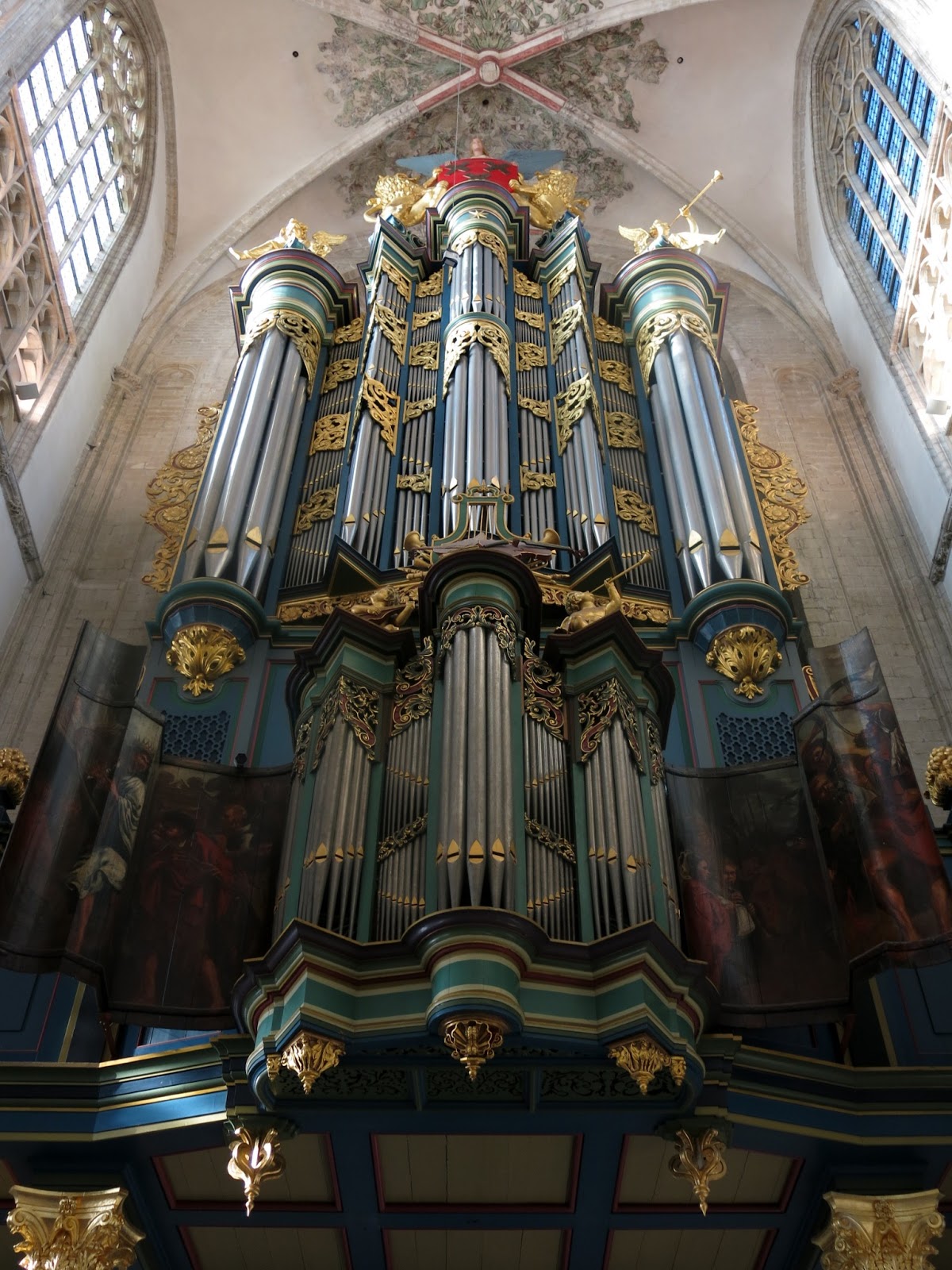
Admittedly many are defaced, either by iconoclasm which also struck here in 1566, vandalism or negligence, but they are worth seeing. There are even several modern ones, added much later.  Apart from the choir stalls, there is a magnificent organ built against the west wall. 
Details of the pipe organ


As the church is no longer regularly used for worship, the nave is empty and the beautiful blue floor tiles add character to the interior. Breda was the seat of the Princes of "Orange-Nassau", the forebears of our Dutch royals, and many of those princes were interred her. So the church also houses many elaborate tombs. In the sixteenth century a special chapel was built, the "Princely Chapel". The vaulted ceiling was beautifully decorated in blue and gold. 
A tryptich by the well-known Jan van Scorel which is still present was situated behind the altar. The monument  was built for Engelbrecht II of Nassau and his wife, by his son Henry III of Nassau. To me it seemed unusual that the couple is lying there in what looks like simple shrouds instead of formal and ornamental attire. Is it because they wanted to stress that we are all equal in death and that neither rank nor wealth makes any difference?
Since it was such a sunny day, the church was flooded with light which showed off all the subtle colours, the gold and the blue.

Another place worth seeing is the Beguinage
 Below: reflection of the church in a window of one of the houses
 Just an picturesque corner in the Beguinage
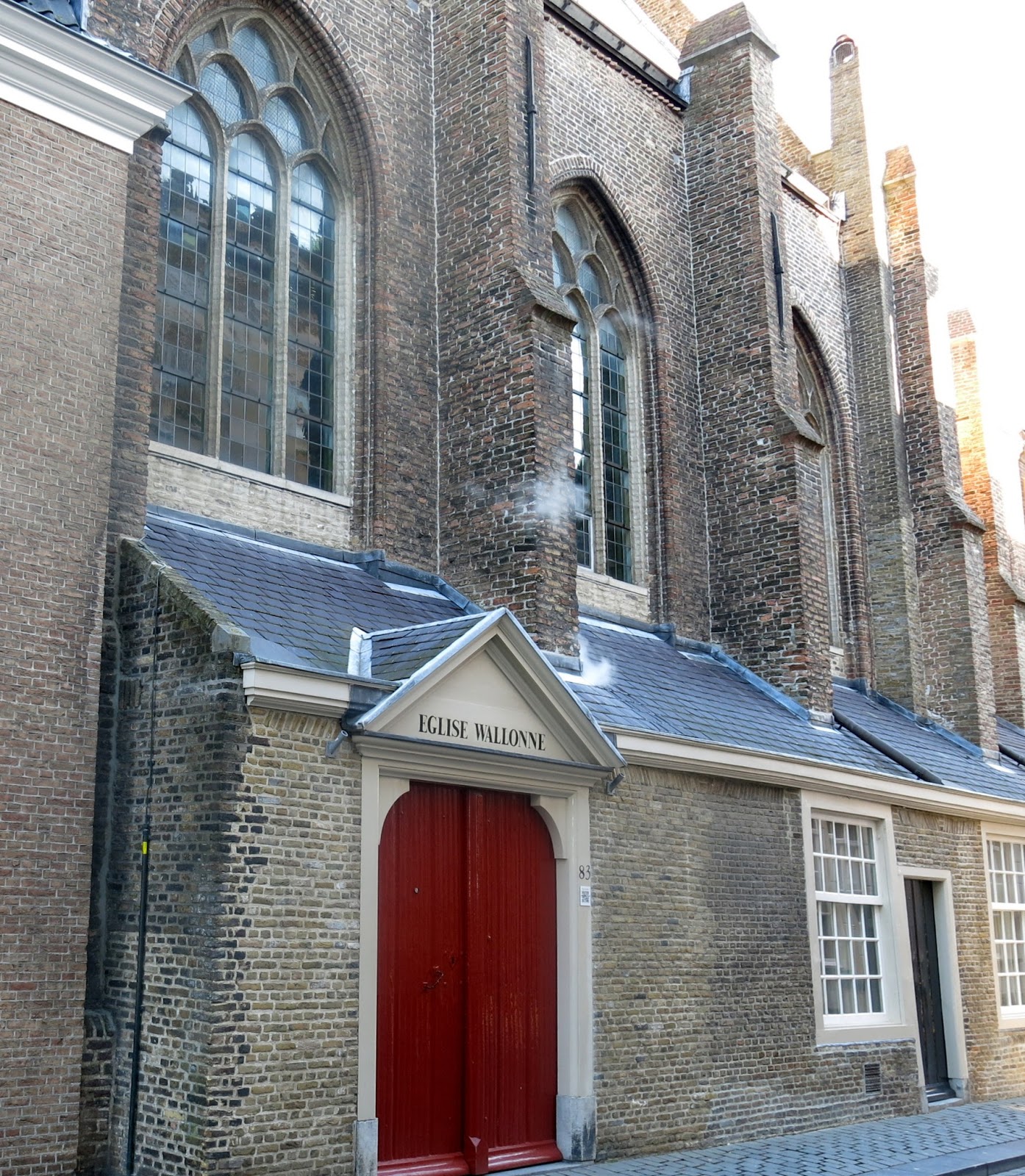
It is walled in, and so protected from wind. There are regular services in the little church or chapel, but when I was there in the early morning, I could only see the interior through a glass partition. The pictures are not much good, as I could not avoid my reflection in the glass. It is quite a large Beguinage, with several water pumps. It must have been good to live here, protected and well cared for. And I guess it still is. The Eglise Wallone is also part of this Beguinage, but the oxblood red doors were firmly closed and I could not even peep through a glass door or window. The history is rather fascinating. The Eglise Wallone originally was the church of the Beguinage. But it was taken away, and the entrance was moved to the street, the original doors walled in. 
Eglise Wallone. The white blob is smoke coming from a hidden chimney
In fact it left the women living in the Beguinage without a church. Their new church which now forms a focal point dates from 1838 and a priest, Pater van Zon,  was the driving force behind the building plans. He had a vicarage built next to the church in 1850. So over the ages quite a lot has changed here.
Another corner in the Beguinage
It was difficult at any time of the day to take good pictures, as the contrast between light and shade was so stark.
My next stop was the Museum of Breda, just outside the centre, to see an exhibition of paintings by Petrus van Schendel (1806-1870), a Dutch romantic artist and  a master of night scenes, especially outdoor markets which were lit by candles. Light and shade fascinated him. He was internationally famous, won many prizes during his working life, and even kings and queens bought his paintings. I never knew there were night or evening markets in the Netherlands in the nineteenth century, or at any other time. But the backgrounds were realistic, and can be traced to market squares in Rotterdam, Amsterdam and The Hague, towns where he lived for some years. 
 Two of the paintings by Petrus van Schendel, from the flyer.
The paintings were very atmospheric, but after so many candle lit market scenes, I got a bit tired of them. Nevertheless it was an exhibition well-worth seeing, even a revelation.
I retraced my steps and had something to eat and drink in an amazing cafe-restaurant in the market square. Apparently that too had won a prize, for its remarkable and attractive interior. It is in an old building, and as the Christmas trees and decorations were still there, it looked very festive indeed.
 The exterior of the church, and the tower seen from one of the narrow shopping streets.
Days are not very long at this time in January, which is just as well, as my feet needed a rest, and the battery of my camera died on me, just when the light faded. Time to take a train back home and relax.
Some details from the church in Breda:
 Painting on the ceiling
below: detail of a wall in one of the side chapels
 St. Caecilia, on the banister of the stairs to the organ console

Wednesday, 9 January 2013

New Year resolutions


2013, a new year. Why do we celebrate the new year in the middle of the year? And what is so new about it? For people who have always been involved in education, as pupils and students, and later as teachers and lecturers, the change of year takes place in the middle of the educational year. School years are planned from September to July. September being a new year, a fresh start, new faces, both of pupils and teachers, and colleagues. Why doesn't the new year begin in September, just after the summer holidays, or on the first day of Spring, or the day after the shortest day, December 20th or 21st?  At university budgets have to be ready before January 1st. Funds are granted for a period of a calendar year, starting on January 1st. Targets have to be met, money which hasn't been used, can't be saved for the next year when it may be badly needed, but is taken away. It is a peculiar system. For the new year is just a continuation of the year which began in September of the "old" year.
I have never felt any pressure to decide what I am going to change in the so-called New Year. All through the year I might promise myself to do better after I have failed, or said something wrong, or made a mess of things, or have had too much to eat or drink. After such a day or time I evaluate what went wrong, what changes I have to make, if any. Not especially on New Year's Eve or January 1st. This also saves me the heartbreak of disappointment, as it is well-known that New Year Resolutions have a very short sell-by date, usually less than a week if statistics have any truth in them, and they are certainly forgotten at the end of January. Nevertheless I do use this slack time well. Christmas has come and gone, meals are frugal to make up for the bounty of December, there is no more singing, there are hardly any choir rehearsals nor Christmas concerts. There is no excitement over frozen canals, no feverish hope of skating on natural ice. It has been far too mild a  winter so far. However, there have hardly been any sunny days. Instead it has been dark and gloomy and wet for weeks, with only the minimum of daylight hours and very long and dark mornings and evenings. Now that I have taken down the Christmas lights and decorations, it seems even darker. Tracks are very muddy, so walking is no pleasure. Instead I have made the most of it and have cleared out kitchen drawers and wardrobes, and gone through piles of magazines. I have boxed things which I no longer need or never needed in the first place, ready to go to a second hand shop – or the dump. I have bought  matching containers which stack neatly in my kitchen cupboards, thrown away foodstuffs which were not in view and so had lived on my shelves for years and years. As the weather is still miserable, I may do some more clearing out and cleaning. No New Year resolutions for me, but boy, do I feel virtuous!

Followers

Blog Archive