Tuesday, 21 May 2013

Whitsun, Almshouses and Concerts


Whitsun and time for the annual concerts in the 35 almshouses Leyden can boast of.
Here is a map of the almshouses I visited.

 Although the almshouses may look like the Beguinages in Belgium, in Holland they were not built for women who were beguines, religious lay sisters of the Roman Catholic church not living in a convent. Often the houses were built by rich women and men who took pity on the poor, on single women and widows, and so provided a cheap and safe place for them to live. The almshouses were governed by a board of directors, men and women who decided who could live there and who couldn't, and who saw to it that the inhabitants strictly observed the rules and regulations. Although they were not religious institutions, but secular ones, in most cases the inhabitants had to be members of a protestant church. Many almshouses in Leyden are now inhabited by students. They are peaceful havens in the middle of a busy city.
A. Jean Michelhof, when it was still dry. Young singer, having trouble with her voice because of the damp weather.

For several years concerts have been organised in the courtyards and enclosed communal gardens of those almshouses during Whitsun. Two days long it is possible to go from one almshouse to the next to enjoy music. There is a classical route, a young talent route, a jazz route, a Spanish route etc. It is very enjoyable to be so close to the musicians, who are all talented. Some are just building up stage experience and fresh from the conservatories. On Whitsun itself, the Sunday, we experienced a few hours of summer and sunshine, from 10 am till 3 pm, a most welcome relief after this cold spring. I had visitors after church, so we didn't go into Leyden but enjoyed coffee and drinks in the garden, a first this year. 
D. (hidden behind E on the map) Sint. Jacobshof (Roman Catholic, see noticeboard below). Typical entrance to an alsmhouse, which was often tucked away and accessible by a long passage behind a heavy wooden door.


On Whit Monday I and a friend went into Leyden to enjoy the concerts and see some of the almshouses which I am not so familiar with. Unfortunately the weather had changed completely and it was cold and very wet indeed! Instead of playing in those lovely gardens, when the rain came down in buckets after a few hours, the musicians had to take refuge in the covered gateways, amongst the parked bicycles of the inhabitants. 
 FBarent van Namenhof. Spanish music in a covered bicycle shelter, next to the potplants
 G.Bethlehemshof, the lute player in the room for the board of directors.

H.Tevelingshof.The harp tucked away in a corner of the bike shed
Not the romantic surroundings they had dreamt of. Most of them were very brave, and did not walk away but just continued to play with frozen fingers, shivering limbs and in draughty porches.
I saw quite a few almshouses I had not explored before, and I will certainly go back on a brighter day to have a better look. A saxophone player did his show irrespective of the weather. He walked around the courtyard, playing his sax, like the pied piper, under an umbrella held up by his companion, before giving his splendid recital under a canopy, a bright orange party tent.
 D.Sint. Jacobshof, the sax player, undaunted!

FBarent van Namenhof, sheltering under a party tent and umbrella's

When the festival was over, we were drenched, and tried to warm ourselves with "bitterballen" and a glass of wine in one of the few bars open on this special day, before returning home. A hot shower, dry clothes and piping hot soup were an excellent remedy against the cold.


Hopefully next year will be kinder to us, because the festival is a marvellous event and the choice of music and locations so varied it is impossible to hear and see everything in just two days.

Tuesday, 14 May 2013

Gable Stones


If one looks up when just walking around in the centre of an old Dutch town, one may discover a world of delights. There is hardly any country with such a wealth of gable stones and fanlights (or overlights). Think of Edam, Monnickendam, Hoorn, Enkhuizen , towns North of Amsterdam, and in the South of Heusden, Woudrichem, and even further south Veere, Middelburg and many other towns. Leyden also boasts many gable stones and a small book was published claiming to contain each and every of them in that old university town. In some places new gables stones are added, a delightful custom. The older gable stones often refer to the trades of the former inhabitants, with obvious signs for butchers, fishermen and milkmen or farmers. But the history of the colourful gable stones is not always clear. There is a website which aims to list all the gable stones, starting with Dutch cities and that accomplished extending their inventory to neighbouring countries.
Here are a few gable stones which I took photos of.

 Top and below: Alkmaar

 Brielle
 Brielle
Brielle
 Brielle
 Brielle
A modern gable stone; Brielle
Enkhuizen
Gouda
Heusden
Heusden

Edam
Edam
 Haarlem
 Haarlem
Haarlem
 Monnickendam
 Monnickendam
 Monnickendam
 Monnickendam
 Monnickendam. Who wouldn't want to live in a house enveloped by a guardian angel? At present it is even for sale, situated on a picturesque canal.
Monnickendam.
Several of the gable stones are surely quite modern. But there are also very old ones.
Monnickendam

Wednesday, 24 April 2013

Spring!


Today, Sunday April 21,  leaves are sprouting from the trees, to my delight spoiling the clear outline of bare branches against the sky. All of a sudden tiny pale pink blossoms appear on trees. Daffodils, blue scylla's, the bright yellow stars of lesser celandine, decorate the garden. Not long now before nature will again be a feast of colour, all in time for the installation of the new king and queen. It will be wonderful to see the many shades of green and copper of the young leaves, so different from the rather uniform green in midsummer. It is just a week ago that the first frog arrived in my pond, and already it is filled with spawn. The fish have been disturbed and woken by the comings and antics of the frogs, and are swimming near the surface to catch some sun and warmth. I am glad many seem to have survived the long an very cold winter and that there are tens of tiny young fish as well. Although not very clear, the water of the pond is at least healthy. The magnolia stellata is turning its pure white flowers towards the sun and the light. But there is still danger, danger of night frost which will kill off the blossom as it did the flowers of an earlier flowering magnolia. But whatever happens, spring has definitely arrived. And who knows, perhaps the tulips may also decide to show their colours, competing with the only colour in the bulb fields so far, the bright yellow of the daffodils. 

Sunday, 21 April 2013

Saturday April 20th


Although I first added a post about Sunday April 21st, I now like to mention a few events from the past week.
   The past week has been a busy and enjoyable week. Last Saturday (April 14th) the first brown frog splashed around in my pond. Quite a lot later than last year. But everything is later. I did not envy the frog, quickly followed by a number of fellow frogs, as the water is still very cold. Is it the light that draws them out and urges them to mate, or the temperature?
  Caught in the act on my doormat, totally oblivious of their surroundings. They did not move, even when I tried to push them carefully with my foot towards the pond and the safety of the water away from the greedy herons.
I noticed them early in the morning, before setting off for Antwerp where we had our first choir rehearsal for our week in Southwell Minster in August. We have a provisionary programme, and concentrated on a few new – that is new to our repertoire – compositions. Not every singer could attend the rehearsal. One of pieces we read was Ascribe unto the Lord by S.S.Wesley. The notation is rather complicated, as voices split, are left out, and added again, so at one point one's voice is notated in the third bar line and then again on top or in the second bar. I was screeching away at terribly high notes in what I thought was the first alto line, growing quite desperate. Nobody said anything till we finished. It was quite a relief when they told me I had been singing the second soprano part! The last part, "The Lord has been Mindful..", we have sung several times and are familiar with, but we have never before sung the whole composition. It is beautiful, but I will have to attack my lines with a highlighter, as it seemed all rather confusing.
   I was back just in time to drop off a few fellow singers as we car-pooled, and to take a quick snack before setting off for The Hague again to attend a "trombone extravaganza", an amazing concert with 10 trombone players. Before the interval we listened to ancient music, a lute, harpsichord, baroque violin and an old – baroque trombone, the latter totally different from the modern instrument with that name. After the interval well-known music by later composers arranged for trombones was performed. It was funny to see the constant change of position of the musicians. Sometimes there would be five of them, one conducting, then 6 or 10 or whatever, changing position all the time and taking their music stands with them. An amusing form of musical chairs, although they had no chairs. The most impressive and really very moving part was at the beginning of the concert, when the trombone players were standing along the sides and at the back of the audience and the sound came from all around us, quite mesmerising.
It was a weekend filled with music, starting with our regular choir practice on Friday evening.

The week brought a variety of activities, appointments with doctors and internet providers, meetings with friends from far and near, and meetings of the board of the "Volksuniversiteit" of which I have been the secretary for the past  3,5 years. Not to mention a tea afternoon for the women in this street, a monthly event, fitness classes and another choir practice.

Haarlem revisited
One day – the last possible date – I took advantage of my "free rail day" and took the train to Haarlem. Haarlem is an interesting old town. I have often been there, for choir practice and for services and concerts in the Bavo, the main church in the market square, as well as several other churches on various occasions. Just before Easter we sang Stainer's Crucifixion in one of the catholic churches there. Haarlem also has at least two museums in historic buildings, with attractive and interesting exhibitions which I have often been to see. This time I wanted to do a tour of the well-hidden almshouses. I have seen most of the ones in Leiden, and in some other Dutch towns, but was not familiar with the ones in Haarlem. And I was amazed at the variety. They are well hidden in parts of the city where tourists and shoppers wouldn't normally go. Quiet parts as well. It is wonderful to find these hidden corners in a busy city. It is always a surprise when I open a door in a gate, ornamental or not, and then hit upon a beautiful court, surrounded by small houses, with pots of flowers on most doorsteps and a well tended communal garden. There is always a stone pump, and the absence of traffic noise is unexpected and so wonderful. Living in such a serene place in the middle of a busy city has always appealed to me. The almshouses were often purposely built for single women, and did not start out as beguinages, as most of those houses do in catholic areas.
 An interesting variety of water pumps in the different almshouses 


 I also discovered that Haarlem has many narrow streets, lanes and alleyways, lacking  front gardens. In many of those streets people have taken out a pavement stone or two directly in front of their house and planted climbers, roses, honeysuckle, wysteria, all sorts of plants. They have even put lines high across the street so that climbers form a canopy over the street. Many colourful pots with annuals en roses decorate the pavements.
No flowers yet, but wait and see
Another attraction are the shops. Haarlem still boasts many specialist shops, unique ones, not part of a chain. Cook shops, camera shops with lots of tantalizing lenses, the latest gadgets and very nice cameras , many restaurants and cafes. And not just around the big and impressive market square with the Bavo church taking pride of place, as well as some other old buildings.
 Top and below: two entrances to (former) almshouses

 Doors in Haarlem
Below: various almshouses


 Three women gossiping


St. Olofs Chapel
Talking about old buildings: The day after my Haarlem visit I attended a symposium in Amsterdam. This took place in the St. Olofs Chapel, a very old chapel on the Zeedijk in Amsterdam, at the top of what is now the red light district, but once was the dike along the former Zuiderzee. The chapel is very interesting, but no longer used as a church. It now is part of a big hotel, and is connected to it by a tunnel under the Zeedijk. It is sad that so many churches and chapels are no longer used for religious services. On the other hand, by using this chapel as a conference room it has been saved from ruin and destruction. Walking on large stone slabs which were originally used as gravestones, still engraved with the names of the people once buried there, I felt I was trespassing. The deceased and their relatives surely thought they would lie in peace under those gravestones forever, or till the end of time, the second coming they believed in. When the chapel was rebuilt and restored after various mishaps and a fire, the graves were opened. I suppose they removed the bones, which is usually done, and buried them elsewhere. That seems sacrilege, as I think it is also sacrilege that we exhibit Egyptian mummies in glass cases in museums. Mummies which were at one time so well preserved for eternity, their graves hidden in the depths of pyramids, almost impossible to discover, buried with all they thought they needed in the afterlife. When is a dead person no longer considered to be a dead person and can a body be relocated or displayed to curious eyes? Is there a time when a body is no longer a body but just an object? Somehow to me it seems totally wrong.
   The symposium was interesting, and I was glad to see the inside of the chapel which I had so often passed on my way to the station but never been able to enter. It is a place full of history, and I hope it will be preserved, even if not for the purpose it was originally built for.

Here are a few more links to the history of the chapel, and to some pictures


Sunday April 21st


This past week was full of interesting events. But I will write about them later as today is still fresh in my mind.
   A long service today in our church in The Hague, lasting for almost two hours. One of the reasons was a talk and slide show by a missionary couple. They have worked in Mozambique for over 20 years and were sent out and have been supported by our church. It is a difficult country they work in, and the work they do is invaluable. They are both artists who have given up their jobs to run an orphanage, but they also support widows of which there are too many, run bible study groups, and do lots of other things. Mozambique is rampaged by HIV and Aids, so there are orphans galore. This couple consider all 40-50 orphans to be their own children and part of their family, and not as living in an institution. Many don't leave till they marry. I felt humbled by them and by the work they do and the lives they live. However, it would have been better to have organised this presentation in the evening service which is informal, or during the family lunch in the church hall. During a Eucharist it seemed a bit out of place. Besides, we also celebrated the founding of this particular church building. It is strange for me to realise that I was a secondary school student and passing on my bike probably to or from school, when this church was opened by a member of the British Royal family, either Queen Elizabeth or her sister Margaret, I am not sure. I stopped and watched, never guessing that I would be a regular member and even a member of the choir one day. 
So many things were going on simultaneously in the service, not to mention lots of  announcements. All in all, a wonderful service, but a bit too long I think. Almost two hours might be fine in Africa, but not in Holland. And I could not take part in the family lunch because there wasn't enough time between the service and a concert.
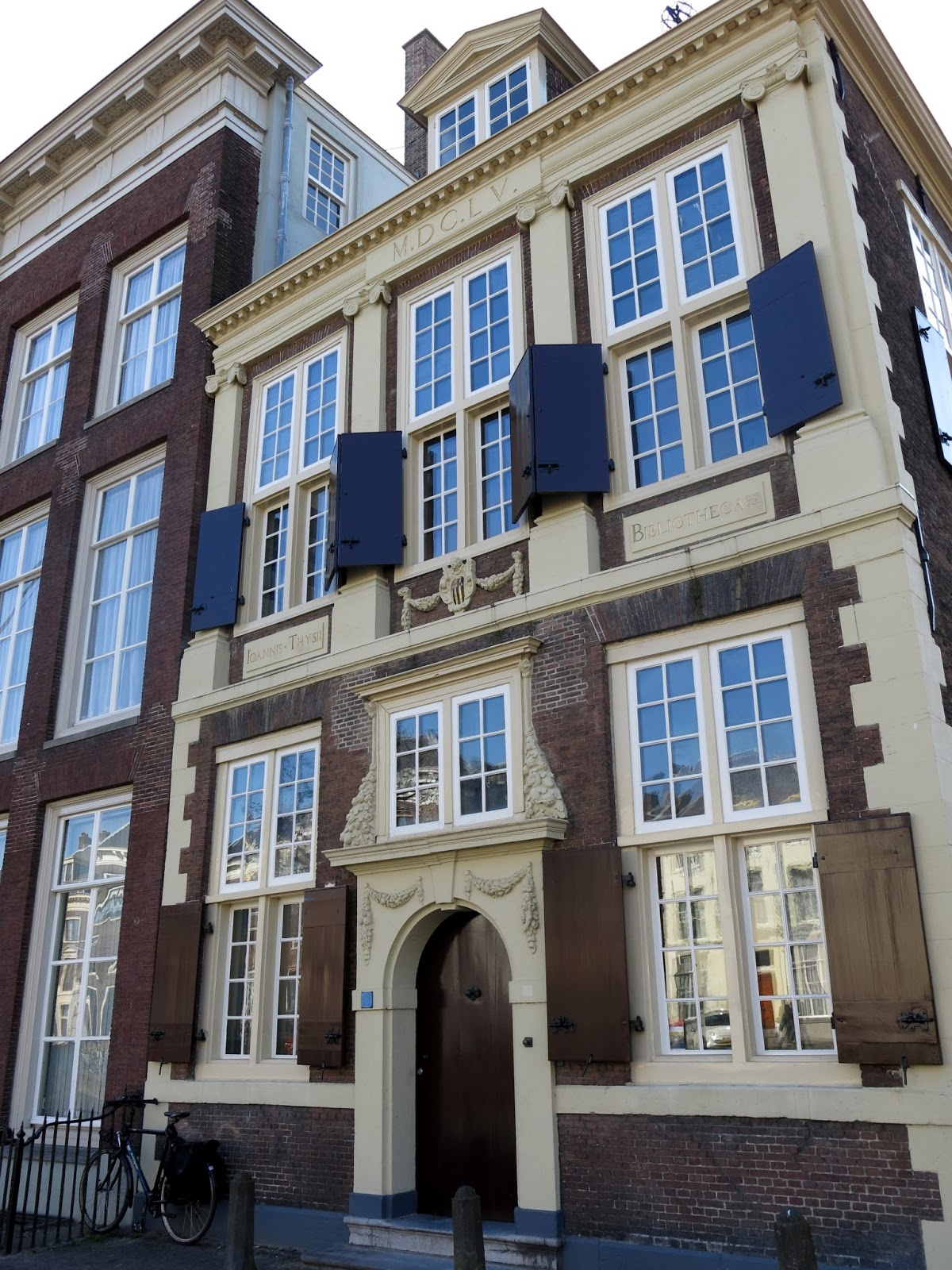
Bibliotheca Thysiana
For in the afternoon I attended a concert in Leiden. Young musicians often can't afford a good instrument, so there is a charity, which lends excellent instruments, mainly string instruments, to young and promising musicians. This weekend that charity, the NMF (Dutch Musical Instruments Fund) had organised some 100 concerts in historic buildings all over Holland. Most buildings are not usually open to the public, and indeed well worth seeing. The concert was given by two young female violinists, in the Bibliotheca Thysiana in Leiden. It is an amazing building with a very interesting history. 


 The books are behind railings and only accessible to the librarian. He will find the required book(s) and put them on the large reading table opposite the stairs which open up in the middle of the library.
This isn't an entrance door, but a locked bookcase in which private family documents were kept. Or probably rare books. The family coat of arms is painted over the doors. It is the only ornament in an otherwise quite simple room.
Johannes Thysius (which in fact was Jan Thijs), a rich man, collected all the books in this library and stipulated in his will that after his death they should be kept together for the benefit of anyone who wanted to consult and study them. The library contains many rare books and is very important for the history of science in the 17th century. All the disciplines are represented: music, the arts, history, geography, mathematics, you name it and it is there. It was very comprehensive at the time. Johannes Thysius died young, just 32 years old, and left money to have this house built for his library. The library itself is on the first floor, the ground floor has living quarters for a curator and his family. The library walls are lined with rows and rows of books bound in white vellum and brown leather. Nowadays the collection is integrated in the catalogue of Leyden University Library. The library Thysiana is no longer physically open to the public because of the absence of a caretaker or librarian, but books can be consulted in the University library. It is both awesome to see these rows of books, and at the same time frustrating not to be able to browse through them. But after the concert the curate, a professor of Book History, gave us an introduction to the house and the library and showed us some of its treasures, a pleasant and  unexpected bonus.
 A view down the staircase
 Awaiting their turn
One of the rare books
The concert itself, or rather a recital by two violin players, was very intimate. An audience of 14 or 16 is all the library can accommodate, which made it a very enjoyable experience indeed, almost a private performance. One of the musicians told us something about every piece they were going to perform and that added to our enjoyment. Instead of the one hour concert we were given a two hour event, including a tour of the library. 
We were shown a fat vellum bound manuscript and told that this library is in fact world famous, because this particular tome contains the largest collection of lute music known at that time. The owner copied any piece of lute music he heard or came across. A facsimile copy was produced several years ago so that it is now available to a larger group of interested musicians. 

Followers

Blog Archive