Monday, 1 July 2013

Day 4, Montréal, Fontenay, Morvan

Fontenay
The plan today is to explore some places around Vezelay, and perhaps drive through the Morvan.
Via Avellon we go east. We pass a castle which like so many is privately owned and not open to the public, and stop in Montréal, the charming walled town where we admire the beautifully carved choir stalls which I talked about in a recent post.
Then on to Montbard, which is rather disappointing. It looks seedy and dilapidated, probably because everything is closed at this time of the day, and the railway station doesn't make things any better. We climb the steep streets of the town, but not as far as the church. We go back to the entrance road and drink coffee in a very unpleasant cafe. When we leave the town, we come across a nice bakery along the main road which is open all day, and there we buy provisions. Soon we turn off the main road towards Fontenay, a former abbey in wooded grounds, built along a stream. Before we reach the abbey, we enjoy our picnic in the sun along this quiet road.
 The nave of te abbey church taken from the netrance doors
 Virgin and child, 13th century
 Detail of the stone altarpiece, 13th century
From the choir towards the main entrance
Fontenay to me is a revelation. Monks did know to find the most rural and picturesque places for their abbeys. Like Fountains Abbey, it is built along a stream, vital for survival. I presume that unlike Fountains Abbey in Yorkshire, the climate was a lot better here and therefore life easier and the buildings less damp. Although empty now, I can very well imagine the monks living and working here, praying in the church, copying manuscripts in the vaulted long room.  
The monks' room where the scribes worked
Even their sleeping quarters were far more convenient than the ones in Fountains Abbey,. Here the dormitory was on the first floor, over the big ovens with openings guiding the heat from below into their sleeping quarters.
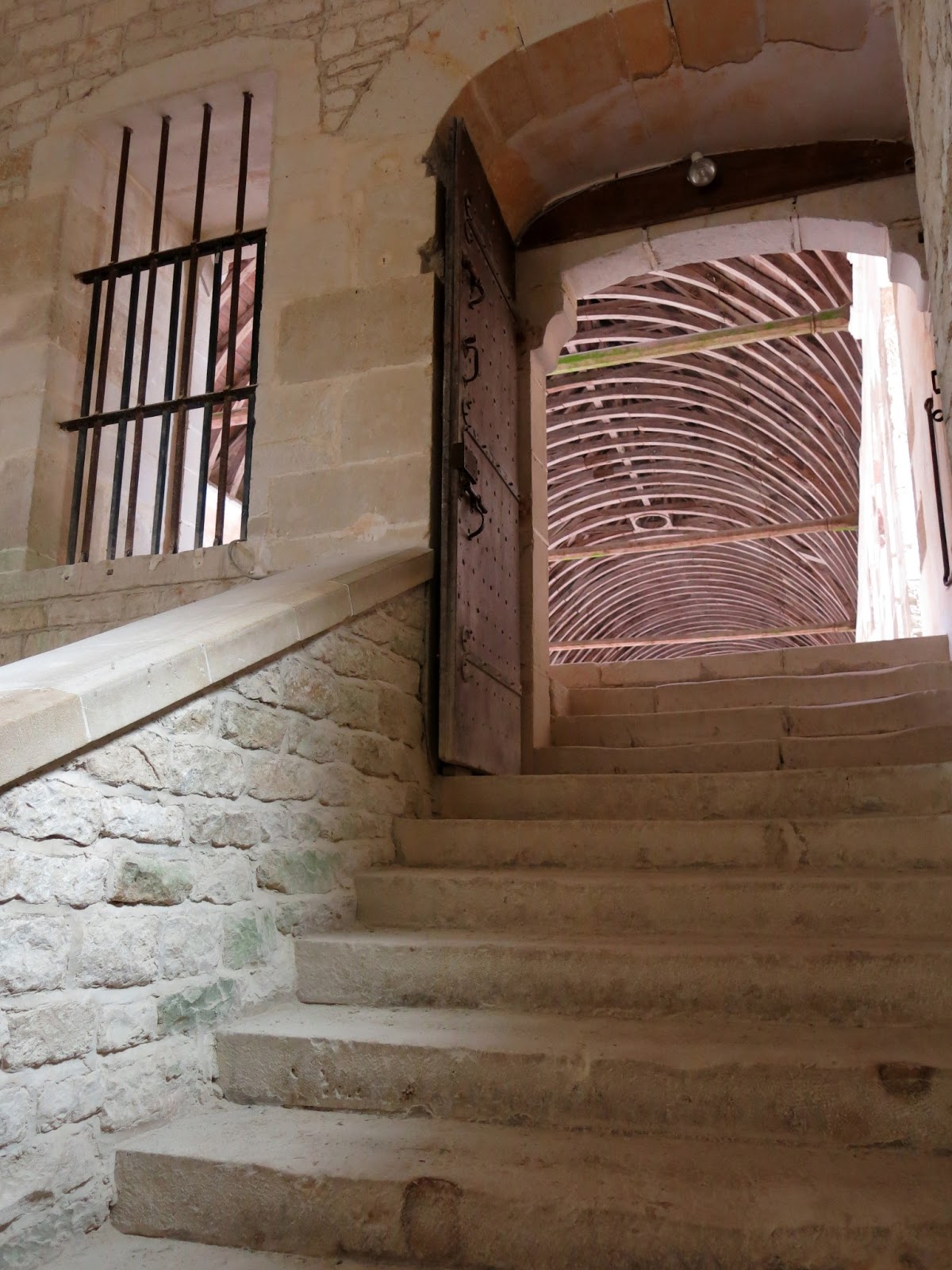
  The stairs to the dormitory, and the wooden roof of the dormitory

In Fountains Abbey the monks slept on the ground floor, which might have been very damp given the climate and the stream next to the abbey. The church is big, and apart from the altarpiece and a statue of Mary and child, empty. From the church one reaches the living quarters of the monks.

The monks' room and the cloisters are very intimate. The monks' room, the place for the scribes, wasn't heated but next to the big kitchen fires, so perhaps not as cold as other parts of the abbey buildings. The church seems very big, but in fact isn't. It is stark and simple, without decorations. Its emptiness makes it look bigger than it is. It was all part of the Cistercian philosophy. Here no intricately chiselled pillars as they would distract. Only light was important, as God is light.

 The forge. Through the door the watermill is just visible

A bit away from the main buildings is a forge with a huge hammer which was driven by a watermill. Working with metal – metallurgy - is still an industry in this part of Burgundy, especially in Montbard.
 The abbey is surrounded by nice gardens.

After the French Revolution, the abbey was used as a paper mill. Perhaps that is why the place has been saved from destruction.
It is hard to leave this peaceful place, but we do and go for a short tour through the Morvan, looking for a rather modern abbey which is still in use and hidden in the depths of the forests. Before we enter the park, we skirt Semur-en-Auxios and are pleasantly surprised by this medieval town. The view from the bridge is great with the historic church and the ramparts high above the river standing out against the sky. We have no time to explore the town, unfortunately, so I promise myself to go back one day soon.
 Semur-en-Auxios


It takes some time to find the 'Abbaye de la Pierre-qui-Vire', hidden in a maze of wooded, winding country lanes, but in the end we do. The buildings are new and modern, but the few monks we see old! We drive on to St.Léger-Vauban, high on an open plateau, where Vauban (1633-1707, Marshal of France and military engineer) was born. A big statue of Vauban adorns the triangular common. 
 Tour d'Horloge, and a shop in the main street of the historic part of Avallon

From here we drive back to Avallon, and enjoy a pizza in a very nice and friendly restaurant next to the Tour d'Horloge, in the historic part of the town, and decide that this is certainly an area worth coming back to to explore more historic towns and places.

Saturday, 29 June 2013

Part 3, Auxerre-Vezelay

Venoy (Auxerre)-(Vezelay) Pontaubert
After a wet night the weather is sunny again and beautiful. We have breakfast in the main building of the hotel and go on our way. It would be very tempting to stay here a bit longer and explore the area, but we have to move on. We skirt Auxerre, perhaps not very wise as it seems to be a charming town with a lot of history and a very old centre. The St. Etienne is one of the most important gothic cathedrals of Burgundy and the Abbeye de St. Germain in roman-gothic style houses in its crypt the oldest murals in France, dating back to the 9th century. So I have to go back some time. But as our goal is Vezelay, we move on and follow the attractive banks of the river Yonne.
 Cravant
 Cravant
Gate of the town - Cravant
We stop in Cravant, a gem of a walled town where the river Cure joins the Yonne. Here we walk around, buy sandwiches in a baker's shop which we eat in the park around the church. The town is built up against the hills and has all the ingredients of historic towns in this part of France: town gates, a lime tree walk, a big church, a covered wash house where the women could do the laundry, a "Tour de Horloge" higher up in the town, a Mairie facing a square, a covered market place, flowers decorating walls of golden stone, big doors and shutters with pastel coloured peeling paint. It is a delight to wander around. But we have to go on.
 Wash place
 Picturesque Cravant


We turn off the road to explore an old abbey in the meadows down by the river, but are disappointed as it turns out to be privately owned now and has a restaurant where people seem to enjoy either lunch in their Sunday best or are having a party. The rest of the buildings is closed to the public, including the former chapel. At least the buildings are still there.
 Asquins
 View of Vezelay Abbey from Asquins
 Coquille de St. Jacques
Murals in the sacristy - Asquins
Just before Vezelay we see a small village church in Asquins, high on a hill. We drive up through the narrow streets to get a better look at it. From here we have a splendid view of Vezelay and the Abbey. The church, built in this high position, seems a modest village church. An old lady sitting quietly in the back tells us that in fact the pilgrimage to Compostella starts from this church and not from Vezelay Abbey. There are two statues of St. Jacques, and a brass shell outside guides the pilgrims on their way. It is a very interesting church, with murals on the walls. The woman opens the door of the sacristy for us en shows us some more murals. In fact the church is a very peaceful place, a place where it would be easy to pray, or to be blessed before being sent on a mission. It is simple, humble in a way, which is far more fitting for the life of a pilgrim than the big cathedrals. They may fill one with awe, but they are not on a human scale. Too grand for simple human beings, however beautiful they may be. When we walk back we notice that one of the picturesque houses with a view of the church is for rent as a holiday home. Not a bad place to stay!
 St. Jacques
 Asquins - side door of the church
And then it is only a short drive to Vezelay, down the village, through the valley up towards the town. Destination reached, the satnav would say. And indeed we have reached what we set out to reach, Vezelay. We park the car, walk up through the main street to the Abbey and I have my first look of a church I have heard so much about. The tympanum is amazing, the one outside as well as the one inside in the hall before entering the nave of the church. We spend quite a lot of time here. The abbey is wonderful with its black and white blocked roman arches, the architraves and the tympanums chiselled in great detail, the light fascinating. The choir is gothic, in contrast to the nave. It is amazing that people have been able as well as willing to build such cathedrals, for this is a splendid example, but still one of many others, scattered over western Europe.
We also walk around the abbey, admiring the views from this high point, and spot the small church in Asquins we just visited, also on a hill but a much lower one appropriate to its size. 
 Vezelay


 View of the church at Asquins from Vezelay
Finally it is time to make our way to our hotel for the coming two nights, in Pontaubert on the road from Vezelay to Avallon, the latter another historic town where we have a meal.


 Avallon, church entrance
 Ramparts of Avallon high above the river Cousin 

Try-out for a pilgrimage, part two

Bouillon - Auxerre

 One of the gates of the castle of Bouillon
 View from the castle 

Our second day begins warm and sunny. The sun is on the right side of the castle for us, so we have a much better view of it than the day before. It is still very quiet when we walk along the river to find a place for breakfast. To my surprise most café's are closed. I had expected all of France to be like Paris, people having a coffee and a croissant for breakfast on one of the many sidewalk café's before going to work. But they are closed, and waiters are busy cleaning tables and organising chairs. We can only get breakfast in the few hotels. After that we walk around, than go up to the castle by car and decide on the spur of the moment to go in and join the other tourists. Here too it is still quiet at this early hour. The castle is most impressive, large, but apparently not much is left of the oldest, most original part. The main bulk of the castle was added later. It offers splendid views over the river on both sides, as the ridge it is built on is very narrow. A strategic point indeed. We watch part of the falcon show, but then leave Bouillon, as it is late already and we have to get to Auxerre on time.

Once we have passed Sedan, we take minor roads. The land is wide and undulating, villages sheltering in the folds of the hills, church spires revealing where they are situated. We see many old churches, for apparently we follow a touristic route, a woodland, abbey and historic churches route. And a most enjoyable route it is. Nobody seems awake in those villages, but most churches and public places are decorated with bright red pelargoniums in tubs. So somebody must be busy tending them. Also we see porcelain blue irises everywhere, which contrast beautifully with the pale golden stone of the walls.
 The church of Cheveuges and the neighbouring farm with irises
 below: Chehery
 Characteristic small towns with the market place covered by a red-tiled roof on wooden pillars, historic churches with roman windows, covered places along rivers and rivulets where the women used to do their laundry, it is all there. As well as the remains of old abbeys. 
 Chemery, church and market hall
 Chemery
 We drive to one, via a narrow country lane off the main road, situated in beautiful fields full of wild flowers  surrounded by shady woodland. Chartreuse is now privately owned, the owners aiming to restore it as well as possible to its former glory. It must have been very large when still used as an abbey, and the position is idyllic.
Chartreuse 
  
We buy provisions in Vouziers, a rather bigger town with many shops and a large and hot square in front of the Mairie. We enjoy the sandwiches with thick cut ham and the cherries just outside Vouziers, with a view of the land. We struggle through Chalons-en- Champagne, a bigger town than we expected, and then emerge on wide plains which seem rather boring. Most of it is farmland. We travel south. In contrast to Holland we hardly see any church spires or towers on the horizon. This land, the area of the Marne, has seen fierce and awful battles during the first world war. On the highest point there is a large monument, an Ossuarium, sitting squarely on a flat plateau overlooking the former battlefields. The soil around it is rutted, as if it still bears the scars of the trenches. A large part of the land is still used by the army and forbidden territory. The soil seems rather white and stony. This Monument, the Ossuary of Navarin,  contains the bones of thousands of unknown soldiers. And it is juts one of many osuaries and graveyards. It seems such an awful waste, the waste of young lives, of the futures of so many, and for what? We are not so far from Verdun. It is a very sad place and not one where I would like to stay for long.

In Arcis-sur-Aube, a pleasant and charming town on the river Aube, we stop for a stroll and a drink in a café opposite an imposing church. 
Arcis-sur-Aube
Fortified we take the circular road round Troyes and continue towards Auxerre. Just outside Auxerre we find our destination, a converted watermill, now a hotel and restaurant. Our satnav guides us along tiny and narrow winding country lanes to this place in its rural setting, avoiding Auxerre. After a long travelling day we can't resist the nice restaurant, apparently well-known. Not cheap, but in fact we have no choice as it is late and there is no other restaurant within our reach. So we enjoy the evening as well as the nice accommodation.


Tuesday, 25 June 2013

Try-out for a pilgrimage

I went on a short trip to France as a try-out for a pilgrimage. Not mine, but some friend's future pilgrimage. I know England far better than France, and Burgundy was new to me. Strange, because it is not so far away and there is no ferry involved. Travelling via Namur the trip became interesting after we had left the town and followed the river Meuse to Dinant. 
Overgrown gravestone of an unknown family in the churchyard of Dave, a small village on the banks of the river
Dinant itself was rather busy, perhaps due to a saxephone festival which made the town colourful as you can see in the picture. 
Colourful saxs on the bridge in Dinant
Besides Dinant is a narrow town, clinging to the banks of the river Meuse. From there we took country roads and avoided the main roads as much as possible. That made the trip far more interesting as we happened on small towns, interesting villages with old churches and picturesque markets covered by red tiled roofs, remains of former abbeys and little streams. The aim was to end up in Bouillon, this first day on the road, just on the border of France. It is an interesting town, with Godfrey de Bouillon's castle high on a rock overlooking the town and a crucial loop in the river. 
 A street in Bouillon in the evening light
It was a balmy evening, swallows and martins flying low overhead, making those high pitched squeaks. The canoes on the slow flowing river, the smell of mown grass and hay, the outdoor cafes where people enjoyed their meals now that for once the sun was out, it was all a joy. It is a bonus to travel with a friend who is so well versed in history, especially the history of this part of France and Belgium. A promising day, except for our rather shabby quarters for the night. But then hotels and B&B's if not booked in advance are rather hit and miss. There were better ones to come.
Bouillon: An ancient bridge in the late evening on the other side of the castle

Followers

Blog Archive