Wednesday, 4 December 2013

Assen and the Dead Sea Scrolls

In between all the singing, concerts and Advent services I took the train to Assen in Drenthe to see an exhibition of and about the Dead Sea Scrolls. It was a cold morning, with a freezing fog, which gradually dissolved into a slight haze, the sun trying hard to break through. At first the fields and rooftops of the houses we passed, were covered with a fine layer of hoar frost, which gave everything a wintery but also festive appearance. At this time of year the sun throws long and elongated shadows across the land, like caricatures. This morning the shadows of poplars and willows lining the many ditches and separate fields were not black or dark as usual, but white silhouettes painted on the green fields which had already been warmed by the sun.  It looked very peaceful and Christmassy.
Nowadays there is a direct train connection to Assen, which took me there in just under 2.5 hours. The train traverses the Flevopolder which is littered with rows and rows of modern windmills, today standing motionless, their three wings waiting in vain for a slight breeze. There was no wind whatsoever all day long, so the only thing those mills achieved was ruining the view and spoiling the landscape. With their extended arms they looked like a corps de ballet, frozen in the same position waiting for the music to begin.
In another part of the Flevopolder, a large piece of land reclaimed from the former Zuiderzee, it was clear that the man-made nature reserve, the Oostvaardersplassen,  is vastly overpopulated. Trying to warm themselves in the early morning sun were large herds of horses and deer, and not just one or two herds, but quite a lot in a very bare landscape. It could have been Russia or the prairies we were passing through, except for the temperature. Why we ever introduced them there, I don’t understand. It was meant to be a bird sanctuary. And now those animals are protected and there are just far too many. The land can’t feed them all, and they have killed off the trees looking for food. It looked as if a battle had taken place, like the woods near our house when I was a child. During the war all the trees had been used for fuel, and the former woods were a total wilderness. But fortunately they were replanted and they aren’t vandalised by herds of animals which surely never lived at this former bottom of the sea.
The former chapel of the nuns which is now part of the Museum 
In Assen it was cold, just above zero, but the bright sunshine made the centre look very attractive. The Museum is housed in a former nunnery, which since long has had various functions. The interior is worth a visit. This was the first time that I used the entrance of the newly built and very modern extension, partly hidden underground with an amazing garden on top forming steep hills. The main expositions are now in this modern extension. This time a few pages or scraps of the Dead Sea Scrolls were on view. I admire the way the (art) historians and other experts had managed to make this a very interesting exhibition. There was a lot of information about the history of the Middle East and of Palestine and Qumran where the scrolls were found in the 20th century, everything so intricately linked to the history of the Jewish people. Nowadays exhibitions can be extremely interesting with the use of modern techniques: video’s on the main walls, re-enactments of battles, a clear timeline and information about all the peoples and rulers who had lived in and/or conquered that corner of the world. It was too much to take in in one visit, so for once I made an exception to my own imposed rule and bought the catalogue. The texts on the scraps of parchment, papyrus and leather were translated into Dutch and English. It is amazing to me that scholars have been able to decipher those remnants of scrolls, and pieced them together.
The three religions which all recognise Abraham as their forefather, were also represented: the Jewish faith, the Islam and Christianity. Texts which are similar in the Holy books of those three religions were quoted and juxtaposed. And there were interviews – on video – with modern believers of each of those three religions, all of them women representing three different stages in life. They explained what their faith meant to them in their daily lives.
There was another room where the techniques of writing were explained, of making vellum and parchment and papyrus, and even of making a copper scroll! Amazing that some of the texts on the pieces of scroll were still so clear that it seemed they were written only yesterday. Other letters had almost completely faded, apparently depending mainly on the type of ink used.
 The beautifully decorated entrance hall of the old part of the museum
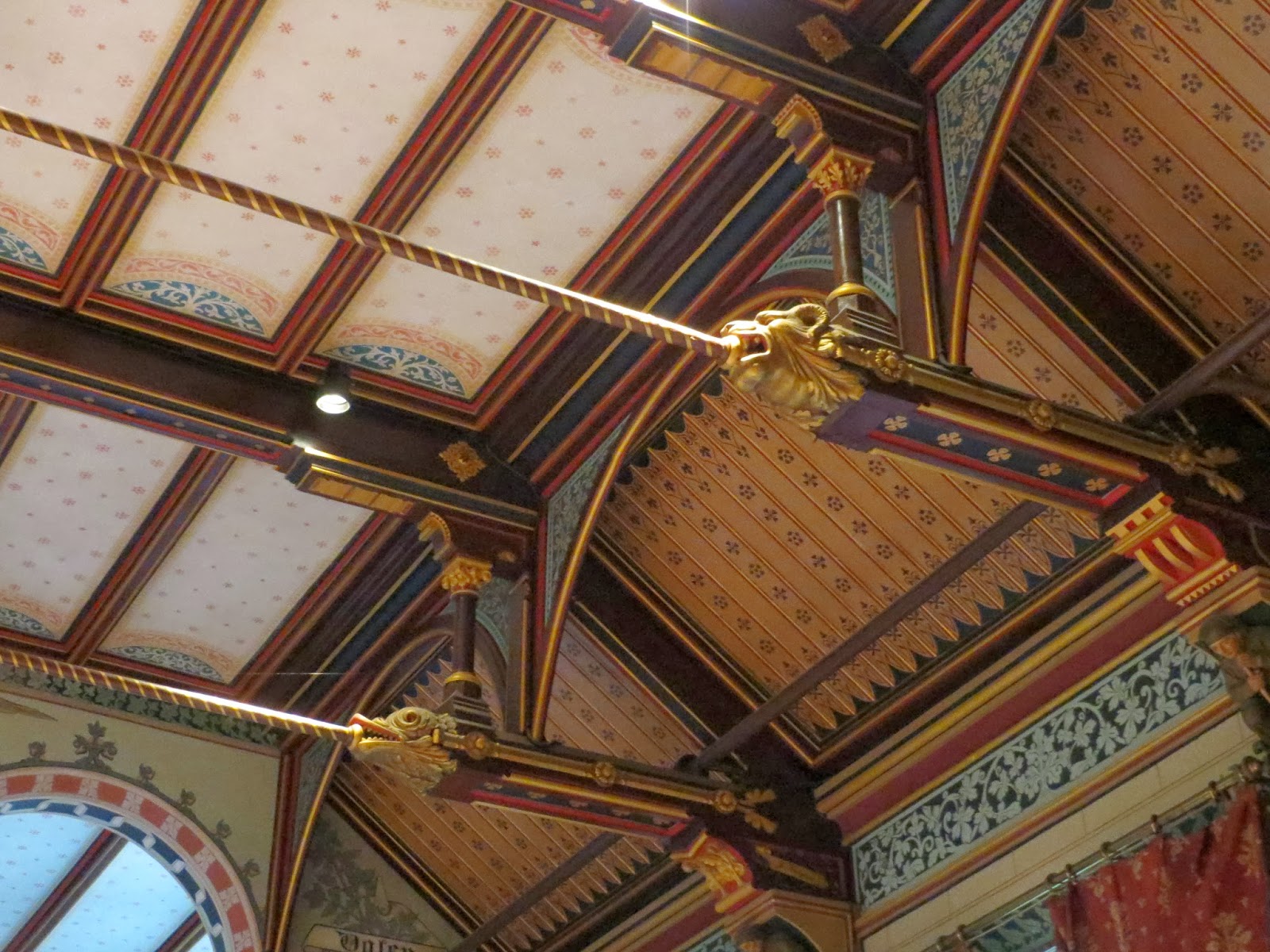
 
A hall in the museum which was once used by the governors of Drenthe
Assen’s town centre was buzzing as people were shopping for December 5th, St. Nicolas, the traditional day in Holland for giving presents. But after the sun set colouring the sky a deep red, it quickly grew dark and cold, so time to take the train back home.

Talking about meetings. Here too, and not only when travelling abroad, I had an interesting meeting. Two women whom I thought were about my age were sitting in the same compartment. During their conversation it became clear that they had both been students at Leiden University, the woman opposite having read the same subject as I had! She was also a member of one of the choirs of my organist friend and former organ teacher, wrote children’s stories which she said might be too naive for this day and age and modern children, and she hated golf! There was a rapport, although she thought I was at least 10 years younger than she was. Which wasn’t the case. Sometimes it is nice to be flattered. Time passes quickly when meeting interesting people. And so we were back at our destination before realising it. A day well-spent, topped up by “The Painted Veil”, for once a very interesting film on the TV. 

Monday, 2 December 2013

The first Sunday of Advent

The first Sunday of Advent, always a Sunday full of joy and expectation. I lit the first candle on my Advent wreath, bought at the Christmas Fair yesterday in our church. A Fair full of interesting things, crafts of a very high standard, homemade cakes and everything with cranberry: cranberry chutneys, cranberry jelly, cranberry granola etc. All beautifully packed in cute glass jars, very festive indeed. I couldn’t stay long for I had the privilege to be invited to sing at a very special service in The Hague of the Order of St. Lazarus. Which was a joy and a unique experience indeed. An investiture service, which was most interesting.

The Advent Procession with Lessons and Carols was inspiring and meaningful, as every year. I am a guest singer in that particular choir, so always a bit nervous as I do not attend the rehearsals on a regular basis.  But it is great to be included in this worship, even although I do not like processing into a dark church with a lit candle. There is the possibility of setting someone’s hair on fire or a choir robe, mundane thoughts during an Advent Carol Service. Once that part it over, I can give all of my attention to the music and the meaning of it all, the promise of the Christ child, a mystery.
Year after year we sing the same Introit, the Matin Responsory by Palestrina. And every time it moves me again. Standing at the back of the darkened church, hearing the cantor sing

 I look from afar and lo, I see the power of God coming, and a cloud covering the whole earth. Go ye out to meet Him and say

and the choir answering:

Tell us, art Thou he that should come to reign over Thy people Israel, ...

sends shivers down my spine. It has a beauty which is in such contrast with what we see around us at this time of year, materialism. As if Christmas is just a time for luxury, for presents, expensive and exotic food and party clothes. No, Christmas, the birth of this child, is a mystery, and it inspires us with hope. It gives meaning to our existence, and radiance.  That is particularly comforting at this dark time of year, when the nights are a lot longer than the hours of daylight. And so we light candles, to lighten not only our houses, but also to warm our hearts.
The Vesper Responsory almost at the end of the service never fails to move me either, both with its beautiful chant and its words:

Cantor:        Judah and Jerusalem, fear not, nor be dismayed
Choir:          Tomorrow go ye forth, and the Lord, He will be with you
Cantor:        Stand still and ye will see the salvation of the Lord

Here is our contribution to the service:

-Matin Responsory , followed by Come Thou Redeemer...
- Advent wreath prayer  
- O come, o come Emmanuel
- Advent Prose
- Remember, O Thou Man
Hymn NEH 15
- How lovely are the messengers  (Mendelssohn)
Hymn NEH 12
- There is no rose (Near)
Hymn NEH 7
- The Angel Gabriel
- Ave Maria - Archer
Hymn NEH 10
- Lo! He comes
- Creator of the stars of Night  
- Vesper Responsory
Hymn NEH 30 – O Come all ye faithful


Tuesday, 12 November 2013

Remembrance Day


They shall grow not old, as we that are left grow old:
Age shall not weary them, nor the years condemn.
At the going down of the sun and in the morning,
We will remember them.

Remembrance Day and Remembrance Sunday.
Although yesterday in church we remembered the many men who died in the first and second World War, today it is really Remembrance Day, November 11th.
In the small churchyard in our village there are just 17 war graves, of both Canadians, British soldiers and a Dutchman, a pilot, who had joined the RAF. Most of them were killed when their aircraft was shot down near the spot where they now lie buried. Although in the Netherlands we remember the dead on May 4th, I am very glad that we also have a special ceremony in this 14th century church and the surrounding churchyard near the graves of those young men. For young they were. For me it is always a very moving ceremony. The church organ is invariably played by the former mayor of this village, an amateur, whose performance touches me. A professional organist and choir master whom I know quite well, has written a special choral piece for the choir in this village to be sung on this occasion. They are getting better at it. The last post, flowers on the graves, and a salute by the veterans, fewer of those every year. It is emotional to see those veterans, who once were war heroes themselves and young. But they survived, unlike the young men buried here. They have grown old, and are leaning on canes, supported by friends or a family member, or sitting in a wheelchair or on a scooter. We do not recognize those heroes from times past. There is no glory for them. They have escaped the fate of those unfortunate pilots and fighters, but they have grown old, and age has indeed wearied them.
We put white flowers on the graves, and in the silence think of those and of all the others, of their sacrifice, the ultimate sacrifice.
It is also an emotional day for a private reason. My husband joined the RAF after the war, to work as an interpreter in Germany at the war tribunals. He interpreted from German into English and the other way round. Clever for one who had not been able to finish his highschool during the last two years of the war. Like many others in his position, he was given his diploma anyway. As he had listened in secret to the BBC during those war years, his English was quite good. And he must have had an ear for languages. Instead of having to go to Indonesia as a soldier, he served three years with the RAF in Germany. I found his RAF uniform and other paraphernalia in a wooden chest in the attic after his death, with lots of pictures of him in his uniform, a dashing figure driving an open jeep and riding a horse. He made many friends during his years of service, Irish, and British, whom he kept in contact with through the rest of his life. He would always, without exception, go to the Remembrance ceremony in this village. If I did not have to go to work, I would join him. The last time we went together, he was already very sick and drove his scooter into the church, which has a rather narrow passageway. He could no longer walk, nor drive a car as he had lost the use of his legs. Undaunted he just pushed on. I was very embarrassed when he couldn’t turn round in the church after the ceremony, and tried to manoeuvre this scooter backwards which was a disaster. Anyway, we got out. Before we went home he decided that he would chose the plot where he wanted to be laid to rest. There were a few empty plots available, and he sent me to find the caretaker so that he could make enquiries and if possible reserve a spot. An unusual request, as it could only be reserved after buying the rights to that plot. But my husband promised that he would pay on the first day of the new year, if he would still be among the living at that time, which he was determined to be. Tax wise it was more profitable to pay in the new year. The caretaker was a bit taken aback, but agreed and said he would reserve that plot for my husband. Around Christmas the caretaker phoned me and asked if the deal was still on, which I confirmed. But he did not have to wait till the new year. My husband died exactly on the last day of that same year. When I phoned the caretaker to tell him we needed that plot, he was upset and asked if my husband had deliberately died that day. A strange question, which shocked me. I paid in the new year!
Since that time I always go to this ceremony, to represent my husband who is no longer with us, and because my life too was saved by the Allies, the British and the Canadians. We - and I - owe them our freedom.
Today, Poppy Day, I stopped at this other grave, my husband’s. No poppies here, just brown and wet autumn leaves covering the grave and the name of his son who joined his father just two years later. My husband resting not far from those RAF members, no war hero but in a way strongly connected with the RAF which he had served as well as he could. And I was proud of him, of his fighting spirit, and sad because of all those things we could no longer share: the beauty of the changing seasons, the pleasures of exploring new countries, of travelling together. But thankful he had lived his life to the full, unlike those men we remembered today.

Saturday, 2 November 2013

November 2nd, All Souls' Day

The day to remember the dead, those who have gone before us.
Today they remembered Prince Friso, the Dutch prince who died this summer after an accident 1,5 years earlier which left him in a coma. His funeral in August was a very quiet, private affair. But on this day the historic church in Delft where he also got married was packed with his friends, business friends and family. The beginning and the end of his married life in the same church, in the town where he went to university and where he lived for a few years. A perfect circle, although it feels that his death was terribly untimely, leaving a young family behind.
This evening I attended a special Requiem concert, in the church where my late husband and I were married. Although his remembrance service didn't take place in this church, he was buried in the small churchyard surrounding this 14th century church, a church founded by Willibrord who landed in Katwijk, a fishing village on the North Sea coast, and walked along what used to be a branch of the river Rhine to our village where a church was built. That branch is now a canal. It is a historic spot, a place where generations have worshipped, had their new-born baptised, asked for a blessing on their marriage and buried their dead. (Interestingly this church which officially is called the Willibrord Church, is known as the Green Church due to the fact that at one time it was totally covered by ivy which has since been removed.)
This afternoon I removed the dead and soggy autumn leaves from my late husband's grave, a grave shared by his oldest son, so that their names were clearly visible again. It started raining, rain which only lasted as long as it took me to finish the job. In Italy relatives picnic on the graves of their dead on this particular day, but the weather here usually isn't appropriate for al fresco dining.

 Peter Sculthorpe, Requiem for Cello
The Requiem concert this evening was special. And very modern.
A Requiem for cello by Peter Sculthorpe was the framework, filled in by various pieces of requiem music, both old and modern. The cello parts were extremely difficult, and often very moving, but I did not know the piece and I think it takes time to appreciate Sculthorpe's  music, and to familiarise oneself with his compositions.

 Howells Requiem 2
The choir sang parts of Herbert Howells Requiem, as well as Versa est in luctum by Alonso Lobo, a 16th century composer, followed by a very modern Miserere by Rudi Tas (*1957-), this last composition together with the cello.

Rudi Tas
The men sang a Gregorian lament, Libera me Domine, standing in a circle.
In spite of all this beautiful and clever music, I felt the strong urge to listen to some more traditional Requiem Masses, preferring Fauré and Dvorak. It is brave that this small choir dares to tackle this difficult and modern repertoire. But personally I found it hard to get into the mood of the evening, as I had to concentrate so much to understand the modern compositions.
It rained when I left the church. Symbolic for our tears, the tears we shed for the departed? If beloved relatives died years ago, is it really for them that we cry, or is it the awareness of our own mortality, of the near futility of our lives, the unimportance of our daily worries and struggles? We will be forgotten and who will remember us? But then there is the ethereal Lux Aeterna, the eternal light, which passes all understanding.
 Alonso Lobo, Versa est in Luctum


Monday, 21 October 2013

The Dutch Store, another meeting

I met him in the Dutch Store, which he founded when he came to Canada. It is a remarkable store, just an unattractive low building from the outside. It could be anything, a garage, a shed. Inside I find a Dutch world in miniature. In this part of Winnipeg where many Dutch immigrants live as well as Germans and Mennonites, this store is quite popular. To my surprise I see Dutch brands, "Bolletje beschuit", "ontbijtkoek", Dutch cheeses, and not only Gouda cheese which is exported to many countries, but also Dutch farm cheese, which is much nicer as far as taste and quality are concerned. There are chocolate letters which are given in December at St. Nicholas, unique for Holland, there are Delft blue products, tea towels, cheese slicers, Dutch coffee and cacao which is unsweetened, and much more.  The owner, Marten Posthumus, a Frisian from the Northern provinces of the Netherlands, has retired and his son, a true Canadian born in this country, has taken over the shop. I would like to meet his father, who has written a book about his youth in Friesland, as son of a poor labourer’s family. He has illustrated this with his own pen drawings, and that is the reason why I would like to meet him. I wonder if there are any similarities with my own father, who has also written a book about his youth as the son of a poor fisherman, an autobiography which he embellished with his own drawings and watercolours.
 pictures of a ghost town
 An abandoned old timer
The former general store
In the shop there is a marvellous book on display, the latest one by Marten Posthumus, a fat tome with drawings of ghost towns, barns, grain elevators and small towns in Manitoba and Saskatchewan, drawings of a past life that is quickly disappearing. In these black and white pen drawings he has captured this past, abandoned homesteads as in spite of hard labour the land did not yield enough to make a living. 
Badlands; Big Muddy River
I have just travelled with dear friends through this part of Saskatchewan and Manitoba, through the Badlands (556) and the wide open grasslands, where the winds blow freely across the treeless prairies. A land which seems too barren and wild to cultivate. A land with its own beauty of undulating grass in an ever changing pattern of pastel colours, with grasses turning orange in autumn.  When the sun slants through the grasslands, they look like burnished gold. In some places there is arable land, with ripe corn rippling in the wind.
Badlands
 Big Muddy River
 orange grasses and ranchland

Some of the old grain elevators are still in use, others abandoned like so many other buildings, the paint peeling, the place names fading. With the dismantling and disappearance of those old grain elevators, the small towns have vanished, the elevators being the heart of the towns, the reason for their existence. Grain is now stored in modern, much bigger and uglier elevators, and everything is done on a grander scale, so the towns are dying.
The book which is on display captures the sadness of lost dreams, mourning and honouring a vanishing past. It pays homage to the hardship of the settlers who tried to cultivate this land under difficult circumstances, battling with the forces of nature, the climate, the land, the barren winters and the heat and drought of summer, the wild animals. As everything was built of wood, in 50 years time there will be no trace left of those villages, as if they never were.

 Some old grain elevators
 an empty land

Part of the Dutch store has small tables and chairs and serves as a coffee shop and lunchroom. Apart from typically Dutch food, such as “kroketten” one can also buy soup, a BLT or a Rueben sandwich, which is American: pastrami and sauerkraut on bread. To my surprise the former owner of the shop, the author of the book on display, enters the shop. I am told he comes to the shop every day to meet people he has known for as long as his shop exists. We start talking and there is an immediate rapport. Posthumus reminds me so much of my father. He was widowed a few years ago but has this attitude which I recognize, thankfulness for every new day, a love of the natural world and an eye for beauty. He still draws and drives around to forgotten towns and homesteads with his sketchbook to record what he sees before it gets lost forever. Like my father, he admires the hand of the Creator in the wonders of nature. His background is Dutch Reformed, as is mine and my father’s. So there is this feeling of knowing each other, of finding a soul mate, in spite of the differences in age and living conditions. We talk about his book, and he tells me a book about Friesland is going to be published soon. He and his son have just come back from a visit to the Netherlands and Friesland, which he thinks it will be his last. I wonder how this shop will change after his death. His son was born in Canada, is Canadian. So as well as the homesteads, this remnant of a Dutch past, of the history of the Dutch immigrants and their culture, will also die.
I buy his book as a present for my friends, and he signs it for me. When I say goodbye to him, it is as if I say goodbye to my father.

It is one of the more memorable and meaningful meetings during this trip through Canada.

Wednesday, 16 October 2013

The Rocky Mountains from the air, and impressions from Vancouver

This September a dream came true, to cross the Rocky Mountains by train. I had travelled through that area two years earlier with dear friends, and the urge to see it from the train had become stronger than ever. My friends tried to convince me that I would see more from the road than from the train tracks, but I still wanted to experience how people travelled through that area in the 20th century. There are not many passenger trains left, but instead there is the Rocky Mountaineer, a fancy tourist train which is of course more expensive than the usual train which still crosses the Rockies. But the tourist train only rides during the day and drops off its passengers in hotels for the night. So the most exciting and stunning parts of the mountains are seen in daylight.

 Just a view from the porthole window
 Above and below: Confluence of the Thomson and Fraser Rivers


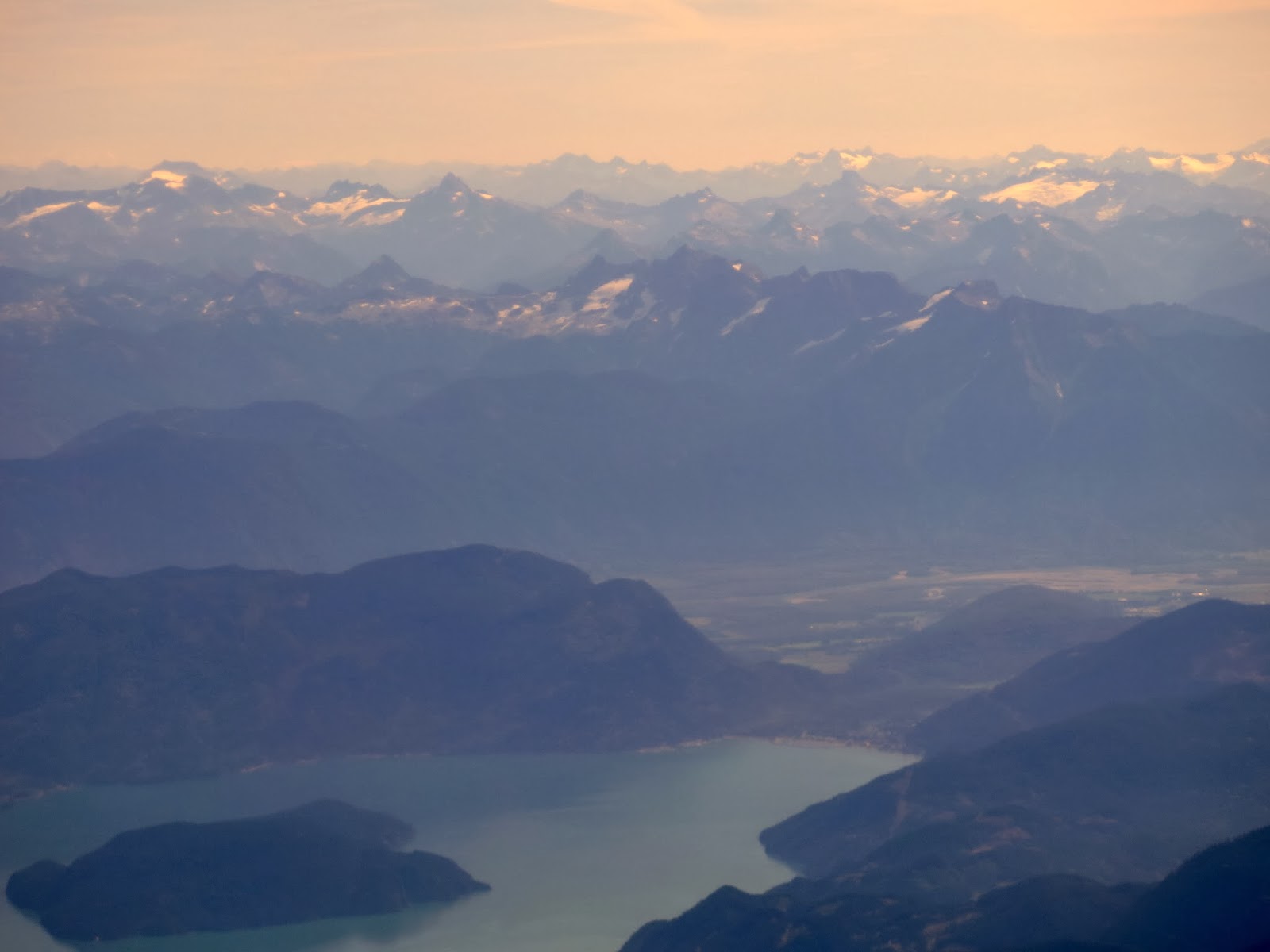
 The Rocky Mountains seen just before landing in Vancouver

I flew to Vancouver, a city I had briefly seen earlier, and after a long flight still had a few hours left to do some sightseeing. Vancouver is beautifully situated on the water. It was a very warm and balmy day and evening, and although sleepwalking I enjoyed the view from the Vancouver lookout Tower and walking along the Waterfront. I had a meal there in an Irish pub cum restaurant, seeing the moon rise on the water like an enormous football. Then it was time to pick up some food before retiring to my luxury hotel, courtesy of the Rocky Mountaineer.
 Downtown Vancouver

 Two different views of the lookout Tower

Two views from the tower

Two views from the Waterfront
The moon rising over the Waterfront
Vancouver seemed like an Asian city, with more people from the Far East than Westerners. Also the majority of schoolchildren and students I saw seemed to be Asian. To my surprise the shops in the downtown area where I stayed carried expensive and exclusive fashion labels. But I was shocked to see so many beggars and homeless people in this seemingly affluent city. It seemed that two extremes exist side by side in this city.

Monday, 14 October 2013

Meeting people

The most valuable aspect of traveling is meeting with people, sometimes in unexpected places. On the long transatlantic flight, during the two day train trip through the Rockies, in remote towns where we were not expected, in Indian reservations, during hikes, everywhere I encountered kind people who shared part of their life stories with me. Countries might stun us with their natural beauty, the vastness of the skies, with awe that settlers have had the courage to try and cultivate very unpromising lands. I can be jealous of their surroundings, their freedom, of the beauty around them. As a mere tourist this might be my first reaction. But when talking to people it is clear that they too suffer from despair, illness, loneliness, autism, family tragedies and poverty like any human being. Beauty is no guarantee for happiness. Glimpsing the different ways people live their lives, may help us to be more content with our own lives. Or give us an impulse to change the way we live, the routine we are used to. Or at least question that routine. And it might make us more compassionate and tolerant.
The house of the spirits
Among the memorable encounters is the meeting with a few Indians in a reservation, one of them claiming he had sired 69 children, which made us wonder if apart from their own language they might have their own arithmetic system.
We were on our way to see an Indian burial ground, the “house of the spirits”. The unusual white roofs low on the ground built over the graves lured us into the village. We knew we had to make our intentions clear if we met any body. At first we did not see them, as they were hidden in the shade of a tree. An old sofa, something which looked like an old car seat, a tree trunk, those made up the outdoor furniture. How many there were I do not really remember. Five or eight maybe, and just one woman among them. They were at leisure, talking, drinking beer, and just passing time. Not till one of them raised his hand in greeting I noticed them. We walked down and asked if we could see the “house of the spirits” and how to get there. They pointed us in the right direction. We had not expected them to follow us, but two of them did. Perhaps they did not trust us, perhaps they just wanted to be guides. Whatever, they told us quite a few stories about the people buried in that graveyard. They all seemed to be related: a twin brother who died at the age of two, a father, a mother, aunts and uncles. It was only a small village, but apparently housed one large family group. We were allowed to take pictures, not so much of them as of the graves which seemed unusual to us. Afterwards we walked back to the big tree where they sat down again and started to tell even more stories. The man who claimed to have 69 children was quite proud of his success in that field. And who wouldn’t, as long as you do not have to support all of them? It seemed unlikely anyway, given the size of the village.
This was not the only burial ground we came across in that part of the foothills of the Rocky Mountains. A sad one was the lonely grave of a little girl, just the one grave near a creek, all on its own in the vast wilderness.

Ponteix
Ponteix. The old grain elevators have not been replaced by modern ones yet fortunately.


Another memorable meeting was that with the couple in a remote prairie town, Ponteix, who proudly showed us round their church, a church the size and shape of a cathedral, a small Chartres, the spires visible from a great distance, next to the two old grain elevators. Their lives seemed filled with happiness, till the wife told me about the cancer of her youngest grandson, still a baby.
The story of the church was a remarkable one, and of the French nuns who started all this and came quite unprepared to these remote lands, where they found very primitive living conditions and were shocked by the undrinkable water. The water is still bad, as it comes from what they call sloughs, shallow pools which have a high content of salt. The little sloughs in the prairies are often surrounded by thick rims of blindingly white salt, and the taste of the water is bitter. Most people now have purifiers in their homes for their drinking water.
It is sad to see the decline of a once thriving town, built partly by the efforts of the nuns who established excellent schools. Apart from the buildings, not much is left. The church is still there, but it is hard to keep it open and in good shape now that the Roman Catholic population is diminishing and the whole town is not as thriving and important as it once was. But at least the church is still standing and people care.

And there were many other encounters.
It began on my flight from Amsterdam to Vancouver.
I sat sardined between two women who were traveling alone. Nine hours is a long time to keep silent, so somehow or other we started talking. The woman on my right was the first to turn to me and to make an attempt at conversation. She was Irish, newly divorced from her Dutch husband of many years and lived and worked in the town I grew up in and which is not very far from where I have lived since leaving for university. Quite a coincidence on a full plane. The conversation somehow turned to Irish authors and she was surprised I knew anything about them, not knowing literature and English literature is my subject. Every year she played the part of Molly Bloom, a main character in Joyce’s Ulysses, in the town which for me still feels like home. And she looked the part: generous and generously endowed with her full figure and long, blond curls. She was going to Vancouver for a surprise party organized by the wife of a rich man who was celebrating his 60th. Apparently he lived in a large house in an expensive part of the Vancouver area.  “Molly” had flown in for the weekend celebrations and would fly back three days later. Just for one weekend of parties she had taken two big suitcases with her.   
“Well, you know, I want my shoes to match every outfit, so I took many pairs – and many outfits,” she confessed, a bit embarrassed about it all. I love that woman! What bliss to find a fellow sufferer of the Imelda Marcos syndrome, a woman who knows her priorities. 

The woman in the window seat was on her way back from Finland. She was married to a Canadian, and lived on a farm in a beautiful part of the Rockies, between Kamloops and Golden, on a lake. Now that her children had left home, she was homesick for Finland and wanted to retire there as she still owned a farm in her home country. But her husband, also of Finnish descent, did not want to leave Canada. Traveling through that stunning part of Canada, I thought: Who would not want to live here? Perhaps she didn't like mountains. It is hard to understand why some emigrants are always homesick, and some adept wonderfully to their new lives and surroundings. She was an extremely good guide for me. It was a clear day and she offered me her seat once we were flying over the Rockies. To my delight I recognized places and the confluence of the Thomson and Fraser rivers which I had seen on a road trip two years earlier. She pointed out the landmarks to me and explained where we were. It was like a Google map unfolding below me, the satellite version.
Before the plane landed we exchanged email addresses. Whether we will ever use them or meet again, I do not know. “Molly Bloom” might be my best bet. Perhaps one day I may even see her playing the part of Molly.

Vancouver

Followers

Blog Archive