Friday, 21 October 2011

Day 18 Wednesday September 28th

From Pincher Creek to Medicine Hat
A last chance to see the Rockies. We are glad to leave the motel which became very cold during the night when a strong wind almost blew the roof off and the draught through the doors and windows cooled down the temperature considerably. There were no extra blankets, so I had to live with it.
Stardust Motel
Breakfast in an Inn next door warmed us a bit and we set off facing the Rockies. The skies are very big. It is hard to capture the open space and the liberating vastness of it all in photos. The land here is cowboy land, with free roaming cattle and horses. Grass is all there is, and the undulating, yellow hills form a beautiful contrast against the backdrop of the blue mountains in the distance. Old wooden sheds, sagging and often in bad repair, give some idea of distance and perspective. Cows in the fields look minute, like children’s toys.
Views from Pincher Creek towards Waterton

We are heading for our last National Park in this area, Waterton Lakes on the border of the USA and Canada. In fact it is one with Glacier National Park in the USA, but we don't cross the border and stay on the Canadian side. The lakes are hidden deep down in the valley. On top of a hill, a Victorian type of hotel is looking out over the lakes. It is in a fantastic position, but I would prefer to stay in one of the more cozy cabins down on the shores of the lake.
Waterton
Deer walk through the village, grazing in gardens and on stretches of grass. It is very quiet and serene, probably because we are in between seasons. There are some very attractive shops, souvenirs shops with coffee corners and restaurants. One shop sells the most beautiful and unusual Christmas figures, blue and gold. They are expensive, but worth it. I can’t take them home though, so regretfully have to leave them behind.

We go to see Cameron Falls at the end of the village, which is not very spectacular except for the view from the top. We turn around and drive up to Cameron Lake, high up in the mountains. The drive is interesting as the road is winding and offers different views round each bend. We pass a historic landmark, the spot where the first oil well in Western Canada was drilled. No oil is found here now. It was a short lived adventure. But Alberta is full of oil and we see many pumps ("jaknikkers" as they are called in Dutch) along our route.The lake itself is very clear and the snow topped mountains reflect in the water. It is bear country again, but not for us this time. On the way back we get spectacular views of the lower lakes and the Disneyland motel.

A road near the exit of the park leads us up into the mountains again, at first through rolling hills, golden in colour, dotted with dark spruces.  At the end of the road we reach what we have come to see, the Red Canyon. Not very deep or very high, but the stone here is a very distinct red, with white layers. We have seen red rocks on our way to the canyon, but they were just outcrops and here in the canyon the rocks are bare and so show themselves in all their glory. We take the obligatory hike around the canyon, which is no hardship.
Red Canyon
When we leave the Park we head for Cardston. We are dying for a coffee, but it s a Mormon town and so no coffee shop in sight! Mormons don’t drink coffee. The big Mormon Temple is here. But the town looks dreadfully unattractive, most shops are closed, so we buy some provisions in a supermarket and have a picnic in a small park along the river: bread, cheese, salami, apples and some juice. This whole area is Mormon country. It is amazing that towns in Western Canada, and perhaps all over Canada, are still so dominated by ethnic groups or religious groups.
Waterton area map
We are not sorry to leave Cardston, and follow highway 5, via Raymond and Stirling south of Lethbridge, then the 24 and the 33 to Taber and via de 114 on to Medicine Hat. En route we see many dilapidated homesteads, old grain elevators and new ones along railway tracks. Traveling east the grasslands become flatter and grass is replaced by grain. No more cowboy country with corals and horses and cows. This is an area where many Dutch farmers have settled, as well as the Mormons. As we have taken a back road, we miss the hotel strip west of Medicine Hat and have difficulty finding a place to stay. In the end, after some wrong moves, we are directed to the business strip on the East side and a Super 8 which offers a nice hotel unit, next to a delicious fish restaurant. It couldn’t be better, except for the fact that the hot tub is not in the bathroom, but in the living room opposite the TV and next to the settee which is my bed for the night. Peculiar arrangement! But the fish is super!
Waterton

Wednesday, 19 October 2011

Day 17, Tuesday September 27th

Banff-Pincher Creek
Bow River Banff
It is still raining, the mountains are invisible and the weather forecast is for more rain and cold weather the coming week. We had planned to drive along the Icefield Parkway towards Jasper, the most spectacular route in the Rockies, but it is not to be and pointless to waste our time driving along invisible glaciers. We enjoy a breakfast in a beautiful hotel and conference center which belongs to the same owners as our modest motel. The view is beautiful, but would be much better if we could see the mountains.


We leave Banff driving East along highway 1. Once we come down on the other side of the Rockies, the weather improves greatly and it is dry and sometimes even sunny. In Canmore we buy provisions for our picnic

We turn unto the 1A towards Kananaskis, where we follow highway 40 going south, east of the Rockies and along its ridge. We stop at Canoe Meadows for our picnic lunch, basking in the sun with a view of the golden aspen. Rafters are enjoying the river and it is fun watching them coming down the rapids. It is bear country, but we don’t see any.


Highway 40 is a beautiful and quiet road, once an unpaved logging road. There is hardly any traffic so we stop frequently to take pictures of the beautiful scenery: the yellow aspen and dark green pines,, and the Rockies which are on our right hand side.

At Highwood Pass we have a splendid view of snowy mountain tops, so we are quite happy. At 2.206 meters it is the highest navigable pass in Canada and the summit is just about at the tree line. If we had come here earlier in the year, the alpine meadows would have been in full bloom.


At Highwood House – hardly a village but actually just one building – we take route 541 east towards Longview, away from the Rockies.
Longview is what the name says it is, a very tiny speck on the map, rather high on a plain with open skies and fantastic views in all directions, also towards the blue mountainrange in the distance. This is ranch country with grasslands and hayfields, horses, cowboys.

Except for a very unpromising hotel along the highway, everything else seems closed for the season, so we have no choice. However, the coffee and the cakes are rather good. There are two elderly couples at another table. When one of the men hears us speaking Dutch, he addresses me. He is originally Dutch, born in Andijk, and emigrated to these parts of Canada in the fifties with his parents when he was 8 . He lives in Alberta and is touring around with another couple. It is amazing that in the most unexpected places we meet people who are of Dutch origin. We leave Longview which has some 300 inhabitants, spread over a large rural area.


We take route 22 south and approach the Rockies again. At Lundbreck we turn east towards Pincher Creek, a very small town. The Ramada Inn is fully booked. On the other side of town we find several rather seedy motels, but strike lucky with the Stardust motel, not very upmarket, but clean and run by a friendly young couple. Apparently this is an oil town, and the cheaper motels are for workers in the oil industry. We rent two interconnecting motel rooms. Surprisingly there is a nice restaurant, bistro Denise, within a stone’s throw of the motel, where we enjoy a very nice meal of salmon, pilaf rice and very fresh and crisply cooked vegetables.
During the night we wake up because of a freak storm , which causes a lot of rattling and a terrible draught.

Tuesday, 18 October 2011

Day 16; Monday September 26th

Golden-Field-Yoho-Lake Louise-Banff

The view from our window this morning is disappointing as there is a thick fog. We have a very luxurious breakfast in the busy Ramada Inn and take our time over it. My next experience is a visit to a walk-in clinic, a first for me in this country. Just as well, as it is still foggy and it would not do to start our drive right away because we wouldn’t be able to see anything on one of the most spectacular stretches of our trip. I meet two receptionists, a nurse, and a doctor. The longest wait is at the pharmacy, as if pills are still hand-made and all the ingredients weighed out carefully and double checked. But I get the help and medication I need in a relatively short time, which is great.
We have a coffee in historic downtown, frequented by locals, and only at noon do we leave Golden. At least the fog has lifted and the mountains are clearly visible.
Along Highway 1
We take route 1, initially along Kicking Horse River. It is indeed a spectacular drive. We turn into a road leading to a creek just to be able to take some pictures of the amazing autumn colours and the white mountain tops. The highway goes through Yoho National Park. Once in Fields, we turn left towards the Natural Bridge and Emerald Lake, a lake which is of an astonishingly deep emerald colour. The “natural bridge” – a rock formation which forms a bridge over a waterfall - attracts many tourists, in cars and RV’s, but is worth seeing.
Natural Bridge


On the banks of Emerald Lake is a holiday village and a conference center with stunningly beautiful views of the lake. People take out canoes, although it isn’t very warm and a fine drizzle has started. We walk partly around the lake, admiring the remaining flowers in an alpine meadow.
Emerald Lake
It is a very restful and quiet place, and I wouldn’t mind at all spending a week in a cottage here.

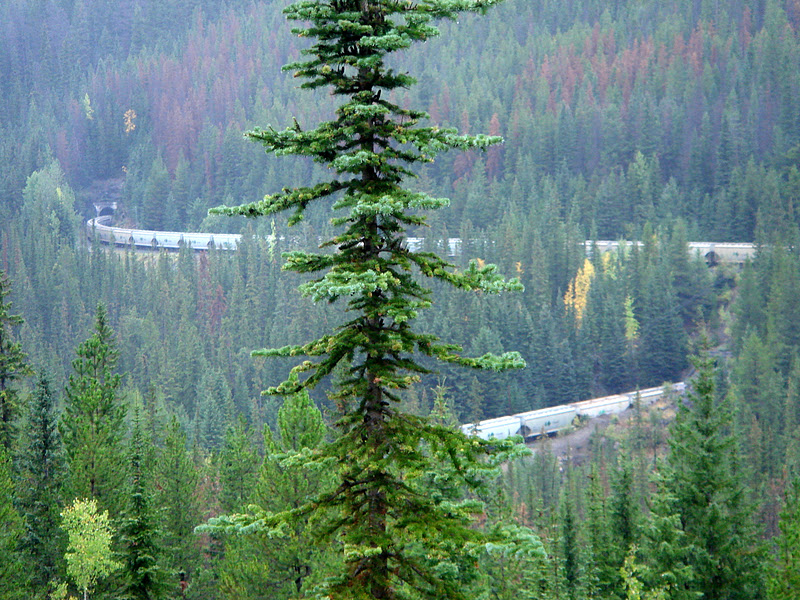
We return to Fields, noticing the long freight trains in the station and turn off the main road again to go to Tatakkaw Falls. The weather changes and it now rains seriously.  We stop to see the upper spiral train tunnel, and are lucky that one of the trains we saw in Fields is creeping through it. It is a very unusual sight, to see the front and the tail of the train on different levels.
Upper Spiral Train Tunnel
We also stop at the confluence of the Kicking Horse River and the Yoho River, each with a different colour, but we have to huddle together as the temperature has dropped considerably.
Tatakkaw Falls
The waterfalls are reached via hair pin curves in the road. Some vehicles go backwards up one leg of the bends and forwards on the next one, because they can’t easily negotiate the sharp turns. It is something which I have never experienced in Europe on the steep climbs of the Swiss and Austrian mountains.
The waterfalls are awe inspiring, but it is raining hard and it is very cold and we have to hike the last stretch to see the falls well enough. Once we have dutifully done that, we go back to our car as soon as we can, drenched!
Down Kakattaw Falls
We return to highway 1 and are in luck, because in the lower spiral tunnel we see a train simultaneously on three different levels!
On to Lake Louise, through the rain. We can’t find suitable and affordable accommodation, so drive on to Banff, and after a false start on a strip with only expensive and very up-market hotels, we find an adequate motel a few steps from the emerald Bow River within walking distance of the center of town. It is no longer pouring, but still wet and very cold. No view at all of the high mountains which are supposedly the most spectacular of the Rockies. Banff looks attractive as it has no loud neon signs and ads, but instead a manicured high street which reminds me of Aspen, the fronts of the shops in chalet style. The number of Japanese and Chinese surprises me. Shop owners and motel owners, hardly any of them are true Canadians. Most of them are Asian or at least foreign, judging by their difficulties with the language. After a bit of window shopping, we find a nice Italian restaurant and share a pizza, hoping for sun and a view tomorrow.


Monday, 17 October 2011

Day 15; Sunday September 25th

Pioneer church in Revelstoke, rain at Rogers Pass, Golden
We were lucky yesterday, because there is a slight drizzle, but it isn’t cold. While in my own church a very special Evensong is taking place – or rather it has already taken place considering the 8-hour time difference – we decide to attend a service at the tiny white clapboard Anglican church at the back of our motel. It dates back to 1885, and is the oldest pioneer church of Revelstoke
Revelstoke

The 10 o’clock service is announced as a traditional Anglican service, so we expect traditional hymns. To our surprise we sing from a missionary hymnal, and from a loose sheet. The minister walks up to the front of the church guitar in hand. A young man is strumming a guitar as well, standing next to a wheezing harmonium. Before the service starts we have to practice a new song, which is rather unsingable. But the text and especially the refrain we won’t forget as it is so appropriate:
Refrain:
We are companions on the journey
Breaking bread and sharing life:
And in the love we bear is the hope we share
For we believe in the love of our God,
We believe in the love of our God.
1.
No longer strangers to each other
No longer strangers in God’s house;
We are fed and we are nourished
By the strength of those who care,
By the strength of those who care.

Refrain: etc.
Unsingable or not, we keep singing it once we are on our way again, like a song for a youth camp. After all, we break bread together every day during this road trip.

I forget to count, but guess there are no more than 20-30 people in church. They are a mixed bunch, coming from different parts of the world as we find out later. Wherever we go, we meet people who are European by birth and have emigrated either as an adult or with their parents when they were still children. Whatever the songs and hymns or the service, this small group of people valiantly tries to keep this church alive, which is remarkable and humbling. After the service we drink coffee in the hall which is also the local dance school. The two women at out table come respectively from Heidelberg and the other one has dated a Dutch chap for several years when she was young, who was ever so sweet – her words! She tells me she didn’t marry him in the end, because he was Dutch Reformed coming from Kampen in the Netherlands, and she was an Anglican, which was a gap they couldn’t bridge. Times have changed. She is a very happy woman with a shock of grey curls and she laughs a lot. Her face softens when she tells us about this Dutch boyfriend. The woman from Heidelberg looks rather unhappy. She tells me that her late husband was a pilot owning a private plane and that they have seen a lot of Canada and the USA together. She obviously feels lonely. Often there are meetings like this on our road trip, which is one of the nicest parts of it.
The vicar has a farm quite some distance away. His ministry is a sideline. He has come in a shining dark red pick-up truck and gives some elderly ladies a ride home.
Through the car window

The weather unfortunately doesn’t improve, which is a pity because we are going to cross Rogers Pass in Glacier National Park, a narrow pass through the Rockies and although just at an altitude of 1300 meters, quite impressive. The whole area is avalanche prone because of the steep rock faces. At Rogers Pass there is a very interesting video about monitoring this road in winter and shooting down avalanches every day to keep the roads free from danger. The train could not easily manage the steep gradient and accidents happened. The lines were changed and a loop was constructed plus tunnels, which also meant that the once famous station and hotel Glacier House was abandoned and dismantled. The stone pillars which once supported the rail line, are still there as dumb witnesses. A scale model shows the former course of the train and the new loop and tunnels.
Rogers Pass in the rain and the Trans Canada

Unfortunately because of the rain we can’t see much of the glorious mountain tops nor go to explore the glaciers or the remains of Glacier House. As far as mountain peaks are concerned, we are not very lucky at all during this trip. The road to the glacier near Revelstoke was also closed and hadn’t been open at all this year as bridges had been ruined and trees were blocking the roads. All this due to inclement weather in spring and summer.
At Rogers Pass we cross a time zone and lose an hour.
Once across the pass the weather changes dramatically and it is dry and sunny. There are many aspen here, ablaze in the sun with their golden leaves. Against the backdrop of mountains and a blue sky this is glorious to see, but impossible to photograph.
Big skies
We stop and find a motel in Golden, an appropriate name as the many aspen along the river and in the small town are all showing off their best autumn colours.
Autumn colours along the road to Golden
Golden is a pleasant town at the confluence of the Kicking Horse River and the Columbia River. The business part and the highway area on one side of the railway lines, the town on the other side. It still has a historic part, which is now revamped and although attractive is unfortunately losing its authenticity. But it is a nice spot with restaurants and a covered wooden pedestrian bridge across the river. We enjoy a leisurely evening, find a Greek restaurant where the lamb is succulent and very tasty, and return to our very comfortable motel unit.
Park and footbridge at Golden

Day 14, Saturday September 24th

Revelstoke, Farmers’ market, alpine meadows

We have stayed another night in Revelstoke to be able to explore the alpine meadows more thoroughly and walk some of the trails. When we wake up there is a thick fog, which fortunately clears up quickly. We walk into town to have a coffee and to visit the farmers’ market, which is fun. Sticky cinnamon buns are apparently a specialty in this country, and we buy a nice packet plus blueberry scones and other delicacies. Fresh whole meal loaves and buns, ripe fruit directly from people’s gardens and farms, cheese and sausages, it is all there and we buy it for our picnic lunch. Artists, potters and a writer of children’s’ books are selling their special products.
The local author of children's books
They are all eager to talk to us – or perhaps with any passers-by. So are three men who enjoy a coffee on the sidewalk café we visit. They give us very useful information about the area and the places worth going to. If we would follow their advice, we would need to stay here for a full week so we have to make a choice out of their suggestions. I find that people everywhere in Canada are friendly and helpful and like to talk to travelers and strangers. It is one of the joys of traveling here, I think.
The Courthouse from the Parkway
Meanwhile the weather has changed for the better, the sun is shining in a clear blue sky and it is warm. So we drive back to the Park and the meadows, not taking the shuttle this time but hiking up to the top. But first we enjoy a delicious picnic on the small lake near the parking lot.

The view on the top is even better than yesterday, and we follow several trails, pausing frequently to enjoy the vistas and to take pictures. We stay till closing time as it is wonderful up in the meadows and there is no shortage of hiking trails. There are more people here than yesterday, but it still seems rather unspoilt by mass tourism - forgetting that I am a tourist myself.
Along one of the hiking trails
In the early evening we walk around Revelstoke, admire the Courthouse and discover a small wooden Anglican Church right behind our motel. The decision to go to the service the next morning is quickly made when we see that it is the only surviving pioneer church in Revelstoke. Besides we are promised a “traditional” Anglican service, something to look forward to.
Revelstoke Anglican Church

Day 13, Friday September 23rd

New Denver to Revelstoke; Mountains, lakes, a ferry, and a real town worth mentioning.
It would have been my parent’s 75th wedding anniversary, and it is one of my brother’s wedding anniversary today.
We get up early and have a makeshift breakfast. It is beautiful weather and the light is quite striking so early in the day. From New Denver we drive along Slocan Lake via Roseberry to Nakusp on Upper Arrow Lake. I try to catch the beautiful light, but it is difficult. The mountains gradually become visible. We try to catch the 9.30 ferry, but stop too frequently.

The ferry at Galena Bay is seen as a continuation of the road – there is no other option – and so is free. It only crosses every hour, on the half hour. The view from the ferry landing is beautiful, and we have some time to see the 10.30 ferry cross the lake towards our side. Time to use another toilet, one of the famous upside down buckets! To our surprise the ferry can take even a number of the heavily loaded trucks and logging trucks, which are very long. Once on the ferry the view of the lake and surrounding mountains is breathtaking. There are rocky islands and peninsulas where pines try to clutch on for dear life. The people on the ferry are also an interesting mix of truckers and tourists and locals. One man has a moustache which has such huge curls upwards, that I can imagine them being used for a game of medieval  “tilting” . I suppose he will sleep with two nets around them, one for each side.

On the other side of the lake we watch in awe when a logging truck disembarks and goes backwards up the landing. Meanwhile we enjoy our picnic lunch on a table in Shelter Bay Provincial Park, together with nosy squirrels and under a tree which has obviously been robbed of its acorns and leaves by a hungry bear. The grass is littered with leaves.
 We continue along Upper Arrow Lake, which is mainly hidden from sight. At Blanket Creek Provincial Park we stop near an awesome canyon. I try to capture the deep gorge on camera, but it doesn’t work out. Besides, I have climbed a steep hill on slippery shoes and am scared stiff that I will slip and slide down. It is easier to make photos of the canyon down near the lake where we hit upon picturesque Sutherland Falls.

Early in the afternoon we arrive in Revelstoke, where our first stop is a sidewalk café for coffee. The evenings are getting cooler, and I unwisely left my zip-in fleece at home. So I buy a nice fleece here, we do some more shopping and go to the Bank. It is an attractive town, nicely situated on the confluence of the Columbia River and the Illecillewaet River in a wide valley. It reminds me of Aspen, which has still a few interesting historic buildings, and wide streets divided into regular blocks. A bit higher up is the Trans Canada highway , and it has a busy railway line where we see a large number of freight trains passing by blowing their whistle. There is a Railway Museum as one it was an important railway hub. The small town has several cafés, lots of shops and restaurants. Apparently festivals are organized here as well. We find a motel within walking distance of the main street, which is clean and convenient, although the golden and purple sheets plus the dark wooden bed frames and furniture would be more fitting for a house of pleasure than a sober motel room where the door opens directly into the room.
Revelstoke from the Meadows in the Sky Parkway
As the weather is so beautiful we decide to go up to the alpine meadows, to the Meadows in the Sky Parkway. It takes 30 minutes by car – a distance of 26 kilometers - to reach the top, where a shuttle takes us even higher. As the park gates are locked at 5 o’clock sharp, we can only have a very swift look around. The view is so stunningly beautiful, a view of meadows, snowy mountain tops, pines and rocks, that we decide to return the next day and spend another day in Revelstoke. We can see the different mountain ranges, the Selkirk Mountains and the Rocky Mountains. Revelstoke Mountain itself is only 6360 feet high and below the tree line. The trees here are remarkable. They are very tall with very short branches.

This means they will not break under the heaps of snow – up to five meters - which fall here each winter. The Rockies are the only habitat of those trees. There growing season is very short and lasts only two months, so they grow very slowly. The ones we see here are very old indeed, some even over 500 years, the guide tells us. The alpine meadows still have some flowers, but a month earlier they must have been glorious.

Paintbrush is still flowering, and we also find some velvety white flowers, yellows and blues. All the colours, the dark pines against the white mountain tops and the blue sky, the yellow aspen, it is the best we have seen so far.
After just 40 minutes we have to descend again. In town I buy a pair of better walking shoes preparing for tomorrow and we find a very nice Italian restaurant  where I enjoy lobster ravioli with shrimps, a salad to start with and strong black coffee for a dessert, which I had not expected in this town. On our way back we walk along the tree lined streets and admire the starry sky over the river.

Friday, 14 October 2011

Day 12, Thursday September 22nd

Hippies, invalids and ghost towns. Kaslo to New Denver
Kaslo
A very short trip today. In fact it would have been better if we had stayed in the same motel and done a round tip. Anyway, we have breakfast in the Tree House Café in town, within walking distance, where the locals meet, gossip and ask us where we come from. Everybody so far has been very inquisitive and very pleasant and helpful. A woman who looks like the mother of one of my friends, even hugs me when we leave the restaurant. The number of people with crutches or zeemer frames so far has been amazing, as well as the number of hippies, some mature and of our generation, some young. Our motel owner walks with a stiff leg, the café has some older customers who really have to drag themselves along on crutches, and also outside in the streets the number of people with disabilities strikes me as disproportionate. I feel I am walking in a Jeroen Bosch picture, full of colourful but somehow very different people.
Our motel in Kaslo
The town is very pleasant, situated on the lake and offers views of high mountain tops in the distance.  We walk along the shores, visit an art shop, and eventually pack up. Here as well we find artists, and many of them. I suppose this, like Nelson, is a place for hippies, artists and retired people.
Kaslo

The route we take to New Denver is beautiful. It follows the disused rail tracks along the winding creek. There are rapids, hillsides clad with dark pines, lakes and glimpses of tantalising high mountain tops, with blindingly white snow. This is a former mining district for gold, silver and nickel. Not much is left of the towns of that glory time, except for a few houses hidden among the new forest growth. There are several ghost towns around here, one along the road.
At Retallack, a ghost town
We turn off into a gravel road which leads to Sandon, which was a major town around 1900 with about 5000 inhabitants, three breweries, two different trains and five trams which went up the steep hillsides. It had a hotel and a number of brothels. The trees on the surrounding mountainsides were all felled and used to build the town. The creek which is still there, was guided through a wooden flume and covered by the wooden paving of the main street. The mines closed and people left the towns. The bare mountains sides were the cause of avalanches and floods. Fires, snow and the force of water destroyed the town in the long run. What is left now is just a museum in one of the old buildings, some original houses and buildings, and rusting machines and farmers tools.
Remains of the flume at Sandon
Plus a locomotive and some carriages of one of the old trains. In the nineteen fifties the last of the inhabitants left the town. It is difficult to visualise a booming and busy town here, as the flume has been destroyed by the floods and what remains of it is wreckage. The creek gurgles freely over big boulders and stones, not encaged by a flume. There is new forest growth where once were houses, shops and streets, as we see on pictures in the museum. What is horrible and spoils the atmosphere is a large number of old trams rusting away at Sandon and obstructing the view of what once was. It spoils everything and also proves that some organisation or somebody lacks any historical sense.
When we are ready to go back, after a failed attempt to reach a lookout point on Mount Idaho via a gravel road full of deep potholes and sharp stones, we go on to New Denver, which at one time also was a hippie stumping ground. However, the tiny town with its short main street seems totally deserted. Shops and café s are closed after the summer season, and there is nothing except two food markets and an outdoor clothing store which has beautiful things but is extremely expensive.
Lake at New Denver
We leave New Denver, but return when we see a nice motel as we are rather late anyway to catch the ferry across the lake. So it might be wiser to stay in New Denver. It takes a long time after we have rung the bell at the reception desk before someone answers our call. We see why when first one crutch appears, and then painstakingly another one on which a man is heavily leaning! Is it possible that one can only run a B&B with a broken or lame leg or artificial hips? It is our day for invalids. However, this nice motel with a view of the snow capped mountains is fully booked we are told. Funnily enough we do not see too many cars parked there, in fact just two or three. The owner points out another motel, an unusual one, with dome shaped cabins like gigantic acorns which are modern and very well equipped. However, the price exceeds the daily budget, so in the end the only option is a very basic motel run by Chinese people. Ironically it is called Valhalla Inn! It will have to do, but it means we have to eat out as there are no cooking facilities and there is not even a kettle. We buy groceries for tomorrow’s breakfast in two different stores, and decide to have a Chinese meal at the restaurant in the motel, which turns out to be the only restaurant in town at this time of year! When we open the menu, it appears to be very American, with burgers etc. In the end we eat egg rolls and soup, the only Chinese dishes available.  It clearly was a mistake not to stay in Kaslo or to go on to Revelstoke, for this town is completely dead.

We’ve been lucky with the weather today. There is some very light rain every now and then and the sky is very cloudy, but the temperature is rather high which is good. The website tells us that Revelstoke had rain today, but tomorrow things will be better with more sun. Later that evening we drink the cider we bought at Kaslo, and enjoy the last of the chips. Tomorrow is another day. It is exciting to realise that we are getting closer to the really high peaks and glaciers of the Rocky Mountains.

Followers

Blog Archive