Monday, 22 June 2015

St. Bavo Church Haarlem

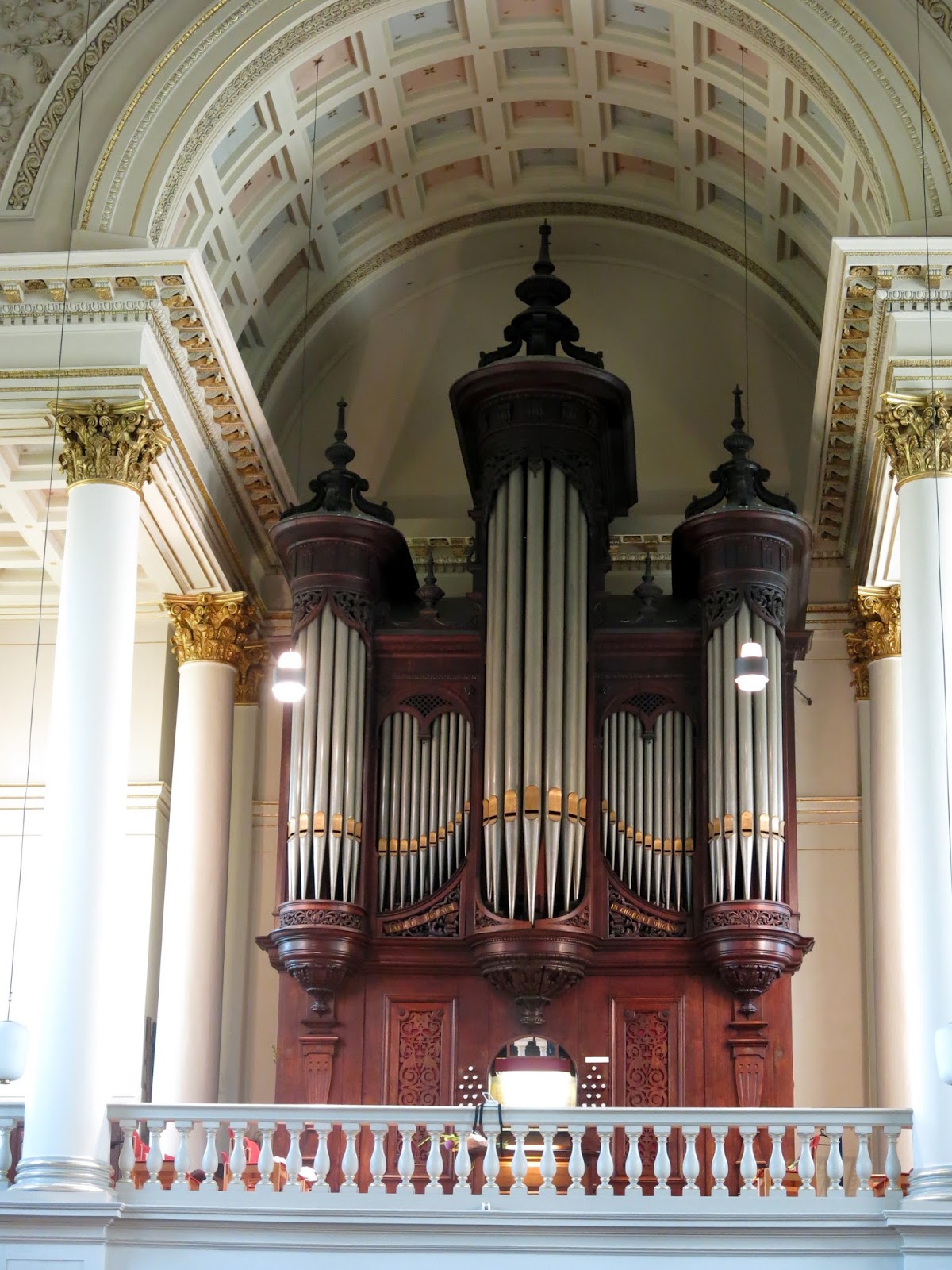
Haarlem has a most beautiful and famous pipe organ. It is very impressive to see, filling a complete wall of the church, but hearing it is of course what it is all about.
The pipe organ, although in a big church, is owned by the city of Haarlem, and not by the church. They appoint a “city organist” who plays the organ regularly. This week Jos van der Kooij celebrated his 25th anniversary as “city organist”. This is just one of his jobs, as he is also the regular organist of a church in Amsterdam, the well known Westerkerk near the Anne Franck House. I went to Haarlem for the celebratory concert, a combination of well known classical organ repertoire, and very modern music, one piece especially written by Daan Manneke, a Dutch composer, for this organist and this particular organ.
The church was packed.
Not my favourite organist whoever he is, but my favourite composition
This is the programme:
Johann Sebastian Bach
1685 - 1750
Toccata et Fuga d moll 
BWV 565
Georg Friedrich Händel
1685 - 1759
Voluntary VI C major, Adagio - Allegro 
from Twelve Voluntaries and Fugues, 1776
Daan Manneke
1939 -
Ligatura, 2015 
The composer claims that this composition aims to link very diverse disciplines in very different ways, eg, different tempi, different tonal systems, very diverse genres and timbres. It was written for the organist and for this particular organ.
Wolfgang Amadeus Mozart
1756 - 1791
Andante für eine Walze in eine kleine Orgel 
F dur KV 616
, 1791
Piet Kee
1927 -
Magic Pipes 
for panflute and organ
, 2012
Max Reger
1873 - 1916
Intermezzo f moll 
from Neun Stücke für die Orgel opus 129, 1913
Olivier Messiaen
1908 - 1992
Dieu parmi nous 
from La Nativité du Seigneur
, 1935

Just on of the many pictures of the famous Muller organ in the Bavo in Haarlem
I must admit that I enjoyed Bach, Händel, Mozart and Reger. Daan Manneke’s composition was totally alien to me. It must be utterly difficult for the organist to play, and I admire Jos for that. It certainly showed all the possibilities of the organ, the many different sounds and effects, so different from what one normally associates with a pipe organ or hears during a concert or a church service. However, I could not make head or tail of the sounds, the dissonants the whisperings and the loud noises. Perhaps I am not ready for modern music and far too conservative, but I have to be able to hear a theme, a melody, a line. It seems the most difficult composition to play, but I could not relate to it. The composer was in the audience and had given a short introduction beforehand about this new piece and what his aim was. Jos had also given an introduction to the music of this concert. However, Manneke was beyond me.
“Magic Pipes” by Piet Kee for panflute and organ I did enjoy. Especially the panflute was surprisingly clear and I loved the sound which wasn’t at all “throaty” as it usually is. And it was amazing that the panflute could compete with the organ, and wasn’t drowned by it. Such huge pipes and such small pipes in the panflute.

Yesterday I had the pleasure of hearing and seeing the organ again. The annual Choral Festival of European Anglican choirs took place in Haarlem this year. So fortunately no travel to Antwerp, Brussels or Luxemburg for us this year. Gordon Appleton from the RSCM showed remarkable patience while practising a few rather modern compositions with us. Fortunately I had attended extra practices for the festival with the Haarlem choir, so I wasn’t totally unprepared. The practice was not just in the beautiful BAVO, a church which apparently hosts many other activities and groups on a Saturday, but also in another church in Haarlem, the Nieuwe Kerk, a church which was originally built as a protestant church and not as a catholic one. The walk through busy but picturesque Haarlem was a pleasure, and we even had some sun although the churches were extremely chilling. Almost the longest day, and still cold.
The organ in the Nieuwe Kerk, Haarlem
Choral Evensong started a bit late as a wedding party was reluctant to leave! The church was quite full, and in spite of the failure of modern technology so that there was hardly any communication possible between the organist high up behind the organ console and the conductor down below, we sang a wonderful service. Especially the psalm was a joy to sing.
On the site of the Anglican Church in  Haarlem are a few pictures somebody took with a mobile phone. I am hardly visible as I am standing behind a rather tall soprano.

The socializing afterwards was no less enjoyable, with many of the participants sharing drinks in an establishment opposite the church, and some nine of us staying for a nice and well deserved meal in the company of choirmaster and festival director, now both relaxed and relieved.

This was only the first Evensong this weekend. On Sunday our choir from The Hague was invited to sing Evensong in the beautiful Old Catholic Church in The Hague. A totally different experience, but for me a meaningful service of worship. The acoustics in that church are wonderful, and so the choir sounded well in spite of the fact that we all felt we were singing alone as we could not hear any of the other singers, except for the men behind us. Nevertheless we managed. A pity there were so few people in the congregation. Perhaps too many things were happening in and around The Hague, June being a time for festivals and cultural events.
  Pipe organ, pulpit and altar of the Old Catholic Church in The Hague
When finally I came home, I just collapsed on the settee.


Next week there will be another Evensong, and then silence till the week in Salisbury Cathedral with the ECS. Something to look forward to indeed!

Sunday, 7 June 2015

Pipe organ crawl

Saturday the “organ crawl” took place in Leyden, an annual event. It is for diehards and fanatics, mainly grey haired men. We were lucky with the weather: after a tropical half day followed by a thunderstorm and rain, it had cooled down, but it was dry and very bright and sunny. Ideal weather to walk into Leyden and from one church to another. The cycle started at 10 am with a concert on the stunning organ in the Pieterskerk. 
 The organ in the Pieterskerk
 The side aisles with the organ just partly visible

 Around the Pieterskerk. Houses are built around to the church and some are attached to it


The next concert took place in the Lokhorstkerk, originally a conventicle, now used by both a Dutch version of the Mennonites and the “Armenians”. All in all there were 6 concerts in 6 different churches by 6 different and well-known organists. This may sound utterly boring, but each organ has a different sound and a different disposition. Some are baroque organs, perfect for Bach, Buxtehude and Walther, to mention just a few composers. 
The modest organ of the Lokhorstkerk
The pump in the alsmhouses opposite the Lokhorstkerk
Others, especially the organ in the Roman Catholic Church, the Hartebrugkerk, are well suited for French romantic organ music, Vierne, Franck, Saint-Saëns. That made the whole experience very interesting. 
Hartebrugkerk, the French organ
The six churches are within walking distance in the heart of Leyden, where everything is within walking distance. On the hour there was a 30-minute concert, which allowed for some 20 minutes to get from one church to another if one wished to take pictures in each church as well. A few churches offered coffee and tea. It took some effort and perseverance to make one’s way along the weekly market, which was crowded with people enjoying the sun and drinks on the floating terraces in the Nieuwe Rijn. There was a break of an extra hour at lunchtime. Fortunately I knew a quiet place to get lunch, not easy on such a busy day, and a very good one too with local and biological ingredients.

 The beaytiful organ of the Marekerk, and octagonla church which was built as a protestant church. So it has no altar and no choir.
Old collection bags attached to long poles so that everybody in the pews could be easily reached from one end of the pew. It took some time to become an expert!

After the 5th concert I gave up and instead saw a friend in his museum, the Leiden American Pilgrim Museum. As we started chatting, I missed the last concert in the Hooglandse Kerk, but since I go there regularly it didn’t really matter. After 5 sessions I was very aware of the fact that wooden church pews are not made for long sit down sessions. Especially those in the Roman Catholic churches are a real pain, and not in the neck!
The organ of the Lodewijkskerk, another Roman Catholic Church
As an antidote I did some shopping in interesting and small boutiques on my walk back, with the excuse of needing a few presents for friends.

Sunday morning I sang in the church choir as usual, with this time two very strong male sections! What a joy to have so much support. A peculiar liturgy though. It seemed the individual parts of the liturgy had been put into a shaker and came out in a different order, the choir starting with the anthem. As if whoever put the liturgy together had pressed the shuffle button!

In the afternoon I attended a special recital, organised by the NMF, the National Foundation for Musical instruments. It is an institute which provides young and promising musicians with suitable instruments which they can’t afford otherwise. The instruments are given on loan, for as long as needed. This weekend there was a special two day event with recitals in historic houses and unusual buildings all over the country, places which are often closed to the public. It is on the one hand a “thank you” for those who contribute to these funds, but also a way to get more people interested in supporting financially by becoming a “friend”. The musicians present themselves and apart from giving a recital also tell the audience something about their instruments and why they are so important to them. I went to Leyduin near Haarlem, one of the many country homes built in the wooded area between the dunes and the agricultural land, here the bulb fields.
 Leyduin
Drinks after the recital
 Those mansions were owned by rich merchants living in Amsterdam and used as summer retreats. Now only a few are still lived in privately. Many are used as museums or for special events such as weddings, dinner parties etc. They are usually in beautiful grounds, and may have an ice cellar and a viewing tower and interesting small buildings like that.  I went to hear a cellist, Genevieve Verhage who played the most unusual and difficult pieces I had ever heard, of Sept Papillon by Kaija Saariaho nr 1, imitating the flight of a butterfly. The cellist, a young woman, explained the different ways of playing the cello and how to achieve those particular sounds, a revelation! The recital was most fascinating and the audience was spellbound.  It was a real joy, and an eye opener for me.
Apart from a Sarabande by J. S. Bach, she played
   Peteris Vasks, Fragment from Das Buch
   Tan Dun, Intercourse of Fire and Water
 The room in Leyduin where the concert took place
To the right the cellist talking to a member of the audience after the recital
This is a Chinese musician playing Sept Papillon, very different from the performance by Genevieve
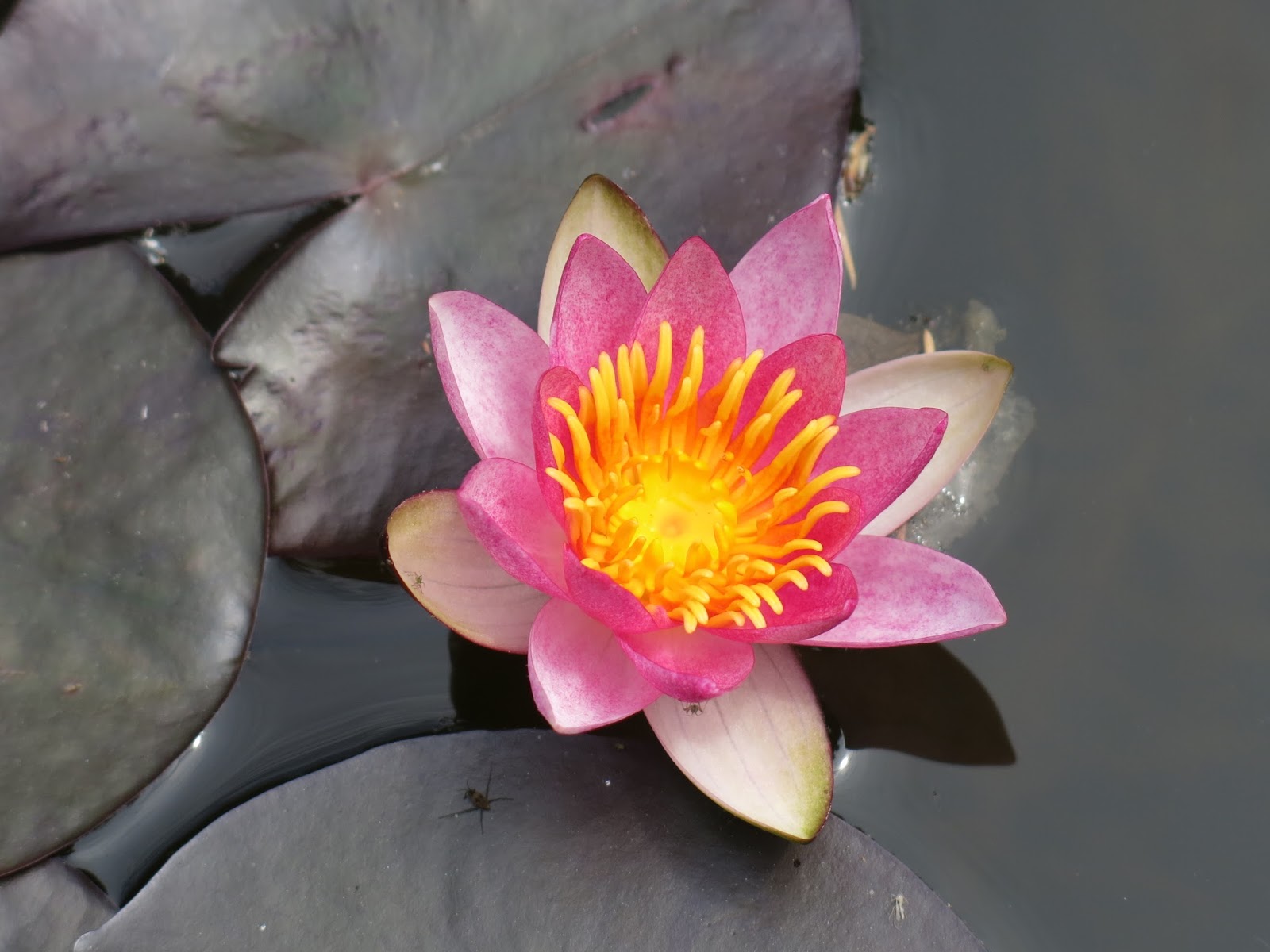
When I came back home late in the afternoon, I noticed that not just one but three water lilies had opened to the sun! And the abundance of roses this year is also unusual. That is happiness!
A wonderful display of roses

Friday, 5 June 2015

Garden delights

A tropical day with temperatures over 30 degrees centigrade. Just for half a day, and then we got thunderstorms and rain. And all this after a very cold spring, with people yesterday still wearing warm down jackets.
 Two climbers, a beautful but very strong pink rose and a white clematis.

But before The rains came I took a few pictures of flowers in my garden, which are at its best at this time of year.
The first flower of my mini waterlily. It opened on June 4th, whereas last year the first flower opened on May 1st! 

Let us hope this is the beginning of higher temperatures and summer!
 My purple climber which looks like the pink, wild roses which grow in the dunes on sandy soil. This one has a wonderful smell, like the wild ones.
The modest flower of a geranium
 The surprising "flowers" or perhaps just seed pods of an acer, such a contrast in colour to the very bright and almost fluorescent leaves.


Saturday, 30 May 2015

A week in Northern Cyprus

Staying with friends is a blessing and a luxury. It is so different from hotel life, even if meals are not shared due to work commitments. 

 Views from my friend's garden
I’d never been to Cyprus before. It is hardly European, although in Northern Cyprus, the Turkish part of the island, many British people have a home or second home. They are called “swallows” as they migrate from Cyprus to England and vice versa according to the season. I am told Northern Cyprus is a tax paradise, where one still gets interest on one’s savings, doesn’t pay tax on them, and where housing and food are cheap, so the cost of living is quite a bit lower than in England. Pensioners and divorced people with lower incomes seem to live happily here. And of course there is the climate, plus religious tolerance towards non- Muslims. There are many mosques, but hardly any veiled women. Lawrence Durrell was one of the famous writers, who once lived here as well, in a delightful village I visited, with famous Abbey ruins which are still used as a concert venue. His novel “Bitter Lemons” is about this period of his life.
 Bellapais, the Abbey ruins. Top left: the pulpit in the church
 The mountains going from West to East are wooded and green, rising rather abruptly from the coastal area and they have a very sharp and distinctive ridge, going steeply down again towards the South and affording a stunning view of both sides of the island, to the sea in the North and the plains on the South of the island.
 The village where Lawrence Durrell lived, with very steep streets
There are several castle ruins, which seem indomitable, high on the mountain tops. Hidden amongst the trees in the mountains many historic and old Greek-orthodox churches and monasteries can be found. The historic heritage is preserved, although many original Christian cathedrals and churches have been converted into mosques or museums in this part of Cyprus, and court ruins of monasteries are sometimes turned into parking lots in the walled towns or cities.

 Kyrenia, historic harbour

Kyrenia is a delightful town with a very picturesque old harbour, dominated by a sturdy castle. There are lots of restaurants on the quays, but more authentic and cheaper food can be had in small restaurants in other parts of the town and in the villages.
 The old Turkish quarter in Kyrenia, my route to the historic harbour
I rented a car for a few days so that I could explore Northern Cyprus a bit more. There is a great variety in landscape: beautiful sandy beaches where turtles lay their eggs are backed by mountains and woods. There are old abbeys and monasteries, winding mountain roads, not wider than just a one-car strip of tar, hidden villages, full of flowers, bougainville, oleanders and many other flowering shrubs, it being spring. There are palms, pines and orange and lemon trees. I had a sandwich in a private garden, high up a steep road in a village, the garden shaded by pergola’s, where I met a few tourists, panting after the walk uphill in the hot sun. Our hostess offered us homemade lemon lemonade, very refreshing. 
 Famagusta and one of the gates in the Venetian wall
 The former gothic cathedral, St. Nicholas, now a mosque as seen from the city walls
Another former church in Famagusta
There are towns like Famagusta, with thick and sturdy Venetian city walls and dry moats, gated and harbouring historic churches. There is Salamis, the very extensive ruins of a big Roman town, the amphitheatre most impressive. Walking there I could hear the silence, the remoteness of the place. Butterflies fluttered from flower to flower, and prehistoric looking big lizards slid silently across the hot stones. The only sound was the sound of the wind through the vegetation; the sun whitening the marble statues still decorating the big former halls.
 The same church, the former St. Nicolas and now the Lala Mustafa Pasha Mosque as seen from the square, and the interior, one of the side aisles
Not far away is St. Barnabas, a Greek Orthodox Church now a museum with a wonderful collection of icons in the body of the church, and archaeological finds exhibited in the former cells around the cloisters. Next to the church, in a small chapel, the remains of St. Barnabas are supposed to be buried.  Barnabas was a Cypriot Jew and an early Christian who travelled together with Paul the apostle to evangelise the Jews and non-Jews. Barnabas is said to have been martyred on Cyprus near Salamis.
 Groups of children in Famagusta, dressed in different local costumes
In Famagusta children were having a special celebration, dressed in national costumes. I could not discover what the occasion was. A city full of ruins, but lived in, and with few tourists, at least when I was there.
 Salamis

With my beautiful and talented hostess I drove to Nicosia, the Greek and Southern part. While she was having meetings, I explored the walled historic centre, which during my explorations got flooded because of heavy showers. Here are some beautiful Greek Orthodox churches, still functioning as such. It was weird to come upon the border, a border which cuts through the main shopping street of Nicosia.
 Nicosia, Greek Orthodox Church
I haven’t seen enough to be able to say anything sensible about the difference between north and south. The south seemed more European and more prosperous, but that was probably because I was dropped off near the Anglican Cathedral, in the prosperous embassy quarter.
 Rain in Nicosia
The Venetian Walls in South Nicosia
As a house guest it was wonderful to meet people who live in this part of the world, and to be able to join the small choir for Sunday worship in the Anglican Church near the historic harbour. The church, freshly redecorated and still smelling of paint, was quite full, which surprised me. Apparently there are enough British living here to fill the church. And when they have gone back to a cooler climate in summer, they are replaced by tourists.
Another view from the garden and the house
I enjoyed the wonderful house, garden and piece of land of my hostess, an oasis on the edge of town, unfortunately gradually surrounded by modern apartment buildings. But the garden is walled as it was founded way back as a hermitage, so the property is protected. It has a tiny chapel. Olive trees were planted a few years ago and the oil is sold by the church.
Never had a cook on the plane before!
In just one week I could only get a foretaste of Cyprus. I would love to go back there to explore in detail, preferably with someone who likes a car with a right hand drive. I don’t mind keeping left, but if possible in my own car which is a left hand drive. 

Followers

Blog Archive