Tuesday, 28 March 2023

Digital Joys

Let me set the scene: I have two old laptops and two printers, a laser printer and a photo printer. All those machines are old, some older than others, and none of them works correctly. That is where the saga begins.

The laser printer: I had never been able to connect it via Wi-Fi with any of my laptops. Nor had my nerdy whizz kid of a nephew. But it worked if I connected the printer via a USB-cable with the laptop. So far so good. It meant of course that printer and laptop had to sit next to each other, which was inconvenient as they were in different rooms for practical reasons. Because of the inconvenience I had not used it too often, and when I tried to get it to work again a year ago or so and fed it a bunch of bright white sheets of paper, it started gobbling up sheet after sheet, spewing hem out without printing anything on them at all. It was unstoppable, just like the porridge of the sorcerer’s apprentice. I decided to forget about it.

The photo printer: It was excellent, printed beautiful photo’s on A4 photopaper, and I loved it. Till Windows decided to update its system, after which the laptop could no longer connect with the printer as there was no driver compatible with the Windows update. E-mails and phone calls to the company which had produced the printer did not help. I was told that it was not worth making a new driver for this printer as the lifespan of a printer was limited, so why not buy a new one? I told them that I was very happy with that machine and that it still worked beautifully, so why a new one? The long and the short was that my oldest laptop, let me call it D, could still connect with the printer via USB. But both internal disks of D were full and it was difficult to clean them and make space. In the meantime, D no longer connected to the internet. So, I worked on the latest laptop, let me call it L, which was also old but not as old as D, transferred files I needed in print to a USB-stick, take that to D, connect D with the printer and hey presto, or not so presto, I could print. Not ideal, and a bit time consuming, but I lived with it. Besides, it kept me fit as I had to go up and down the stairs every time I needed the printer. A matter of logistics. This might have gone on for a long time, if not….

Last week I badly needed to print a label. So, I did what I always do, created the label on L, copied it to a USB stick, went upstairs, connected it to D and connected D with the photo printer. All very simple and standard procedure – for me! Alas, the photo printer threw out a blank page. This meant cleaning the printer heads or whatever they are called. But it did not work very well and I had to do it 8 or 9 times. Meanwhile I got a warning that some colour cartridges were by now also empty as testing takes a lot of ink apparently. I did not need colour, but if a colour cartridge is empty, I can’t use black either. A sales trick of the printer company? It meant I could not do anything, as I did not have the right cartridges to replace them. And if I did, I still had no guarantee that the printer would work.  I did my sums and worked out that it might be cheaper (as those cartridges are expensive) and better to buy a new printer, one which could communicate with both my laptops, via wi-fi. So, with regret I said goodbye to my old photo printer, which had served me so well.

As I had to wait for a new printer till after the weekend, I thought of the neglected laser printer and decided to give it a last try before pitching it out as well. It took a lot of time to connect it, but after carefully reading the instructions again, and connecting it with a USB cable, it worked to my utter amazement and printed a faultless page. My joy did not last for long, as I got the warning that the cartridge was empty and had to be replaced. I think that not having used it for so long might have affected the cartridge. By now it was late Saturday afternoon and I couldn’t think of a place where I could buy a cartridge.  Fortunately, I remembered there used to be a computer shop tucked away in a narrow alley. So, I went there and lo and behold, the shop was open and they had the desired cartridge for the laser printer. Back home I put it in and tried the printer, but the prints came out faulty. Hoping that it might help, I first uninstalled the whole programme, and then installed it again, and even managed to connect the printer via Wi-Fi with my laptop D. Naturally I then installed the programme for the printer also on the other old but newer laptop L, and it worked!  So far so good. I could print again! For a non-beta, this was quite an achievement.

However, I still wanted a new photo printer, a multifunctional one with a scanner included. After some research I ordered one online which I had to collect after the weekend in a shopping mall. I did that on the following Monday, not realising how heavy it was to carry it from one end of the large shopping mall to the parking lot at the very opposite end of the mall. Once home the whole process of unpacking, installing and connecting it via Wi-Fi with both laptops started again. Who says working with computers saves time??? But I need a printer, have to fill out my tax return which can only be done online and that has to be done this month. No more paper involved at all.

Well, you think I am all set now and ready to go. However, my newest old laptop, L, is having signs of onsetting Parkinson, getting the shivers if more than one programme is open, and refusing to do anything at all, even shutting down. So, both laptops have to go. A neat, small, and light new laptop is waiting to be installed. And the rigmarole of connecting it with both printers is starting all over again. And that without a CD-ROM drive. I wonder…

Oh, and did I mention that the screen of my 6-year-old telly is showing a black halo in the corners, which is steadily growing? I can’t read the subtitles anymore, nor the menu. There is no cure for it, so I am waiting for the arrival of a new tv which I have ordered, a small one. I will have it installed, as I have wasted enough time installing machines.

Do you remember the time when a letter was handwritten, when banking was done by going to an actual building called a Bank, or by writing a cheque and posting it in a letterbox? The time when there were plenty of letterboxes, and helpdesks with real people on the line at the other end, instead of robots who give you a menu to choose from which seems endless. A sure way of putting down the phone and giving up. Especially when you wanted to ask what to do as your computer was down and not working, and they tell you after having been connected with a chain of ‘people’, all ‘experts’, that you can find all the information needed on their website, which of course you couldn’t access in the first place!! Infuriating. Give me paper, pen and ink, and a real human being for any instructions or questions. Oh boy, how happy I would be.

Don’t tell me Windows will update their system again soon. Not now that I have invested money (although I did not buy expensive products), energy and precious days of my life in connecting all those machines via Wi-Fi. I would need a wailing wall!

Monday, 27 March 2023

‘TextielMuseum’

Tilburg isn’t exactly a town to lift one’s spirits, especially not on a dreary and miserable day in early spring, when the rain batters the car windows and one feels the sun will never show itself again. Google guiding me through part of the centre of town to my destination, I noticed hardly any front gardens, public gardens, parks, open spaces or colourful and exciting buildings. Tilburg is a former industrial town, an industry which once thrived but was hit hard in the mid-20th century. Textile industry was the main source of income and wealth, offering good jobs to many laborers. The linen and damask tablecloths and beautifully woven bed linen was famous, and so were the woollen blankets. All that has gone. Brides to be do no longer get married till after having collected a chest full of sheets, blankets and tablecloths meant to last them a lifetime. Woollen blankets were replaced by eiderdowns. Women were no longer full-time housewives and started working as well. They did not have time to launder and iron linen tablecloths. What remains in Tilburg is a museum, the Textile Museum, in the old mill. The huge hall still houses many looms. They are impressive, high and sturdy, but most of them have lost their function. Videos about times past and the heavy labour in the textile industry can be viewed.  Some new looms which can be worked automatically, are still in use producing custom made articles, or woven items such as tea towels, tablecloths and scarves still on sale in the museum shop. But all that is on a small scale. There is a textile lab, where innovative ways of weaving are tested and researched.


I came to see something unique, three pairs of tall silk curtains, embroidered partly by machines, partly by hand. These curtains are destined for the royal palace in The Hague, the residence of the royal family. The palace has a famous Chinese room, with Chinese embroidered curtains, all silk, with pictures and scenes of daily life in a still rural China. They have to be replaced as they are falling apart and need to be conserved. The idea was to replace them with silk curtains embroidered with typically Dutch buildings and scenes of daily life in The Netherlands today, and so to preserve our material and immaterial heritage. 

Finding the right silk and the matching silk threads and yarns for the embroidery was quite a challenge. All the main scenes, buildings, bridges, ships, towers and other features, were embroidered by machines. The flowers, birds and trees which embellish the curtains, were embroidered by hand, involving some 150 people taken from all the provinces and all the nationalities now represented in our country. Those flowers, birds and other embellishments were later attached to the curtains by hand, and add some depth to the scenes. The curtains are finished now and on display in the Museum till this summer when they will be hung in the Chinese room of the palace and will then no longer be accessible to the public. It was an amazing display. The curtains are stunning and the story around designing and producing them is fascinating. Interviews with the embroidery groups who did the hand stitching, with professionals who researched the correct colours of the silk, with the people who had to find the right machines, who did tests etc., can be watched on videos. The Museum is full of colour, outside the world was wet and grey and dull.

I thoroughly enjoyed my visit, and given the miserable weather was glad that I did not have to drive back home again, but had booked a hotel just on the outskirts of a totally different village or rather small town nearby, with a very attractive centre. But that is another story.

Friday, 23 July 2021

'Kaapse Bossen', retracing my steps

Yesterday I went for a walk through woods which I have loved since I first set foot in them in my teens. As a family with five children and little money, it was not easy to afford a holiday when I was a child. But we were lucky to live on the coast and so easily swapped houses with families living in wooded parts of the country.  Life was simple. We cycled, went for long walks, picked blackberries or blueberries according to the season, enjoyed different views, the purple heather, the ice-cold water of the brooks which we discovered, shelled peanuts, explored the woods opposite which surrounded some of the houses we lived in during the holidays, and had chores peeling the potatoes, shelling peas and washing the dishes. 

The 'Postweg'
A field surrounded by a strip of wild flowers

When I was in my early teens, we had the luxury to stay in a guesthouse, in a former country house, at that time a conference centre and a holiday place for families. It was situated on the border of farmland and the wooded sandhills, a place for many rich farms and big country houses. Opposite, across a provincial road, were the woods, the ‘Kaapse Bossen’. As a child I had a love-hate relationship with the sea, or rather the beach. It was too hot in summer, and too windy and cold in a winter, with no trees to provide shelter against the elements, or the burning sun in summer which gave me headaches and blistered my skin, even gave me sun stroke once which made me very ill indeed. I was delighted by the woods, the trees protecting me from the sun, and giving shelter against wind and rain. Besides, those woods are not flat, but in fact on a sandy ridge which stretches from west to east through two provinces.

Some of the pretty row of cottages, once labourers' cottages for the people working in depot Sandenburg of a tramway which from 1885 till the end of World War II, when the line was bombed, connected Doorn with Wijk bij Duurstede.

I have crossed through that area many times since, by car, by bike, enjoying it, but I never again walked in those woods. So I decided to give it a go, headed in that direction and put on my walking shoes.

Corn and wild flowers

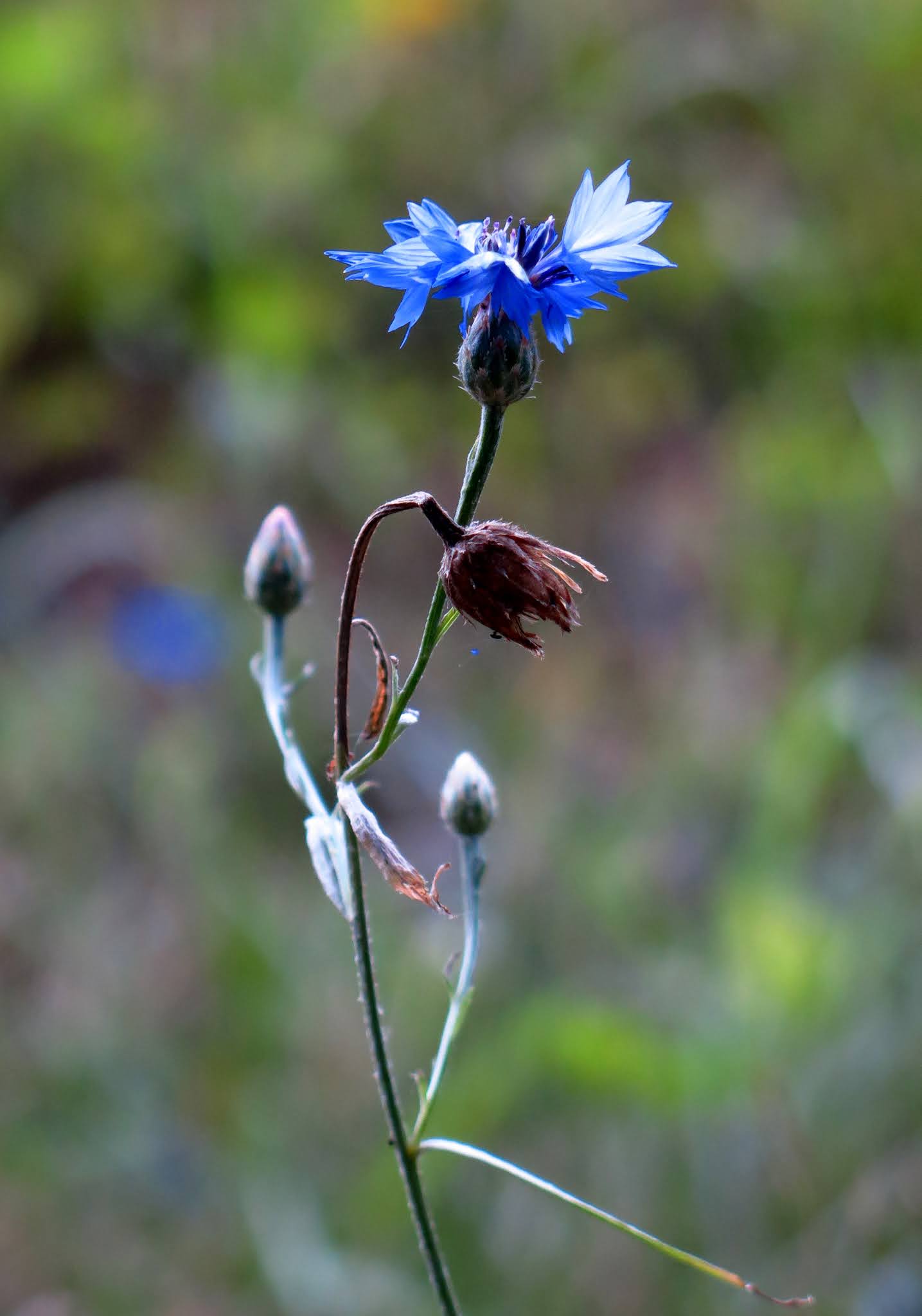
The first leg of the walk went through the area opposite the woods, where the guesthouse was, a rural area with fields, meadows where cows lazily grazed, interspersed with woodland, dissected by treelined lanes and dirt roads. To my delight the fields planted with corn were on four sides surrounded by a strip of wild flowers, so important for butterflies, bees and wildlife in general. Among them bright red poppies and blue cornflowers, the latter rarely seen nowadays. I walked along the ‘Postweg’ , which I already adored as a teenager, a dirt road now so full of potholes and deep ridges, filled with water from recent heavy rainfall, that any stage coach would surely be wrecked immediately. It was quiet with hardly anybody around. Only the wind rustling the leaves could be heard. The beech trees are very mature, their silver-grey, straight trunks proud and elegant. Many rhododendrons grow here as well, once planted on the estates, at this time of year in midsummer unfortunately no longer in bloom. Most of them so large that as youngsters we could hide in them. Then they seemed dark and menacing, taken from a fairy-tale story.

The 'Kaapse Bossen'
Crossing the road into the woods again, I really missed the fields, the lanes and the lush vegetation of that first part of the walk. But the woods too are varied, the large areas with pine trees in places dissected by drives and avenues lined with oak trees and beeches, some still leading to large houses hidden in the woods on the top of a hill. 

The woods are very diverse
A deer gazing in a field surrounding one of the big estates, the Ruiterberg
The gatehouse to the 'Ruiterberg'

The ramshackle and simple wooden view tower I remembered had been replaced by an ultra-modern and very high viewing tower with so many steps that I decided to leave that for another time. Perhaps a pity, as it seems to offer a beautiful and far reaching view over the treetops towards the river Rhine and some far-off cities with characteristic towers. 

The modern viewing tower, 'De Kaap'

On another hill is a very nice teashop and restaurant, the Helena Hill. When we were young, we thought it looked very attractive indeed, but it was far too expensive to have a drink there with our family of seven. Now of course I could and I did, enjoying the view, a delicious cake and the place itself enormously. It gave me new energy for the last part of this walk.

Helena hill, the restaurant
Daytrips are all very well, as Holland is not very big. The trouble is the intensity of the traffic. The former guesthouse on the other side of the road would have been a perfect place for an overnight stay. But even a not unusual delay because of a traffic jam on my way back, did not spoil my day. I was happy to put my feet up once at home, and enjoy a home-cooked meal and a glass of wine.


No social distancing here, but an embrace
Tree Yoga?
Rowan berries in different stages of ripeness


Monday, 19 July 2021

Swollen rivers and fortified towns

A beautiful summer day, after weeks of rain, cold winds from the North and overcast skies. A Saturday, and perfect for going out, enjoying the weather and exploring. Covid rules have been relaxed, and although the number of infected people has risen fast, we are still able to go out.

Belgium and Germany have suffered terrible losses because of floods, as peacefully meandering and gurgling brooks have been changed into wild rivers, the water destroying everything in its path, thundering through picturesque villages, causing houses to crumble like matchboxes, mudslides doing the rest and wiping out large sections of small towns.  There is not only terrible loss of possessions, houses, goods, not to mention the infrastructure, but far worse loss of many lives, people having been buried under their own houses or swept away by the floods which took everyone by surprise. Because of the unusual amount of rain in the surrounding hills, the small and narrow streams couldn’t cope with all the water. Nor the big rivers, which had to deal with all this extra water from the many tributary brooks and streams, now roaring rivers. Along those rivers, towns and cities have been evacuated and several have been flooded. Those rivers eventually empty out into the North Sea, but downstream, more to the North and West, the land is flat and many provisions have been made in the past to give water more space. Dikes have been reenforced and heightened, water meadows no longer are enclosed by dikes so that they can be used as an overflow.

Woudrichem. A view of the mooring site from one the fortfication points. Left he sturdy and high city walls
No meadows or footpath left here
The regular ferry service on this part of the river Waal
Houses along the top of the city wall. They have a splendid view of the river.
I went to see a small and attractive fortified town, Woudrichem, a place popular with tourists. It is well protected by the high and strong walls of its fortifications, the starshaped battlements still adorned with guns pointing menacingly in the direction of the now swollen river, the direction from which in historic times the enemy would come. Sometimes the river here is clear and calm, now it is a wild stream, muddied by all the debris it carries with it from the devastated areas. The water meadows are normally full of campsites in summer. But the water level went up so fast, that people had to leave their belongings behind to save themselves. Trees, camping gear and camping tables, are all swept away and carried towards the sea. Fortunately in Woudrichem campsites were moved to higher plots of land in time.

Normally the historic ships are moored here, but they had to be moved to another part of the habour as the mooring site is unaccessible

The docking place of the ferry
The empty harbour for the historic ships. The water level is too high

For the time being the historic ships are moored here.

In Woudrichem, no rubbish is visible. The water of the river is brown and muddy, the stream dangerously fast. Any pleasure boats, of which there are many during the summer season, are strictly forbidden. The current is too strong and pleasure boats might be hit by hidden rubbish. To my surprise, a ferry, an official means of public transport, is still sailing and mooring very carefully to let off cyclists and foot passengers. 

Loevestein, the castle, is just about visible across the swollen waters of an old river branch. For here is a confluence of rivers

The small foot ferry to a famous castle nearby, Loevestein, has stopped its service. The water level is too high, and the meadows with the footpath towards the castle may well be partly flooded. Mooring is impossible anyway. In spite of all the devastation, disaster and loss of life further upstream, the town looks as pleasant and cheerful as ever, the boards closing the walls if the water would reach a dangerous level, still absent, the quays half flooded by the water, cyclists enjoying themselves.

The gate leading from the river to the church at the other end of the main street, where there is another gate, not half as impressive

Gates around the church green
Unfortunately the church is closed, as always when I visit this town

I walk around the battlements, enjoy some nice freshly fried fish nuggets form a stall on the now narrow quayside, drink something in one of the few curb side cafes. The well-kept houses have pots of flowers and flowering shrubs next to their front doors. The street names are a reminder that once this town counted several monasteries and nunneries.

 One of the 'points' of the star shaped battlements
A view from the walls of the mooring site and harbour, now almost flooded
A statue of a fisherman, specializing in cathing salmon. Apparently the river used to be much cleaner and better accessible for the salmon. They have almost completely disappeared now from our rivers.
Loevestein is just about visible on the other side of the water
Woudrichem has many interesting historic buildings and houses, as well as gablestones


After a few hours I drive on to Zaltbommel, a much bigger town, also fortified with strong walls and gates. It is situated on the same river Waal, a bit more upstream. The water meadows here are in places used as parking areas. Big yellow notice boards tell car owners that they park at their own risk as the water may quickly rise and cars may be swallowed up by the river.  I do find a spot which seems fairly safe, as long as the water level does not rise all of a sudden.

The interior of the church in Zaltbommel, the St. Maarten Kerk. I arrived rather late, and so did not go round the town to take pictures. A pity, as it is a very interesting town, and much bigger than Woudrichem. But I once wrote a blog about Zaltbommel, with photos.

This town too goes back a long way and is historically very interesting. A walk along the river front with its high and strong walls is very pleasant. The water meadows, popular with hikers, have disappeared under water. Only big river barges with cargo can navigate this now wild river.

The purpose of my visit is an organ recital in the imposing main church with its beautiful pipe organ. Many other friends of the organist have also travelled this way to attend this concert after almost 1,5 years of absence of any form of culture. Because of Covid regulations chairs are placed far apart, but there is enough space for everybody in this cathedral sized historic church. Although we have all heard most of the music before, it is a huge pleasure to be able to attend an organ recital again, especially here. 

Angels playing musical instuments. Frescoes on the ceiling

One of the many old wooden pews for the rich and famous.
Afterwards I have a drink with a few friends. To my relief my car is still parked on dry ground. The orange sky over the wide river is beautiful. I start my drive home, happy and content. It has been a glorious day.
Across the river at 22.30, windmills against the rose coloured evening sky
My parking spot, just about dry!
This iron man in the water meadow indicates the highest level of the river. Fortunately it hadn't yet reached that level, or my car would have been lost

Followers

Blog Archive