Monday, 14 January 2013

Breda


A glorious day: blue sky, sun and around freezing point. Such a bonus after the months of darkness, drizzle and misery. I had promised myself a day out, and it was the perfect day for it. I love medieval choir stalls with the misericords carved out of oak, and had been to several towns in Belgium to admire them, but I had never been to the church in Breda, which is a beautiful example of Gothic architecture of the Netherlands, and has wonderful misericords. 


One of the modern misericords
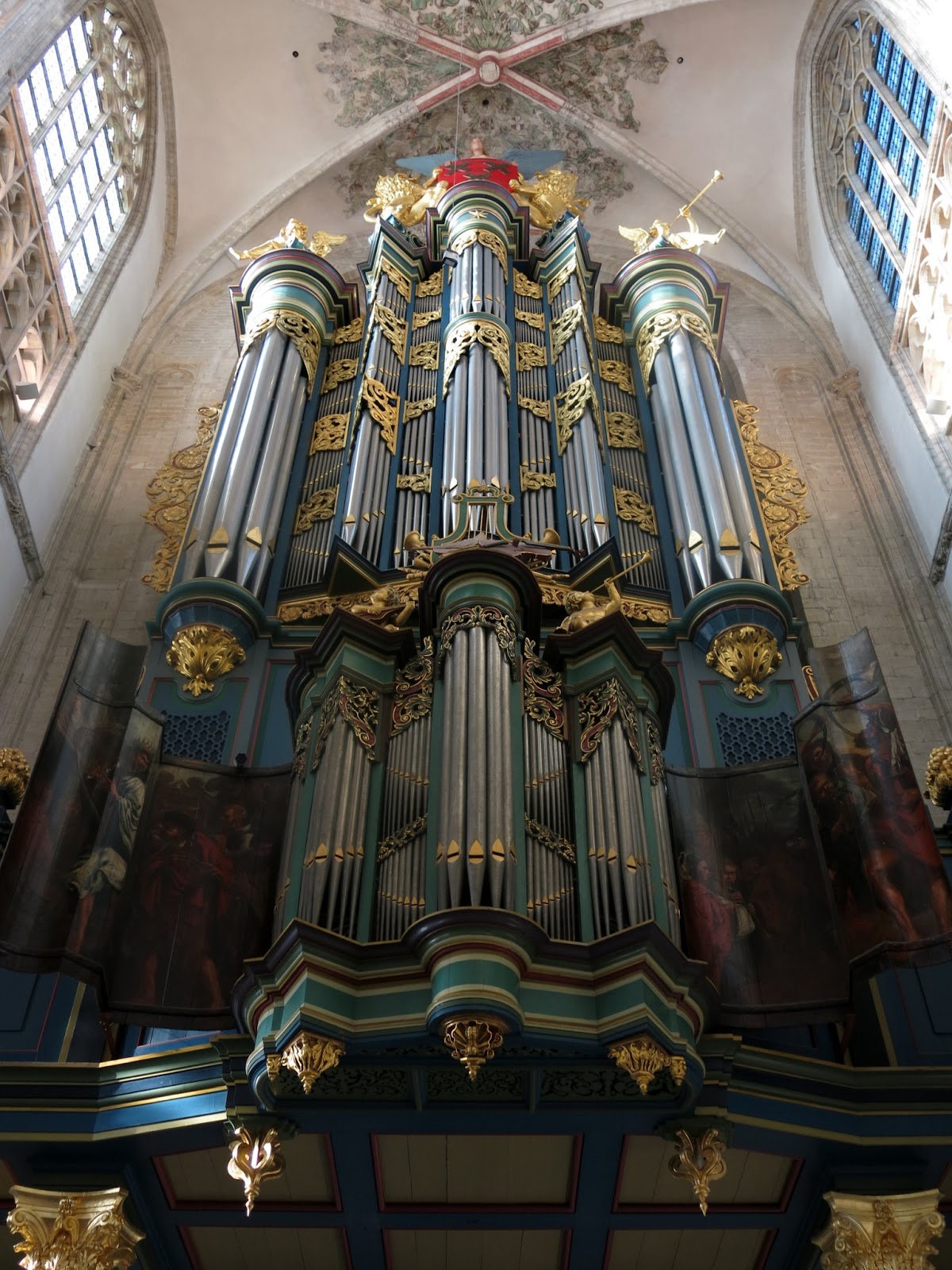
Admittedly many are defaced, either by iconoclasm which also struck here in 1566, vandalism or negligence, but they are worth seeing. There are even several modern ones, added much later.  Apart from the choir stalls, there is a magnificent organ built against the west wall. 
Details of the pipe organ


As the church is no longer regularly used for worship, the nave is empty and the beautiful blue floor tiles add character to the interior. Breda was the seat of the Princes of "Orange-Nassau", the forebears of our Dutch royals, and many of those princes were interred her. So the church also houses many elaborate tombs. In the sixteenth century a special chapel was built, the "Princely Chapel". The vaulted ceiling was beautifully decorated in blue and gold. 
A tryptich by the well-known Jan van Scorel which is still present was situated behind the altar. The monument  was built for Engelbrecht II of Nassau and his wife, by his son Henry III of Nassau. To me it seemed unusual that the couple is lying there in what looks like simple shrouds instead of formal and ornamental attire. Is it because they wanted to stress that we are all equal in death and that neither rank nor wealth makes any difference?
Since it was such a sunny day, the church was flooded with light which showed off all the subtle colours, the gold and the blue.

Another place worth seeing is the Beguinage. 
 Below: reflection of the church in a window of one of the houses
 Just an picturesque corner in the Beguinage
It is walled in, and so protected from wind. There are regular services in the little church or chapel, but when I was there in the early morning, I could only see the interior through a glass partition. The pictures are not much good, as I could not avoid my reflection in the glass. It is quite a large Beguinage, with several water pumps. It must have been good to live here, protected and well cared for. And I guess it still is. The Eglise Wallone is also part of this Beguinage, but the oxblood red doors were firmly closed and I could not even peep through a glass door or window. The history is rather fascinating. The Eglise Wallone originally was the church of the Beguinage. But it was taken away, and the entrance was moved to the street, the original doors walled in. 
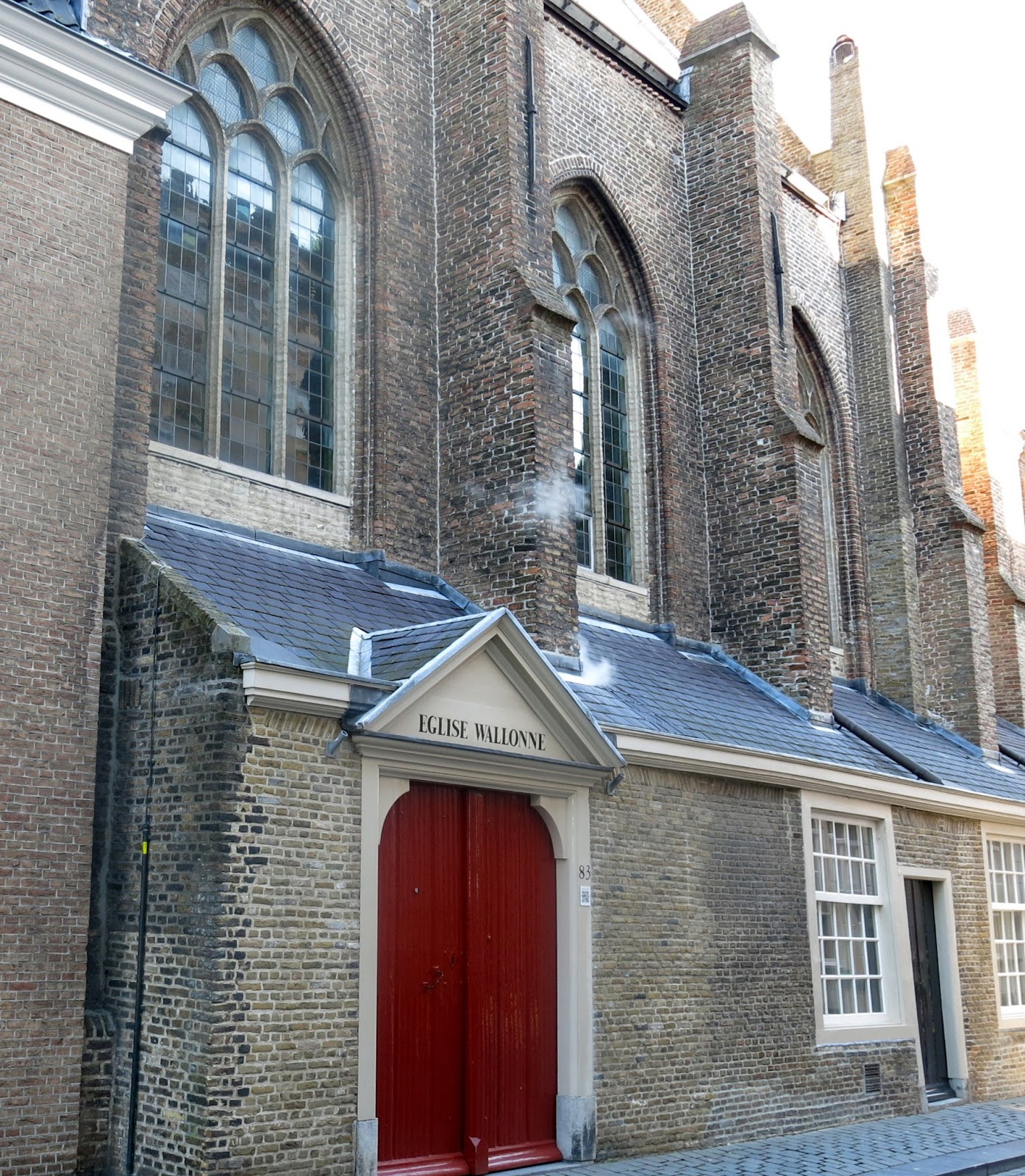
Eglise Wallone. The white blob is smoke coming from a hidden chimney
In fact it left the women living in the Beguinage without a church. Their new church which now forms a focal point dates from 1838 and a priest, Pater van Zon,  was the driving force behind the building plans. He had a vicarage built next to the church in 1850. So over the ages quite a lot has changed here.
Another corner in the Beguinage
It was difficult at any time of the day to take good pictures, as the contrast between light and shade was so stark.
My next stop was the Museum of Breda, just outside the centre, to see an exhibition of paintings by Petrus van Schendel (1806-1870), a Dutch romantic artist and  a master of night scenes, especially outdoor markets which were lit by candles. Light and shade fascinated him. He was internationally famous, won many prizes during his working life, and even kings and queens bought his paintings. I never knew there were night or evening markets in the Netherlands in the nineteenth century, or at any other time. But the backgrounds were realistic, and can be traced to market squares in Rotterdam, Amsterdam and The Hague, towns where he lived for some years. 
 Two of the paintings by Petrus van Schendel, from the flyer.
The paintings were very atmospheric, but after so many candle lit market scenes, I got a bit tired of them. Nevertheless it was an exhibition well-worth seeing, even a revelation.
I retraced my steps and had something to eat and drink in an amazing cafe-restaurant in the market square. Apparently that too had won a prize, for its remarkable and attractive interior. It is in an old building, and as the Christmas trees and decorations were still there, it looked very festive indeed.
 The exterior of the church, and the tower seen from one of the narrow shopping streets.
Days are not very long at this time in January, which is just as well, as my feet needed a rest, and the battery of my camera died on me, just when the light faded. Time to take a train back home and relax.
Some details from the church in Breda:
 Painting on the ceiling
below: detail of a wall in one of the side chapels
 St. Caecilia, on the banister of the stairs to the organ console

Wednesday, 9 January 2013

New Year resolutions


2013, a new year. Why do we celebrate the new year in the middle of the year? And what is so new about it? For people who have always been involved in education, as pupils and students, and later as teachers and lecturers, the change of year takes place in the middle of the educational year. School years are planned from September to July. September being a new year, a fresh start, new faces, both of pupils and teachers, and colleagues. Why doesn't the new year begin in September, just after the summer holidays, or on the first day of Spring, or the day after the shortest day, December 20th or 21st?  At university budgets have to be ready before January 1st. Funds are granted for a period of a calendar year, starting on January 1st. Targets have to be met, money which hasn't been used, can't be saved for the next year when it may be badly needed, but is taken away. It is a peculiar system. For the new year is just a continuation of the year which began in September of the "old" year.
I have never felt any pressure to decide what I am going to change in the so-called New Year. All through the year I might promise myself to do better after I have failed, or said something wrong, or made a mess of things, or have had too much to eat or drink. After such a day or time I evaluate what went wrong, what changes I have to make, if any. Not especially on New Year's Eve or January 1st. This also saves me the heartbreak of disappointment, as it is well-known that New Year Resolutions have a very short sell-by date, usually less than a week if statistics have any truth in them, and they are certainly forgotten at the end of January. Nevertheless I do use this slack time well. Christmas has come and gone, meals are frugal to make up for the bounty of December, there is no more singing, there are hardly any choir rehearsals nor Christmas concerts. There is no excitement over frozen canals, no feverish hope of skating on natural ice. It has been far too mild a  winter so far. However, there have hardly been any sunny days. Instead it has been dark and gloomy and wet for weeks, with only the minimum of daylight hours and very long and dark mornings and evenings. Now that I have taken down the Christmas lights and decorations, it seems even darker. Tracks are very muddy, so walking is no pleasure. Instead I have made the most of it and have cleared out kitchen drawers and wardrobes, and gone through piles of magazines. I have boxed things which I no longer need or never needed in the first place, ready to go to a second hand shop – or the dump. I have bought  matching containers which stack neatly in my kitchen cupboards, thrown away foodstuffs which were not in view and so had lived on my shelves for years and years. As the weather is still miserable, I may do some more clearing out and cleaning. No New Year resolutions for me, but boy, do I feel virtuous!

Wednesday, 2 January 2013

Haarlem and Rafael


Early in the morning I went to Haarlem to see another exhibition, drawings by Rafael. Fascinating! The drawings and sketches, - studies most of them for the paintings and frescoes - are so minute and so detailed, it is just unbelievable. Every scrap of paper is used. And the drawings look very modern, especially the different expressions of the male faces. Such a contrast with medieval art when people were just types. In these drawings individual characters are represented. The women were more idealised, I think, with mostly a very serene expression, fit for the Madonna, who was in fact most often pictured when it came to women.
We – I and a friend who is an art historian - entered the museum as it opened, which was just as well because it became so busy that people were only allowed in piecemeal, one by one, when somebody else left, a slow process. By the time we left there was an enormous line winding its way through the museum and all the way to the front door. Without realizing it, we had spent two hours at the exhibition.
After "loitering" in front of showcases and glass framed drawings, It was very relaxing to sit down and have lunch in a cafe on the market square, with a view of the imposing Bavo church. Time for a chat and for – mild – gossip!

 
The rising sun reflected in the windows


The beauty of being in Haarlem just after 9 o' clock in the morning was that at that hour the city is still rather quiet with little traffic. The early morning light made everything look fresh and new. Fortunately I had brought my camera, so I tried to capture the atmosphere of the city, which with its many waterways and canals is very picturesque in places. For a change there was no wind, the air was clear and the sky cloudless.
After lunch I took a train to Amsterdam because of some errand and since I now had a camera with me, I went back to the museum Ons' Lieve Heer op Solder to take better pictures of the pipe organ and the interior of the church. Fortunately there was hardly anybody around, totally different from Saturday. Here are a few pictures of the interior and the small pipe organ.


Sunday, 30 December 2012

The Christmas tree


December 30th, the last day of my late husband's life on earth, already years ago. I try not to think of it on that day, but can't help it. Not the day that he actually died which was December 31st, but his last full day on earth. There was this small Christmas tree with its pale blue and gold baubles, its happy lights, its green boughs. There were Christmas cards everywhere, wishing him and me all the best for the coming year. There was his hospital bed in our living room, there were candles and Christmas decorations, the wine glasses and the table laid for one of his favourite foods, delicious Dover sole, which he could not eat, only look at and savour with his eyes. Outside there was the occasional bang of early fireworks. In the house it was very quiet, peaceful even. I slept on the couch that night, for hours, next to the Christmas tree, till I thought it would be safe to go up to my bedroom. I checked on my husband several times. I did not see Death entering our door. He came as a thief in the night, stealthily. When I came down early the next morning, Death was sitting on the bed, giving my husband just a minute to take leave of me, although he was no longer able to speak nor move.
The Christmas tree was there till Epiphany, the arrival of the three Kings, my husband's funeral and the thanksgiving service for his life. When I came back, my neighbours had dismantled the tree, and tidied the room. Is that why since then I just can't get myself to buy a tree and decorate it? I have always loved doing that, while listening to Christmas music, drinking a glass of mulled wine, smelling the fresh batch of cookies, the fruity Christmas cake, all the preparations for that long awaited feast, Christmas. I prefer going away now, to friends where I am welcome. This year I have stayed at home, but there is no Christmas tree in my house. There is a crib, a beautiful one which does not remind me of that time as it was given to me years later. It is a crib which I love and cherish and the first – and sometimes only – Christmas decoration which I will always put in a place of honour. It will stay there till Epiphany.

The twelve days of Christmas


It is still Christmas, in spite of what our preacher – a protestant woman by origin – claimed, that Christmas had come and gone and was over till next year. Clearly she had never been to Mexico where Christmas and the Christmas festivities last till January 6th, when the three wise men arrived to give honour to the new-born king. Nor had she paid attention to the poem about the 12 days of Christmas and all the gifts bestowed upon an innocent girl by her "true love", including maids a milking and pipers piping apart from a partridge in a pear tree. And also in Great Britain and in the catholic churches in general, Christmas doesn't stop at Boxing Day. So we sang carols in church today, the crib is still in its place and there still is that feeling of joy and expectancy. What we expect, I do not really know. Is it the hope that the world may at last change and become a better place? That this child will bring the world salvation, peace and be a source of gladness? Are we expecting something great to happen? Or have all the lights, has all the music, lifted our spirits in these dark times, when daylight seems to fade almost as soon as it has appeared? For me this time is a magical time. As a child I loved it. It was about security and happiness, about family and of course about Christ. Not about presents. Present giving at Christmas is not a Dutch tradition. We might be given a book, even two books at times, one by the Sunday school and one by our parents. Reading was stimulated all through our childhood.
The saddest thing is to wake up alone on Christmas morning, something many people have to face. There are different ways of coping with this. Being alone and moreover childless means no family gatherings, no happy bustle around the big family table, a repetitive thing, for it also means no grandchildren and no way of experiencing the joys of one's own childhood again through one's offspring, through the eyes of happy children.
After the many carol services, the joyful Christmas concerts, the frequent rehearsals and two magical Christmas Eve services, at last the singing is over, the sheet music can be filed away till next year, and there is time to visit friends and family, to see exhibitions and explore a town or city. Or to go for a walk, weather permitting. As in England and many parts of Europe, the very wet and windy weather hasn't been inviting to venture out into muddy woods and fields.
Late afternoon sun on the tower of the Zuiderkerk, built as a protestant church in the 17th century by Hendrick de Keyser but no longer in use as a church.
Yesterday I spent a day in Amsterdam with a friend from University days, who now lives in Canada. Amsterdam was flooded with thousands of people, tourists, schoolchildren who are having their holidays, concert go-ers and museum visitors. We went to see an exhibition in the Hermitage, a former old people's home situated in a beauty spot on the river Amstel, and now a museum. The exhibits there are usually on loan from the Hermitage in St. Petersburg. This time there was an exhibition of paintings by the Impressionists. It wasn't as exciting as we had hoped, and the museum was far too crowded, but the building itself is well worth a visit. Especially the former church inside the building, which is now used for special occasions as it is a very spacious and long hall. I love the small organ there, but did not bring a camera and had to make do with my cell phone.
The organ in the "Hermitage", the former old people's home
To our surprise the afternoon was beautiful and sunny, so we went for our lunch to a cafe-cum-restaurant with a view of the river Amstel and the Munt tower. We could enjoy this view from our table next to the window for far longer than anticipated, as we had to wait over 30 minutes for our sandwiches due to a faulty handheld computer. I must admit we were given a drink on the house to make up for the long wait. But it is just annoying when others came in a lot later than we did and then left after having enjoyed their lunch while we were still eagerly and hungrily waiting for our modest sandwiches.
On our walk through the oldest part of Amsterdam with its many canals – and unfortunately in certain parts spoilt as it also houses the red light district – we came upon an old, hidden church, Ons' Lieve Heer op Solder, a Roman catholic church built by a rich merchant in the attic of his house during a time that Roman Catholicism was forbidden in the Netherlands. People met in secret and the front of the house did not reveal what was inside. There was even a separate apartment for a live-in priest. Although once a month mass is celebrated there, it is now a museum. I had passed it often, but this time we went in. It is a very interesting place, and the church with its three galleries has been lovingly restored. Because of Christmas it was beautifully decorated with pine garlands and red ribbons, but no flash pictures allowed. And because of the fading light outside, it was pretty dark, which made it even more mysterious. In fact this visit turned out to be the highlight of our day out, an unexpected treasure.
Looking down from one of the galleries into the main part of the church
On our way to the railway station we passed the St. Nicholas, - the big church opposite the station, dedicated to St. Nicholas, patron saint of Amsterdam - hoping to attend Evensong, a service which is regularly celebrated on Saturday afternoons at 5 o' clock. It is an hour of contemplation, peace and beauty after a hectic day in the busy city. Alas, not on this Saturday, as the two choirs responsible for the Evensongs, enjoyed a well-deserved holiday after all the music they had sung during Advent and at Christmas.

Wednesday, 5 December 2012

Travels through the USA


I am reading John Steinbeck's novel, or rather travelogue, Travels with Charley. Steinbeck decided to take a trip through the USA. He rigged out a truck with all possible necessities, food, clothing, writing materials, camping gear, a stove, just about everything one can imagine. He took his dog Charlie with him for company. Calling his truck Rocinante, the name of Don Quixote's horse, was an appropriate gesture. I am only half way through the book, but it seems to me that his book is not so much about the USA, as well as about himself, his feelings and emotions, his uncertainties, loneliness, homesickness and at times his fear. At the same time I am reading another book, by a Dutch historian, Geert Mak. It is called Reizen zonder John (Travels without John). Geert Mak decided to take the same trip 50 years after Steinbeck did his. Mak wanted to know how America had changed, and what is left of the American dream. The interesting thing for me is that I also went on a similar trip in autumn, although not covering as many states as the two writers did. Nevertheless my observations are not much different from Mak's. It struck me that the heart of many small towns, especially in the mid-west, are dead. The Main Streets are empty, shop windows boarded up, the once proud and imposing bank buildings abandoned, the centres lifeless. 
Former Bank building
If I compare what I saw now with what I saw some 20 years ago, I see a noticeable difference. Then any town would have a motel, now those typical motels are either for sale, boarded up or just left behind, sagging, the paint peeling, the veranda's broken. The many well-known chains of motels and hotels have taken over and are usually found on the outskirts of the towns, next to Walmart, eating places, and shops. Even the banks have moved out to those business centres.
Some towns are still thriving, but that is not generally the case. If a town is still lively, it is sometimes because artists have started living there and there is a bohemian atmosphere. Or a small town near a University campus may be kept alive by the students and their needs. But the hearts of many small towns have been cut out, unfortunately.
In the country it is sometimes even worse. There are churches everywhere, but not always enough people living near or around those churches to keep them open. The emptiness seems worse as most houses are built of wood, and wood can be used for fuel or many other purposes. So dwellings disappear, and often I could not even trace where a town had originally been located. There were just isolated churches.  I saw many sagging barns and abandoned farms and farmland given back to the wilderness and to nature.

 Abandoned houses and cars
A sagging barn

Monday, 3 December 2012

Advent Sunday 1


Time seems to go so quickly. I still have not sorted through all the pictures and the diary I kept on my trip through Canada and the USA. It feels as if the memories are whirling around and haven't settled yet, like snowflakes in one of those glass balls with a scene in it. When you shake one, snow starts falling and it takes some time for it to stop again.
Meanwhile Christmas has caught me by surprise. Yesterday was the first Sunday of Advent. It is weird to begin this Christmas-tide, the time leading up to the birth of Christ, when St. Nicholas is still visiting the Low Countries and the atmosphere is so different. One advantage of St. Nicholas, celebrated on December 5th, is that traditionally most people give their family and friends presents on that day. Which means that at Christmas we can concentrate on what Christmas is really about, at least if we are believers, and in glad expectation await the mystery of this birth.
For choristers this is a happy but busy time. I sing with two Anglican choirs during this period and so it means a lot of rehearsals and driving between The Hague and Haarlem. For me the Advent Carol service is the most wonderful service of all with the Matin Responsory, the Advent Wreath prayer and the Vesper Responsory, partly chanted.
Advent Mattins Responsory (after Palestrina), sung by the Choir of St. Paul's Cathedral. London

We begin in a dark church, the choir standing at the back and holding candles. The most frightening part is processing in, blinded by the small flame of the candle, holding it in one hand and the music folder in the other, having to turn pages, trying not to trip or set the hair of the singer in front of me on fire! I suppose the Fire and Safety department would be greatly upset by what we do. One by one the candles held by the people in the congregation are lit. It is magical, but nevertheless it is a relief when we can put them out, as space is rather limited so we are very close together next to the small pipe organ. I have added a link to the Advent Carol Service held in Trinity Chapel. Here the chapel is lit by candles only during the entire service. It is a wonderfully moving service which you may enjoy listening to.
Advent Carol Service 1012 Trinity College Chapel November 25th 2012

This year the service was one we will never forget. While we were singing a carol, there was an awful noise as if the organ case came thundering down. What happened was that one of our singers had fainted and fallen from the podium, in between the wall and the back of the organ. Although he must have hit a table and other objects, the unfortunate bass hadn't broken any bones. After he regained consciousness and had been given a glass of water, he was able to stay in the choir for the rest of the carol service - this time sitting down securely between two other singers who guarded him. It did ruin our concentration for a short time only, and in part the mystery and beauty of this service .
This is the liturgy of yesterday's service:

Advent Carol Service
Choir: Matin responsory (Palestrina)& Come thou redeemer of the Earth
Choir: during procession: Advent Wreath prayer for Advent Sunday   
Hymn: O come, O come, Emmanuel – arr.Rutter  
         Bidding Prayer
Choir: Advent prose – arr. S.Cleobury   
         Lesson 1: The prophet proclaims the good news to a people in exile
Choir: People look east – arr.B.Ferguson 
         Lesson 2: The Lord promises to send his people a righteous King
Hymn: NEH 15 “The Lord will come and not be slow”
         Lesson 3: The Lord promises that the King will come to Israel in peace
Choir: How beautiful upon the mountains – J.Stainer 
Hymn: NEH 5 “Hark, a herald voice is calling"
         Lesson 4: The prophet foretells the advent of the desire of all the nations.
Choir: Never weather beaten sail – R.Shephard 
         Lesson 5: The prophet foretells the glory of the kingdom of God.
Hymn: NEH 14 (tune 341) “The Advent of our God”
Choir: The angel Gabriel – arr.M.Archer  
         Lesson 6: The angel Gabriel salutes the blessed virgin Mary
Choir: Ecce concipies – J.Handl. 
Hymn: NEH 10  “Long ago, prophets knew”
         Lesson 7: Jesus proclaims the coming of the kingdom of God
Hymn: NEH 9 “Lo he comes with clouds descending”.  
Choir: Veiled in darkness  - Rudolph     
Choir: Vesper Responsory – Ph.Ledger   
         Collect and Blessing
Hymn: NEH 30  O come all ye faithful ,  verses 1, 2, 6. 


I was very happy to discover this website, Saturday Chorale, which has links to a lot of well-sung Anglican church music.

Followers

Blog Archive