Saturday, 21 February 2015

Church Crawl

Historic Churches Crawl
After three joyful days of singing in Coventry Cathedral, but windy, dull and wet as far as the weather was concerned, a glorious day of church crawling from Cambridge. Although the area around Cambridge is rather built up, the countryside is very attractive and scattered with interesting villages. On a bright and sunny day, although very cold, it was a joy to drive around.
Our first stop was Babraham church, hidden along a country lane and not visible from the road. It belonged to Babraham Hall, a large Victorian estate, now housing an important research institute of Cambridge University. Unfortunately the church was locked, the key holder not answering her phone. 
  
So we left without having seen the interior  which according to Jenkins[1] has box pews, a remarkable memorial and a modern but striking stained glass window which was partly visible through one of the windows. It lies next to a pretty gurgling stream, now festooned with early snowdrops. Unfortunately concrete buildings have sprouted all around, spoiling what could have been a very arcadian place.
Our next stop was Duxford, a delightful English village which has two Anglican churches, St. John’s and St. Peter’s. St. John’s is now redundant and under the care of the Churches Conservation Trust. It stands high on the village green.  After collecting the key at one of the nearby houses and opening the heavy door, the interior was quite a revelation. Especially the wall paintings and the massive Norman arches are impressive. The wall paintings depict saints, devils, angels and strange creatures, as well as decorative edgings. The space seems a bit unpractical for worship.

 St. John's
 St. John's


Left: Stairs to the rood loft  Right: the decorated roof beams
One of the attractive houses surrounding the church

The nearby St Peter’s  is now the local church but seemed  less interesting.
 

 Above: St. Peter's Duxford

We went on to Ickleton, to St. Mary Magdalene. The church borders the village green, which is surrounded by brightly coloured houses. The spire is worth looking at, as it has an unusual outside bell, suspended from the top of the spire under its own canopy. I had never seen that before. Inside there are some treasures. To begin with glorious wall paintings, which only were discovered when cleaning the walls after a fire. Besides there are beautiful carved bench ends, and an original, brightly painted rood screen. The setting is very peaceful and I think I could easily live here, or in any of the other villages.


  Carved bench ends
 

 Ickleton village green

It was time for lunch, so we drove further south to the Fighting Cocks, where we expected to feast on good food. However, no food on Mondays and Tuesday and this of course was Tuesday. But the barman referred us to another pub, the Fleur de Lys a bit further south in Widdington. This oxblood red stucco pub was indeed very attractive and quaint, and they did have good food, all prepared with local products they claim. However, on Tuesday the landlord did the cooking and the chef had his day off, so it took over an hour of waiting before we got our food as the pub was packed mainly with groups of women and hikers. Since we still had some more churches on our list, my friend was on tenterhooks. But it didn’t really matter, as we were having a good time anyway.


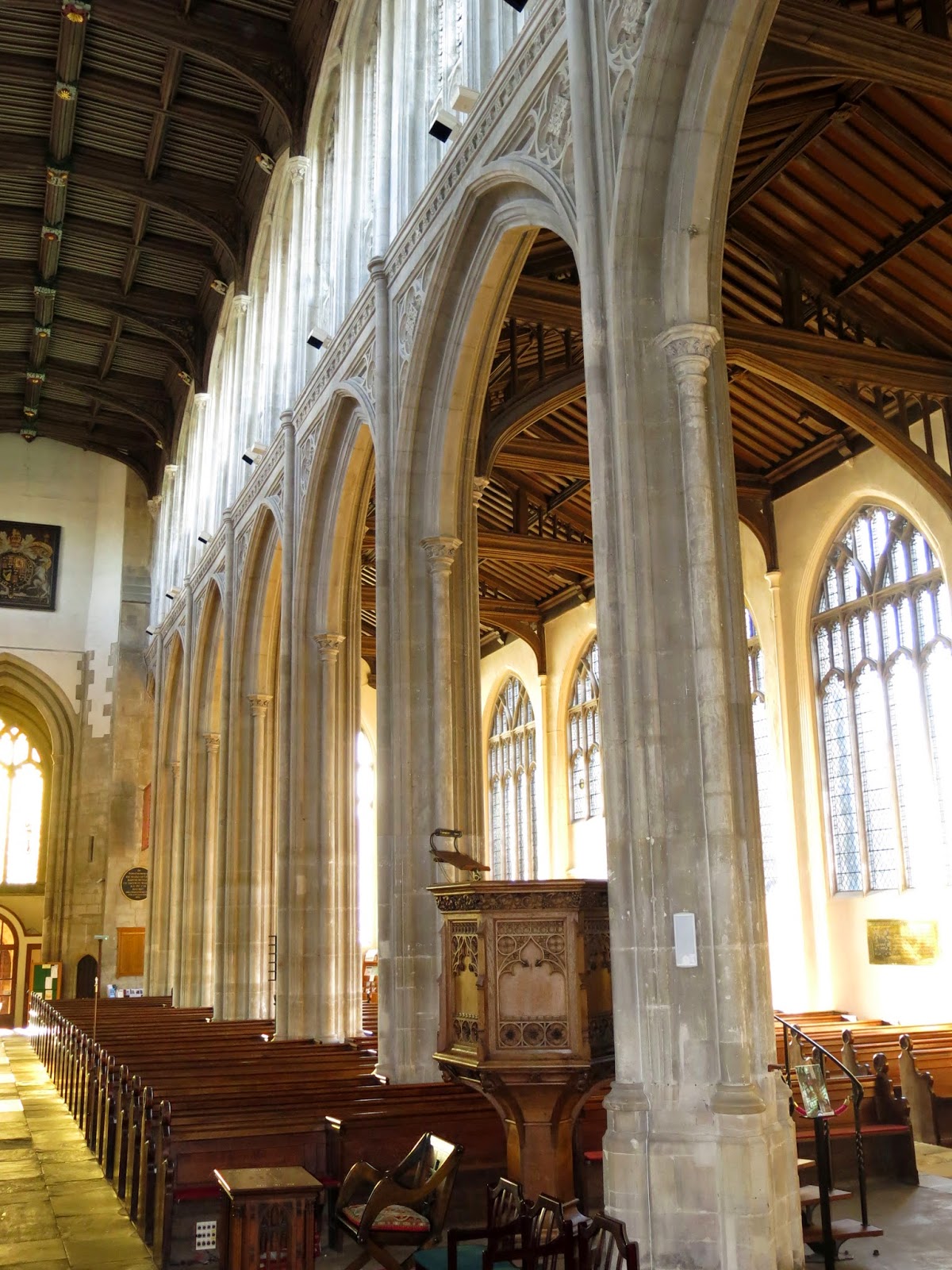
After a very late and but well cooked lunch we went back north to Saffron Waldon, a most attractive market town. The church, St. Mary’s, is the largest village church in Essex and towering over the town on a hill. It is very impressive and amazingly high. It was difficult to capture the height on camera. The town was busy as it was market day and many buildings on the market square were partly hidden by market stalls. Here is a site with photo’s of Saffron Waldon which are much better than mine. It still has its historic centre and streets, and looks very attractive. Besides, it boasts of having three mazes, of which I saw only one being the floor of the bandstand. It was too late to explore Saffron Waldon further, as it was getting dark. But it is definitely worth another, longer visit.

 Saffron Waldon Village church
 

 The door of the building above where Oliver Cromwell is siad to have lodged

 The Market Square


[1] Jenkins, England’s Thousand Best Churches, 1999, isbn 0-713-99281-6, Penguin Press

Coventry

A weekend of singing the services in Coventry Cathedral with the ECS choir.
The history of Coventry Cathedral is most interesting. It was bombed in 1940, and immediately plans were made to rebuild it. Germany also rebuilt historic city centres and cathedrals. However, in Coventry it was decided to leave the ruins as they are, and to build a new and modern cathedral, adjoining the ruins and forming an L-shape with them. 

 The cathedral ruins by night and by day

This also means that the cathedral isn’t built East-West as is normally the case. Through a glass wall engraved with angels and apostles one looks out at the ruins. The cathedral is meant to be a symbol of hope and reconciliation. 
A view from the ruins towards the glass entrance and wall of the new cathedral
 Looking towards the ruins through the glass entrance wall or screen of the cathedral
This weekend the services were in commemoration of the bombing of Dresden, 70 years ago, in 1945. Apparently both cities are twinned. On Sunday a 96 year old Englishman who had fought in the war in Germany, gave testimony of how his whole attitude changed when he saw mothers and children being killed. Since then he has been a staunch advocate for reconciliation and peace.
Lady Godiva 
It is a strange city. The heart is almost gone. Ruins are replaced by concrete buildings, a material which in the sixties was considered to be indestructible. It seems there was no town planning. Apart from the cathedral and the ruins there is a very big shopping centre, consumerism being the religion of our time. A statue of  Lady Godiva connects the old part with the new. There are some very old 14th and 15th century buildings scattered across the city centre. They have escaped the blast. One street which seems reasonably intact and looks very lively during the evening, each old house harbouring a restaurant, looks very dilapidated during the day with dirty window frames and grids to protect the windows. Besides the gaudy blue and yellow colours of IKEA are towering over the humble medieval houses.
A ring road is built around the heart of the city, a nightmare! It is too close to the centre and looks like the arteries around the heart, so close that it seems to strangle the city. The many loops, fly-overs and tunnels are so close together that before I and others realised we had to get off, we had missed our exit – many times that is. We went around innumerable loops and roundabouts. It was like going seven times round the walls of Jericho. But the ring didn’t fall! I wasn’t the only one to have trouble finding the hotel which was within sight but unreachable. It was just outside the ring road, and only a 12 minute walk from the cathedral, but on foot it meant negotiating two tunnels and a bridge to cross the ring, not very nice at night!
A view of the choir stalls with the crown of thorns as a canopy, the pipe organ on both sides and the tapestry, unfortunately partly covered by scaffolding.
 Left: choirstalls. Right: pulpit and the crown of thorns

The acoustics in the cathedral are very poor for singers, and we could not hear the other side of the choir, but to those sitting in the nave it seemed to sound fine. The choir stalls are open, crowned by pieces of wood which represent Christ’s crown of thorns. To me they looked like birds, a flock of doves representing the holy ghost. Wrong interpretation apparently. The whole cathedral is full of symbolism and very fine modern art. But I wondered about so many things.
 The exterior of the Chapel of Unity
 Christian symbols in the marble floor of the Chapel of Unity, a present of the people of Sweden.


The Dove of Peace in the middle under the glass altar. A ball placed on the floor rolls to the centre.
The cathedral is a symbol of reconciliation, yes. But since then so many wars have been fought and are being fought, even in Europe near “home”. It is the hope of the sixties and seventies, when we were determined and believed that war should and would never happen again.
 The Chapel of Christ in Gethsemane
The Chapel of Christ the Servant
Amazingly there was only a congregation on Sunday at the Eucharist in spite of the special weekend. It seems Coventry is not a tourist town. In the large basement of the cathedral there is a restaurant and a coffee shop, but both were closed during our stay. Probably because of half term.
The beautiful window in the Baptistery
Nevertheless, it was a wonderful experience singing in this special cathedral which I had always wanted to see and had heard so much about. Such an unexpected joy that now I could even sing here three Evensongs and the Sunday Eucharist.
A happy choir on the stairs to the Song School, beneath the charred cross, two burnt rafters from the old cathedral which fell down in this shape
We were given a very informative tour of the cathedral, which we enjoyed.  Unfortunately the big tapestry of Christ dominating the cathedral was partly concealed by scaffolding as the tapestry had to be cleaned and vacuumed, a task performed every ten years.
 Some old buildings in Coventry


Coventry was well known for its car industry and cycle works. The hotel we stayed in was a former cycle works, a historic place in its own right.

Wednesday, 21 January 2015

Another farewell

Saying goodbye
Her head peeping out from under the bedcovers is like a bird’s, narrow and thin. The huge, dark rimmed glasses wider than her skull, a pair of giant eyes. She looks healthy, her skin the orange of a cheap fake tan. Hepatitis does that. It is shocking to see her so vulnerable, emaciated, she who once was so sturdy and strong. But she hasn’t lost her sense of humour.
I had not expected her to be completely bedridden yet. The hospital bed seems too big for her now small frame. She is happy to see me, and so are her husband and daughter, who look after her. Her daughters take shifts helping their father caring for her during the night. Even an emaciated body is a dead weight when helpless.
It was a long drive, and I am still very tired after long flights from another continent. But I am glad I came. We talk about former times, all the things she has always done for others, her years as a home help, a social worker, a surrogate mother replacing the sick and being in charge of strange and large families. About how I came into her family and how she accepted me without asking questions. About the time before I got to know her, when she offered a home to nieces and nephews in times of need, never complaining but enjoying the vast brood under her roof. How she taught my stepdaughter to knit, an art foreign to her own mother.
She is content, tells me that people have asked her if she is afraid of dying. She isn’t, she says. She has tried to live a useful life, and she doesn’t know what is awaiting her. A still practising catholic, she just doesn’t know, whatever the priest might tell her. ‘Nobody has ever come back, so how can anyone know for sure’, she repeats many times. I do not have any answers. Yes, she has always been helpful, caring, dominant but fair, and altruistic. Even now that she is dying, she is phoning family and friends that her time is up, so that they will be prepared and not be too shocked when they hear about her death. She tells me again and again that she is not afraid. I haven’t asked her that question. Should I have? Does it help? Would it ease her passage from this world into another? I just thank her for accepting me, for giving us her house when my husband, very sick, was in a wheelchair and we needed a break. Her bungalow was the perfect place. She and her husband took off in their caravan so that we could enjoy their home.
I feed her little pieces of a warm croissant, with a spoon, her always busy hands useless now on the bed sheets. In between bites she sips water from a straw. It is like feeding the tiny birds in my garden. Her daughter is very caring. ‘I changed her diapers, now she changes mine,’ my sister-in-law says with a wry smile. ‘It can’t be helped.’  I see my late husband, his hospital bed in our living room, his body, just skin and bones. They seem to merge into one another, the brother and the sister, a deathbed revisited.
Before the three of us sit down for supper, the daughter takes off her mother’s glasses and she closes her eyes, tired now after all the talking.
After supper I have to leave, for I have a two hour drive at best ahead of me on a dark, and wet night. I am glad I came and that we could talk. I kiss her goodbye. Will I see her again, except in another world, the New Jerusalem? I don’t know, and for her sake and her family’s sake I hope I won’t.

Two days later I get a phone call to tell me that the morning after my visit my sister-in-law has passed away very peacefully. I am sad for lives that end, friends and family leaving this world, but glad she is now released from a body which no longer served her.

In Paradisum deducant te Angeli.

The Gregorian chant


From Faure’s Requiem Mass


Saturday, 3 January 2015

Canadian Museum for Human Rights

Cold
It is cold, really cold. What can one do when it is too cold to go for a walk, when it is a major expedition to venture outside? Fortunately, apart from the Nutcracker at Boxing Day, there is this pile of unread and very interesting books, and there are museums.
One of the latter, the Canadian Museum for Human Rights, is brand new. Even if there were no exhibits, the building itself is spectacular. From the outside it looks like a turtle or a turban. Inside there is glass and steel and there are lots of walkways crisscrossing the building, gradually leading to the different floors and the very top of the museum. It seemed we walked for miles and it was enough exercise for one day. 

In fact for me the architecture, so the building, was far more interesting than the exhibits, although any available new technique was used. The views of the city, the frozen Red River and the interesting construction of the footbridge, alluring in summer, are quite spectacular from behind glass. The exhibits may be more interesting for a younger generation and for Canadians and Americans. For me, a European citizen, not much was new.


As can be expected we were not the only visitors that day. Given it is holiday time and very cold, and this museum has been given a lot of attention in the media, you can imagine the long lines for the ticket office and the coat check.
 Looking through glass, on which the construction of the museum is reflected. 
 A train crossing the bridge across the Red River
 Looking down the steel and glass stairs
Footbridge with restaurant across the Red River leading from the British to the French part of the city
It was too cold by far to take any pictures outside, as my fingers were starting to hurt and stiffen the moment  I took off my gloves. Nevertheless I took a few, especially at sunset when the top of the footbridge tower and the top of the roof of the museum as well as its tower were coloured a deep red, a magic moment.
 Sunset


Followers

Blog Archive