Monday, 14 October 2013

Meeting people

The most valuable aspect of traveling is meeting with people, sometimes in unexpected places. On the long transatlantic flight, during the two day train trip through the Rockies, in remote towns where we were not expected, in Indian reservations, during hikes, everywhere I encountered kind people who shared part of their life stories with me. Countries might stun us with their natural beauty, the vastness of the skies, with awe that settlers have had the courage to try and cultivate very unpromising lands. I can be jealous of their surroundings, their freedom, of the beauty around them. As a mere tourist this might be my first reaction. But when talking to people it is clear that they too suffer from despair, illness, loneliness, autism, family tragedies and poverty like any human being. Beauty is no guarantee for happiness. Glimpsing the different ways people live their lives, may help us to be more content with our own lives. Or give us an impulse to change the way we live, the routine we are used to. Or at least question that routine. And it might make us more compassionate and tolerant.
The house of the spirits
Among the memorable encounters is the meeting with a few Indians in a reservation, one of them claiming he had sired 69 children, which made us wonder if apart from their own language they might have their own arithmetic system.
We were on our way to see an Indian burial ground, the “house of the spirits”. The unusual white roofs low on the ground built over the graves lured us into the village. We knew we had to make our intentions clear if we met any body. At first we did not see them, as they were hidden in the shade of a tree. An old sofa, something which looked like an old car seat, a tree trunk, those made up the outdoor furniture. How many there were I do not really remember. Five or eight maybe, and just one woman among them. They were at leisure, talking, drinking beer, and just passing time. Not till one of them raised his hand in greeting I noticed them. We walked down and asked if we could see the “house of the spirits” and how to get there. They pointed us in the right direction. We had not expected them to follow us, but two of them did. Perhaps they did not trust us, perhaps they just wanted to be guides. Whatever, they told us quite a few stories about the people buried in that graveyard. They all seemed to be related: a twin brother who died at the age of two, a father, a mother, aunts and uncles. It was only a small village, but apparently housed one large family group. We were allowed to take pictures, not so much of them as of the graves which seemed unusual to us. Afterwards we walked back to the big tree where they sat down again and started to tell even more stories. The man who claimed to have 69 children was quite proud of his success in that field. And who wouldn’t, as long as you do not have to support all of them? It seemed unlikely anyway, given the size of the village.
This was not the only burial ground we came across in that part of the foothills of the Rocky Mountains. A sad one was the lonely grave of a little girl, just the one grave near a creek, all on its own in the vast wilderness.

Ponteix
Ponteix. The old grain elevators have not been replaced by modern ones yet fortunately.


Another memorable meeting was that with the couple in a remote prairie town, Ponteix, who proudly showed us round their church, a church the size and shape of a cathedral, a small Chartres, the spires visible from a great distance, next to the two old grain elevators. Their lives seemed filled with happiness, till the wife told me about the cancer of her youngest grandson, still a baby.
The story of the church was a remarkable one, and of the French nuns who started all this and came quite unprepared to these remote lands, where they found very primitive living conditions and were shocked by the undrinkable water. The water is still bad, as it comes from what they call sloughs, shallow pools which have a high content of salt. The little sloughs in the prairies are often surrounded by thick rims of blindingly white salt, and the taste of the water is bitter. Most people now have purifiers in their homes for their drinking water.
It is sad to see the decline of a once thriving town, built partly by the efforts of the nuns who established excellent schools. Apart from the buildings, not much is left. The church is still there, but it is hard to keep it open and in good shape now that the Roman Catholic population is diminishing and the whole town is not as thriving and important as it once was. But at least the church is still standing and people care.

And there were many other encounters.
It began on my flight from Amsterdam to Vancouver.
I sat sardined between two women who were traveling alone. Nine hours is a long time to keep silent, so somehow or other we started talking. The woman on my right was the first to turn to me and to make an attempt at conversation. She was Irish, newly divorced from her Dutch husband of many years and lived and worked in the town I grew up in and which is not very far from where I have lived since leaving for university. Quite a coincidence on a full plane. The conversation somehow turned to Irish authors and she was surprised I knew anything about them, not knowing literature and English literature is my subject. Every year she played the part of Molly Bloom, a main character in Joyce’s Ulysses, in the town which for me still feels like home. And she looked the part: generous and generously endowed with her full figure and long, blond curls. She was going to Vancouver for a surprise party organized by the wife of a rich man who was celebrating his 60th. Apparently he lived in a large house in an expensive part of the Vancouver area.  “Molly” had flown in for the weekend celebrations and would fly back three days later. Just for one weekend of parties she had taken two big suitcases with her.   
“Well, you know, I want my shoes to match every outfit, so I took many pairs – and many outfits,” she confessed, a bit embarrassed about it all. I love that woman! What bliss to find a fellow sufferer of the Imelda Marcos syndrome, a woman who knows her priorities. 

The woman in the window seat was on her way back from Finland. She was married to a Canadian, and lived on a farm in a beautiful part of the Rockies, between Kamloops and Golden, on a lake. Now that her children had left home, she was homesick for Finland and wanted to retire there as she still owned a farm in her home country. But her husband, also of Finnish descent, did not want to leave Canada. Traveling through that stunning part of Canada, I thought: Who would not want to live here? Perhaps she didn't like mountains. It is hard to understand why some emigrants are always homesick, and some adept wonderfully to their new lives and surroundings. She was an extremely good guide for me. It was a clear day and she offered me her seat once we were flying over the Rockies. To my delight I recognized places and the confluence of the Thomson and Fraser rivers which I had seen on a road trip two years earlier. She pointed out the landmarks to me and explained where we were. It was like a Google map unfolding below me, the satellite version.
Before the plane landed we exchanged email addresses. Whether we will ever use them or meet again, I do not know. “Molly Bloom” might be my best bet. Perhaps one day I may even see her playing the part of Molly.

Vancouver

Tuesday, 17 September 2013

Music and pipe organs

Sunday September 15th
Just back from Choral Evensong in a church in Bussum. A big modernised protestant church, but with good acoustics. And a modern organ case. We all enjoyed the service. The repertoire was a combination of music we sang in Southwell this August. I have not written anything about Southwell yet, as during our singing week there was hardly time for blogging, and once back home so many things happened, that I never came round to updating the blog. 
  Southwell Minster: Sculptures in the most beautiful chapter house in England


In the meantime the music of Southwell, the beauty of the cathedral and the joy of singing in such an old building has been pushed a bit into the background by organ recitals I attended in Zaltbommel and Den Bosch. 
Southwell: Left: view of the organ and screen from the choir stalls. Right: The Norman nave looking towards the choir screen 

Den Bosch a real Roman Catholic Cathedral, and Zaltbommel a beautiful old and now protestant church with a famous pipe organ.
  Den Bosch, the pipe organ
Below: the eye of God in the  the late evening sun

 Zaltbommel: pipe organ and ceiling

And there was the Evensong we sang in the BAVO in the Market Square in Haarlem, after our return from Southwell. So many impressions and so little time to write about them. Besides the weather was extraordinarily beautiful and hot, a continuation of lazy summer days, gorgeous sunsets, a long walk to see the bright purple heather, lots of reading because of a very painful neck, and then the beginning of a new season. 
Sunset at Katwijk

Regular church choir which started again, meetings of the cultural institution in my home town/village, a dinner outside enjoying a warm evening on the terrace of a restaurant – how often does that happen in Holland? – with my small writing group. And last but not least, preparing for a long trip this autumn. So perhaps again no more blogging for some time.
 One of the last days of summer and the heather in full bloom

For those who are interested, This was our music for the week in Southwell Minster:

Monday 5 August – First Eve of Transfiguration
Introit: O Nata Lux – Tallis
Preces & Responses: Michael Walsh
Psalms: 99 & 110
Canticles: Wood in E flat no 1
Anthem: O for a closer walk with God – Grayston Ives

Tuesday 6 August - Transfiguration
Introit: Holy is the true light – Harris
Preces & Responses: Gabriel Jackson
Psalm: 72 (Mann sp78 quadruple)
Canticles: Sumsion in G
Anthem: O nata Lux – Morten Lauredsen
Hymn: 494 (t 413) + descant

Wednesday 7 August
Introit: Prayer of King Henry VI – Henry Ley
Preces & Responses: Gabriel Jackson
Psalm: 37
Canticles: Harwood in A flat
Anthem: Vox Christi – Philip Wilby

Thursday 8 August - free

Friday 9 August
Introit: The Lord will come and not be slow – Christopher Tye
Preces & Responses: Smith 5 part
Psalms: 47-48-49
Canticles: Purcell in G minor
Anthem: Prayer of King Henry VI – Gabriel Jackson

Saturday 10 August
Introit: God be in my head – Nicholson Preces & Responses: Leighton
Psalms: 53-54-55
Canticles: Blair in B minor
Anthem: Ascribe unto the Lord – S. Wesley
Hymn: 225 (t.385)

Sunday 11 August, Choral Eucharist
Mass setting: Darke in F
Motet: I give to you a new commandment – Nardone (RSCM)
Hymns: 440 + descant, 297, 285(i), 383(ii) + descant, 388(i)

Sunday Evensong
Introit: Bless, O Lord, us thy servants – Harper
Preces & Responses: Leighton
Psalm: 108
Canticles: Stanford in A
Anthem: Love Divine – Howard Goodall
Hymns: 409, 333


Monday, 29 July 2013

Books and Beach

The nice thing about this more or less dead season is that at last I have been able to read through some of the books labelled "to be read". It has been hot, we even had a real heat wave, so strenuous exercise was not an option. Half the country is on holiday, life has come to a temporary halt, there are no meetings, the church choir is free and many of my neighbours and friends are away. It has been utter bliss to sit in an easy chair in my garden, in the shade, lost in a book and – literally in between the lines - enjoying my garden and the beautiful lilies in my small pond. In the evenings, when most people leave and go home or to the camp grounds to have dinner, sunburnt and tired, I went to the beach for long walks along the water's edge. After two hours it is good to sit down with a glass of wine and watch the sun set on the horizon.
The  setting sun
 and opposite the moon which was relatively big
The moon over the typical wild roses along the path to the parking lot. Especially in the evening the roses are very fragrant
My reading has been very varied. Here is a list of the books I finished. Meanwhile the reading goes on:
Tracy Chevalier, The Last Runaway
Barbara Kingsolver, Flight Behaviour
Ian McEwan Sweet Tooth
John Williams, Stoner
Joanna Trollope, The soldier´s wife
Kate Brighty Colley, While Rivers Flow

         The Last Runaway takes ¨place in Ohio, in a primitive area with settlers, farmers struggling to survive. It is also a passageway for runaway slaves en route from the southern states to Canada where they will be safe. The main character is a young English woman who emigrates by chance from Bridport in England. She is a Quaker, and has to survive without family or friends in this new land. It is well written, I think, and gives an idea of the struggle of the early settlers and of the loneliness and isolation. It gives some insight into the problem of slavery just on the brink of abolition. Tracy Chevalier knows how to tell a story and captivates the reader.
         So does Barbara Kingsolver, but I thought her book not very coherent nor convincing. However, the poverty of the Appalachians and the environmental issues, global warming, wasting resources, are interesting. Even hilarious at times, when well to do students try to urge the poor hillbillies who hardly earn a living, to be frugal, not knowing a thing about poverty. The environmental subject is built around monarch butterflies which normally stay in Mexico during the winter, but due to global warming and logging didn´t get any further than the Appalachians. If you are fascinated by or interested in butterflies, this certainly is your book as well. It is a good read anyway.
         Stoner was written in 1965, but reprinted by Vintage Classics in 2012. It is about the undistinguished career of an assistant professor of English literature at a just as undistinguished university, and about his seemingly uneventful life. He marries the wrong woman, makes the wrong choices, and produces only one book which is quickly forgotten, already during his lifetime. It gives a very clear picture of academic life, the cruelty of people and how manipulative they can be, and about vindictive university politics. I found it rather fascinating. Besides, I think those university politics are still rampant in many universities today.  That part, the university and the intrigues, I recognised and it was an eye opener to discover that nothing is new.
         Joanne Trollope is light summer reading. Since I know little of military life in Britain, it did not appeal to me much. But it was an entertaining read and not too taxing on a hot summer´s day. As always the background is well researched.
         Ian McEwan disappointed me. All the time I was waiting for something crucial to happen, and I think it never did. I have read better novels by his pen. It is about the machinations of M15, the secret service in Britain. Perhaps the subject just did not appeal to me, for it was certainly well written and as such worth reading. His timing, choice of words and beautiful use of language saved this novel for me.
Enjoying the water lilies. I absolutely understand Monet. I made very many pictures to try to catch the essence of their beauty. If I were an artist, I also wouldn't be able to resist painting them over and over again.

While Rivers Flow, Stories of Early Alberta written by a district nurse, was fascinating. A different world, the hard life of settlers, and Indians and white men living together peacefully. Uninhabitable land, homesteads which could only be reached on horseback, and better in winter when rivers swamps and lakes were frozen and could be crossed more easily. I once got a glimpse of Alberta and Saskatchewan, so enjoyed it enormously. It was published with the support of  Alberta Heritage Learning Resources Project in 1970 But the stories all take place more or less between the two world wars. It is told simply by the nurse, so has no literary pretensions whatsoever. But I loved it.


Sunday, 14 July 2013

Waking up

Thinking about waking up, there is such a difference between waking up in the city or in rural surroundings.
Staying in the Cotswolds at a friend's "cottage" , a very quiet spot on a bend in the river and a dip in the valley, I would wake up by the cloppity-clop of horses. No cars or milk floats, but horses. It somehow defined the slower pace of life. Putting myself mentally back in that place, happiness seems to well up in me.
Waking up in a room at the back of a small hotel in Austria because of the soothing noises of the stream just under my window, fast flowing across the pebbles. That is bliss too.
Or from my bedroom window in another English village seeing a fox at daybreak walking proudly in the middle of the road, on velvet, king of the morning.
A beach house in North Carolina, a house on stilts, the waves of the sea breaking almost against the poles. Seeing dolphins jumping happily along while the sun rises red on the horizon. That too is bliss. 
Waking up in the middle of the night in a primitive compound in South-Africa, hearing people outside the camp singing and dancing, till daybreak, waiting for the rains to come. A land without cars, only horses and goats, and then the strange sounds, unreal, almost eerie. Another world.
Seeing the early morning light on the top of a snow capped mountain from one's bedroom window, inhaling the cold and fresh mountain air before going back to sleep again.
Watching the sun rise over a lake, the water steaming, an early boat going out to fish vaguely visible through the amber coloured mist, the doleful sound of loons greeting the new day.
The low morning sun shining through long, diamantine icicles hanging from the roof of the house after an unexpected and early snowfall in the depths of Colorado.  A herd of elk moving slowly in the distance, the shrubs on the foothills like an iced crumble cake, blinding in its purity.
And Chambord, the foolishly ornate palace now only inhabited by swifts and martins, joyfully flying in and out among the crenulated chimneypots and the spiral towers.

All those places are magical. But when I want to write a story, a story which has been forming itself in my mind over some time, wanting to get out, to be written, I imagine myself back in the Cotswolds, in front of the open bedroom window, deeply inhaling the cold morning air. I then put pen on paper behind the antique writing desk, float away into that magic world of fantasy, unencumbered by any worries or daily chores. This is where I escape to, this is where I find inner calm.

Friday, 12 July 2013

Birdsong?

Every morning I wake up at the crack of dawn. I am like a chicken, as soon as there is some light on the horizon, I seem to notice it in spite of black out curtains. If it isn't the light, I wake up because of the birds. Not by the serene and joyful chirping of house martins and doves as in Chambord, where everything was pure and fresh. Nor do the blackbirds sing at this time of year, the height of summer. But by the screeching of angry seagulls who land on the sport fields opposite my house, fighting and arguing. And it isn't  long before the first low flying charters heading for sunnier climes thwart my efforts to get some more sleep, soon followed by cars coming to life on the nearby motorway and noisy engines of various kinds. The sports fields of the high school opposite my house apparently need a lot of care so every morning since the school holidays have started tractors chase the seagulls away with their droning engines, and prevent any extra sleep. Moreover the walls of the school are being insulated from the outside and under high pressure injected with foam, the big trucks with the machines bleeping all the time as if they are reversing and have to warn people. But they are just parked in the same spot day after day and don't move at all. Why do those workmen have to keep such desperately early hours and disturb the whole street? How I long for martins and the smell of hay and freshly mown fields, the cooing of pigeons and birdsong. Chambord seems far away.

Thursday, 11 July 2013

Music and parties

A week of parties and music
It was quite a good and varied week, with lots of baking, several parties, meetings with friends and sharing meals, with family and concerts, and walks on the beach – although the northerly wind made it much colder than expected.

Music
The week began and ended with a concert, both in monumental Dutch churches.
The first concert was an organ recital on Wednesday evening in the beautiful Church of St.John in Gouda. As it was still light, the spectacular stained glass windows showed themselves in their full glory. The verger or rather custodian of the church, Maurits Tompot, is an expert in the history and iconography of the windows and gives presentations in the Netherlands and elsewhere. He briefed us about some lesser visible windows and pointed out things I might otherwise have missed. Funny, because I have often visited this big church and admired the windows, but there is always something new to be seen or noticed.
The big organ in the St.Jan, Gouda
Apart from the improvisation, compositions by well-known French organists filled the church: Alexandre Guilmant, CĂ©sar Franck, Camille Saint-SaĂ«ns and LĂ©on BoĂ«llmann, all 19th century Romantic composers. After playing the smaller organ in the choir, the organist ascended to the big organ over the west door – as far as I know always closed and only used for special occasions such as weddings. It is a beautiful instrument, and a joy to look at while listening to the moving compositions which fitted this grand church. The Suite Gothique by LĂ©on BoĂ«llmann is a very moving and beautiful composition and my favourite.

 Here Marie Claire Alain plays the Suite Gothique on the impressive CavaillĂ©-Coll organ of the St. Sulpice in Paris
Of course there is no comparison with German or French cathedrals. Most big main churches in the Netherlands were turned into protestant churches after the Reformation, stripping them off their altars, paintings and statues. They look stark and bare, except for their windows which were often spared. A pulpit was added in the middle of the nave and the congregation would face the pulpit, often with their backs to the choir, which was no longer used. Fortunately in some churches the choir stalls with their carved misericords escaped destruction. Perhaps because the carvings were not visible when the seats were turned down? Who knows. Some choirs in big churches were even closed off and used as church halls for meetings and coffee after the service. The original idea of the church built in a west-east position, was lost. However, an empty church draws the attention more to the architecture of the building, the lines.

Yesterday, a week later, also on a Wednesday, I went to Amsterdam to attend a concert given by a fellow choir member, James Hewitt, and an organist friend of his, Iason Marmaras. James, also a composer, plays the baroque violin brilliantly. His friend accompanied him on a small cabinet organ, but also played some music on the beautiful choir organ hanging like a bird's nest against the wall at the intersection of the aisles. 
 The choir organ, Amsterdam
The musicians and the cabinet organ
It was all music by Dutch composers, old masters of Amsterdam, Schop, Schenck and Peterson. The best known amongst them Sweelinck, who was an organist in this church, the "Oude Kerk" in the middle of the red light district. Sweelinck was also buried here and there is a bust and a plaque to memorise him next to his grave. 
 Sweelinck
It is such a shame that this church in one of the most characteristic historic parts of Amsterdam should be surrounded by "windows". I don't see why they have to be around the church. Several of the rooms built against the church and opening into the church, have been restored to their former glory and are open to visitors. One of them is now a modest coffee shop for visitors of the church only, which opens to a small "garden" or rather courtyard and is very romantic. From here one has a view of one of the canals and a canal bridge, fortunately not of the "windows". It is such a joy to hear and see such young and brilliant musicians who are dedicated to their music in spite of the negative attitude of the government when it comes to stimulating musical life and talent in Holland, and culture in general.

 The main organ in the "Oude Kerk", Amsterdam 
 One of the adjacent rooms open to the public and restored
 Below: The coffeeshop taken from the tiny patio garden

One of the misericords. Mostly they were hidden under the seat. Just as well.


Parties
On the days in between the concerts there were two parties: an end of season party for our choir with a bring and share meal at the home of one of the choir members. We were lucky as it was a warm evening and we could spill out into the garden.  The food was delicious, the atmosphere good. It is always a nice surprise to sample the baking and cooking of the members of our multicultural choir. Alas, we had to say goodbye to two choir members, both young and gifted musicians who, apart from singing in the choir, on many an occasion had given their musical talents to the church playing the violin and the cello.

Another party was our annual street BBQ. This time it took place in the garden of one of our neighbours. Party tents had been erected just in case, but we were lucky with a very balmy evening and so sat outside till midnight. It is such a nice happening that former neighbours often join in as well, even one who lives in Germany, as well as children who grew up in this street, – now adults and parents themselves, bringing their children in turn.
I did a lot of baking: quiches, two different ones, and a variation on tiramisu with chocolate, crĂŞme de cassis and fresh strawberries. The latter was a great success fortunately, as I had just improvised and not tasted it beforehand.

Beach walks
This week included a day with a former colleague who lives up north, at Petten on the coast, near a nuclear plant. We had a long and cold walk along the beach, and a very nice and prolonged lunch in a beach club. There we were protected against the cold wind and enjoyed the sun, so we were rather reluctant to walk back, especially when the sun decided to call it a day and hid behind very thick clouds. Therefore we decided to return through the dunes which offered at least some protection against the cold wind.
Two evenings ago after a warm day I also went for a two hour walk along the beach near my home. That too was a far colder experience than I expected because of the still strong wind from the north. Fortunately I had taken precautions and brought a much needed sweater. Because of the weather the beach was empty as soon as I left the access to the beach behind me and started walking south. Tide was just going out and each grain of hard sand was glittering like a miniscule diamond in the late sunlight. The beach was as new, rippled by the tide, my footprints the first and only ones which I could still trace undisturbed on my way back. The seagulls were quite indignant that after a day with beach lovers they were disturbed again by this lonely walker. They flew up, spread their wings, circled lazily and waited till I had passed to land again in the exact same spot where they roosted and went on cleaning their ruffled feathers.

Family and nature
On Sunday I drove to Drenthe for my sister's birthday, a  special birthday. As she had her leg in plaster - bright red because she thought white a bit dull – some distraction was very welcome. It was a warm day and we sat out in the garden. I tried to get to her village via minor roads, but was often thwarted by road works and closed crossroads, also on the way back when I had this vision of a red setting sun over wide open fields smelling of freshly mown grasslands. I managed to drive through the heath land near my sister's home, - a detour which I can never resist to make. There has always been moorland in this part of the country, but they – the government? - are extending it by buying up farmland and farmers and returning their lands to what they think is its natural state. It is true that Drenthe was wild and full of moorland which was impassable. That land was gradually either planted with trees and so made into woodland, or cultivated and fertilized and made into agricultural land. Potatoes are the main crop here. Now fields are made into "wild" country again. I think it must be very painful to give land back to "nature" that one has painstakingly cultivated and made fertile with great effort and hard labour. And this is not the only part of Holland where that happens. Much of our farmland is turned into "original" nature, with cows grazing there imported from the Scottish highlands. I do not see what is authentic about that. Or the land is turned into golf courses. Anyway, the late evening light on the rather desolate heath in Drenthe is worth a detour and the emptiness attracts me. The sun hadn't set yet, so no red light on the pools and the white plumes of the reeds. But nevertheless that land always has something mysterious hovering over it, something ghostly.  
 Fochteloo

The week started cold and ended cold, although most highlights were blessed with better summer weather. Let's hope there is some more summer to come!  


To my amazement my garden at least has recovered after a very bad start this year. The water lilies are even outgrowing my pond and have to be divided in autumn. As for now, I enjoy their beauty.


Tuesday, 9 July 2013

Day 8, back home

Chartres-home
The next morning we venture into Chartres. It would have been easier if we had approached it from the side of Evreux, but we didn't and so I have a hard time finding my way and a parking space. But we manage in the end.
I remember Chartres cathedral as very dark, mysterious because of it. The vividly multicoloured stained glass windows immediately draw one's attention. This time, so many years later, the cathedral seems to be different. The exterior is still imposing, dark with wonderful sculptures over the doors in the tympani: Christ the King sitting in glory on his throne. The doors are flanked by elongated figures, disciples, evangelists. 
The elongated sculptures at the west portal 
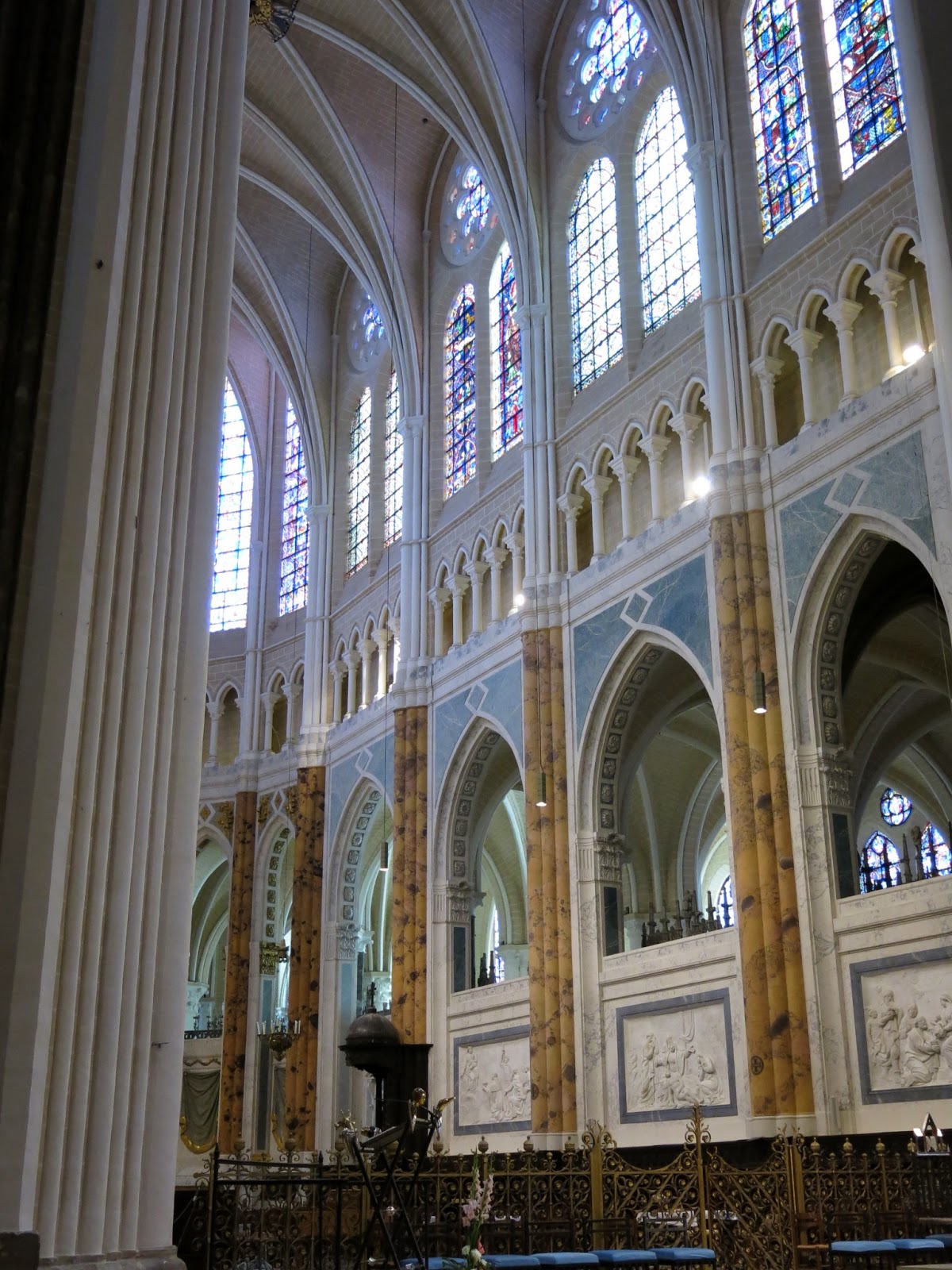
The west front is truly fascinating and I could spend hours trying to decipher the whole story depicted in stone. Inside it is a different matter. The nave is still dark, but the choir is in total contrast with it. It has been cleaned and restored to what one thinks it must have looked like when the cathedral was built centuries ago. Whenever that was, for it took a long time to actually finish it. Also the pillars are painted in a pastel yellowish pattern, which to me looks more Victorian then medieval. Because the pillars are only painted up to the architraves, it breaks the upward flowing line, the height of the gothic arches so reminiscent of hands folded in prayer. It is claimed that that pattern was found on one of the pillars and is original. As the choir is now so light, the stained glass windows seem less striking.  
 I read that the intention is to clean the nave as well. For me the mysterious atmosphere has disappeared with the layers of dust and soot. And with that the memories of the faithful, who for centuries have said their prayers here, seeking refuge or comfort. Their prayers clung to the pillars. In the darkness of the cathedral I could hear their praise and thanksgiving, their agonies, their supplications, whispering along the walls, embedded in this sacred building.
The restored choir
Fortunately the beautiful sculptures around the choir, the new testament in exquisitely carved stone tableaux, is still there. I could spend a whole day looking at them.
The statue of Mary behind the high altar
         What I also find odd is that behind the altar there is no image of Christ or a crucifix except for a very small one, but only a statue of Mary which virtually dwarfs the crucifix. More baroque than medieval, not the shy handmaiden, the virgin, but a very sexual Mary, almost in ecstasy. Mary was a means, not an end, but the emphasis is not on Christ. The whole cathedral seems only to focus on Mary, in spite of the sculpture over the main entrance where Christ reigns in glory. There is the black Madonna as well , and the veil of Mary, a relic.
The labyrinth
         And there is the labyrinth, inlaid in the stone floor just behind the west front, the main entrance. Labyrinths were not uncommon in medieval cathedrals, but in fact pagan symbols which were adapted by the church and given a religious meaning. For ages no attention was given to the labyrinths. Often they were removed, but in Chartres that was too expensive so they were hidden from view by putting chairs and pews on them. The rise of the New Age Movement in California in the nineties has aroused a new interest in those labyrinths. Here, in Chartres, many people are silently walking the labyrinth, slowly, step by step, meditating. It is peculiar that in a time that churches empty out and religion is no longer part of everybody's life, there should be a revival of such symbols which are in the end pagan symbols and were adopted by the church probably to attract people, like the Christmas tree which has little to do with the birth of Christ. To me it feels as if in this cathedral Christ isn't the focus, but a blacker, almost pagan mysticism. It is perhaps an ode to Mary, Mary as the goddess of fertility, the bearer of life representative of all women, a rather pagan concept. It does not give me a spiritual uplift at all, in spite of its beauty, the splendour of the windows, the awe inspiring arches pointing towards heaven, the biblical message made visible through the phenomenal sculptures round the choir. Nevertheless Chartres is still the ultimate example  of a gothic cathedral.
 The wonderful sculptures around the back of the choir


 A street in the old town
 The house of the salmon with the carved beams

 
A sign for the pilgrims to pint them in the right direction
         In spite of the perfection of the cathedral, a basilica we discover by chance impresses me more. Because of our policy to avoid the main roads as much as possible, we happen to drive through Gisors, just on the eastern border of Normandy. To our surprise we find a fine Gothic Church, with gargoyles standing out far from the gutters, beautifully carved portals and a splendid interior. Many of the sculptures outside are vandalised or just eroded. 

 Gisors: the church of St, Gervais and St. Protais
 
Inside the atmosphere is serene. We are the only tourists. Apart from us, there is nobody. Here too beautiful stained glass windows, amongst which a modern one with fields of grain rippling in the wind, very appropriate for this agricultural area. Some of the pillars are intricately sculpted. The large pipe organ seems new. I presume this church is still used regularly. 
 A side chapel at Gisors

There is a side chapel , decorated in striking blue and gold, and a multicoloured frieze telling a bible story. The gothic nave seems to reach to the heavens. Here I can say my prayers, here one can humbly address God.


A modern window
 ...and an old one
Outside cars are parked almost to the doors of the cathedral. This is how I remember Chartres, decades ago. We then just parked the car next to the cathedral.

Gisors: The castle and a view of the church from the castle grounds

In Gisors we also find remnants of a city wall and fortifications. But we have to move on, and drive in the direction of Amiens, again via byroads. However, this takes so much time that we decide to forget Amiens and take the pĂ©age – the toll road - from here so that we can be home just before midnight.

There are many reasons to return and explore all those places we have missed or only seen superficially. Perhaps part of the itinerary of my friend's future pilgrimage? Pilgrimage or not, company or not, I at least will go back one day to discover and savour more. 

Followers

Blog Archive